Generations of the ancient world's most capable minds stood in front of the same tangled knot of cornel bark at Gordium and failed.
Not because they lacked intelligence. Not because they lacked patience. They failed because they accepted a premise that guaranteed their failure before they ever touched the rope.
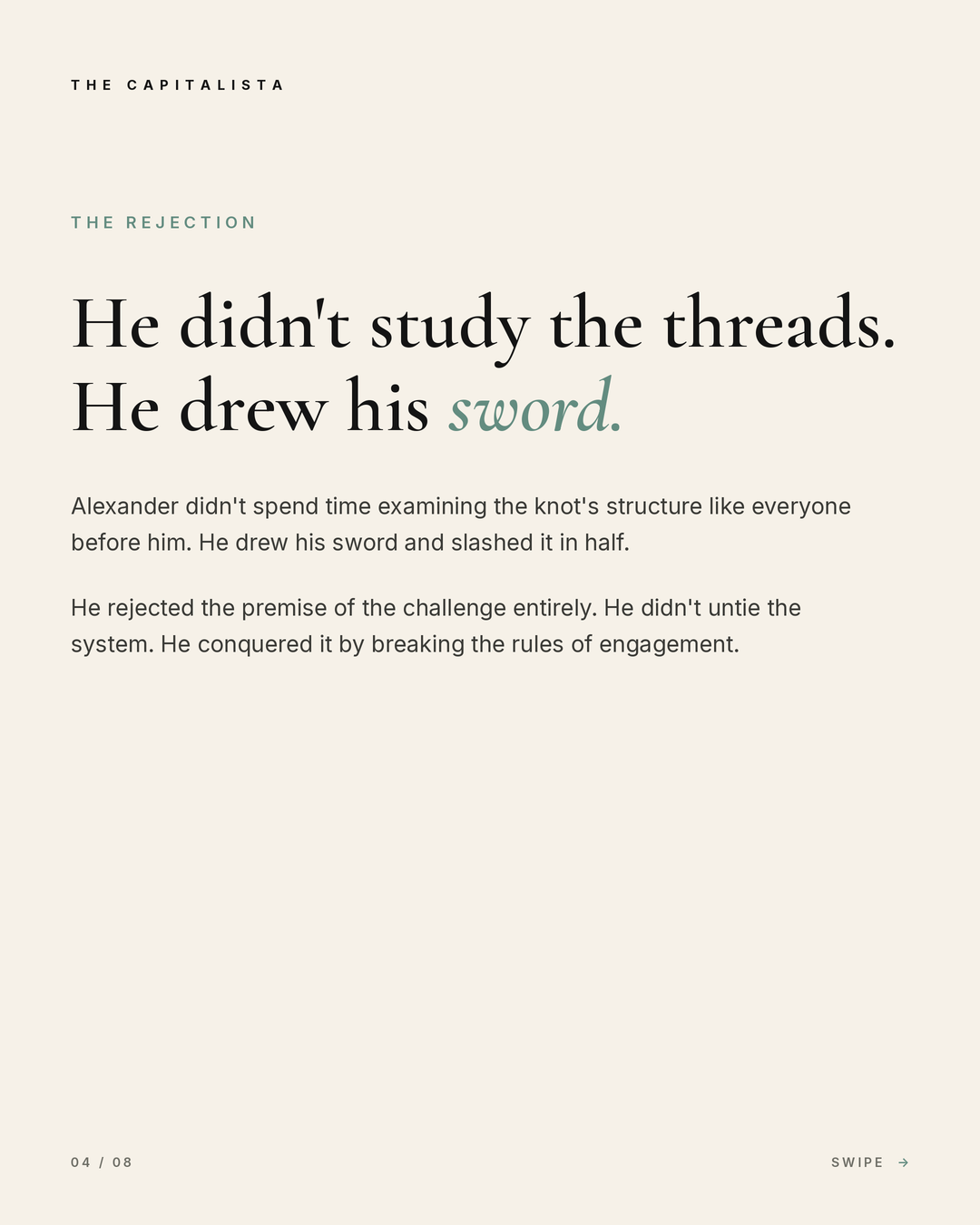
Alexander the Great walked up to the same knot, drew his sword, and cut it in half.
The story gets told as a fun anecdote about decisiveness. It's actually a precise lesson in strategy that most founders, operators, and executives get completely backwards. The lesson isn't "be bold" or "take action." The lesson is that the rules of a challenge are sometimes the actual obstacle, and the only way to win is to reject them entirely.
The Setup: An Impossible Test With Impossible Rules
The city of Gordium held a legendary knot, tied by King Gordius, fastening an ox cart to a post with such complexity that nobody could find its ends. Local legend held that whoever untied the knot was destined to rule all of Asia.
For generations, that legend attracted exactly the kind of people who take prophecies seriously: ambitious rulers, brilliant scholars, skilled craftsmen. Every one of them approached the challenge the same way. They accepted the implicit rule of the test: you must untie it, thread by thread, with precision and patience, respecting the structure of the puzzle in front of you.
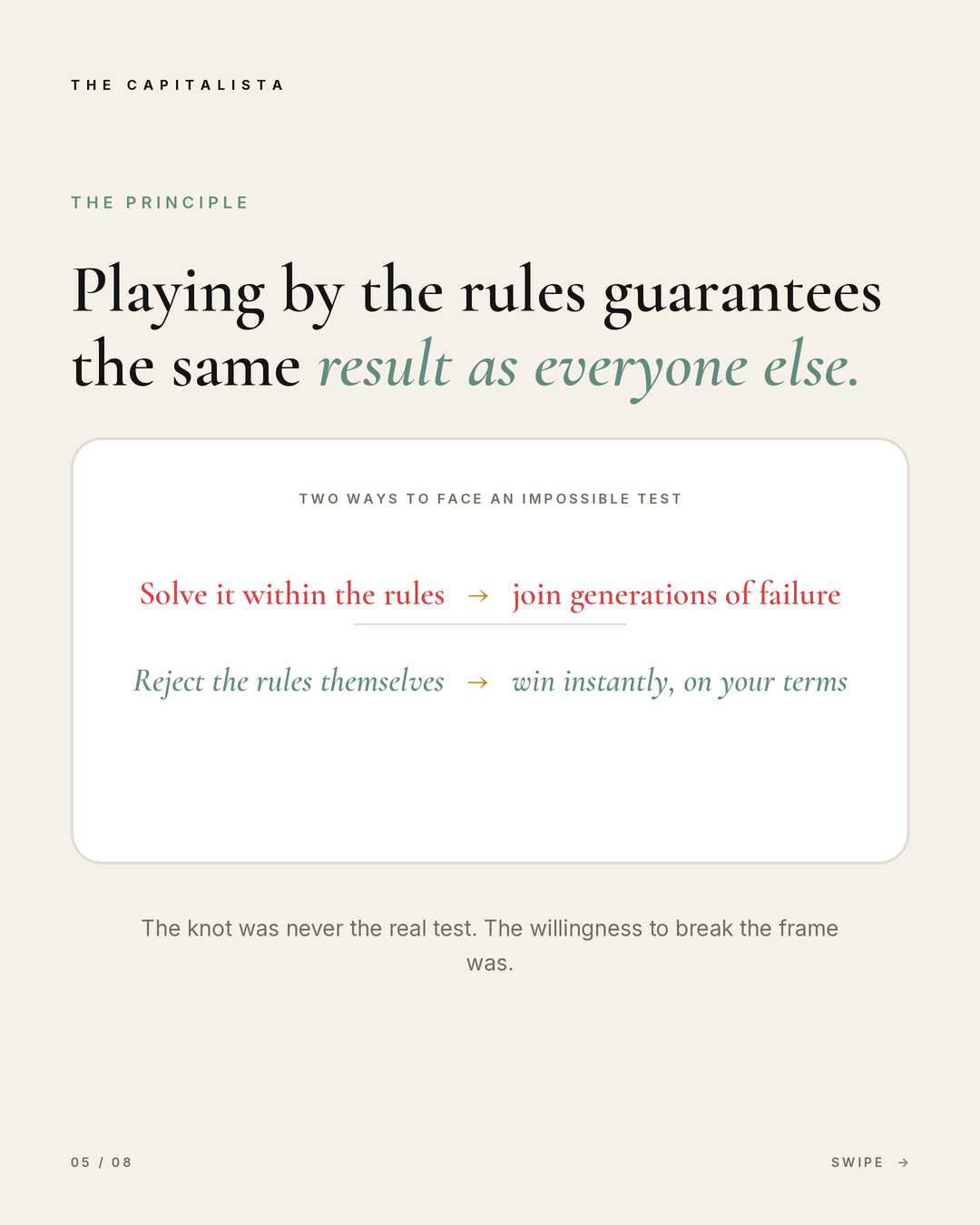
Every single one of them failed. Not because the knot was unsolvable in some abstract sense, but because the "correct" method, painstaking untangling, was itself a trap. The real challenge wasn't the knot. It was the assumption that you had to solve it on its own terms.
What Alexander Actually Did
When Alexander arrived at Gordium, he didn't spend days or weeks studying the knot's structure the way his predecessors had. According to the ancient sources, he examined it briefly, then drew his sword and sliced it apart in a single stroke.
This wasn't impatience. It wasn't a shortcut born of laziness. It was a complete rejection of the premise of the test. Alexander understood something his predecessors didn't: the knot itself was never actually the obstacle. The real obstacle was an assumption baked into everyone else's approach, that untying was the only acceptable method of victory.
He didn't play the game better than everyone else. He refused to play the game as designed, and in doing so, he won it on entirely different terms.
Why This Story Matters More Than It Seems
Most people hear this story and extract a shallow lesson: "be decisive" or "don't overthink things." That's not wrong, but it misses the actual mechanism at work.
The deeper lesson is this: every system, every industry, every competitive challenge comes with an implicit set of rules about how you're "supposed" to win. Most participants accept those rules without question, because questioning them feels risky, arrogant, or even impossible. The rules feel like physics. They feel like the water everyone is swimming in.
But rules aren't laws of nature. They're conventions, and conventions can be rejected. The businesses, careers, and strategies that produce disproportionate results are frequently the ones built by people who looked at the assumed rules of their industry and asked a dangerous question: why do I have to play by these?
The Trap of "Mastering the System"
Here's where most operators get it exactly backwards. The conventional wisdom says you need to deeply understand and master the existing rules of your industry before you can succeed within it. Learn the regulations. Learn the norms. Learn how things have always been done. Only then can you compete.
This advice isn't entirely wrong, but it's incomplete in a way that quietly caps your potential. Mastering the existing rules of a system makes you exceptionally good at competing within a box that someone else built. It rarely produces the kind of results that come from stepping outside the box entirely.
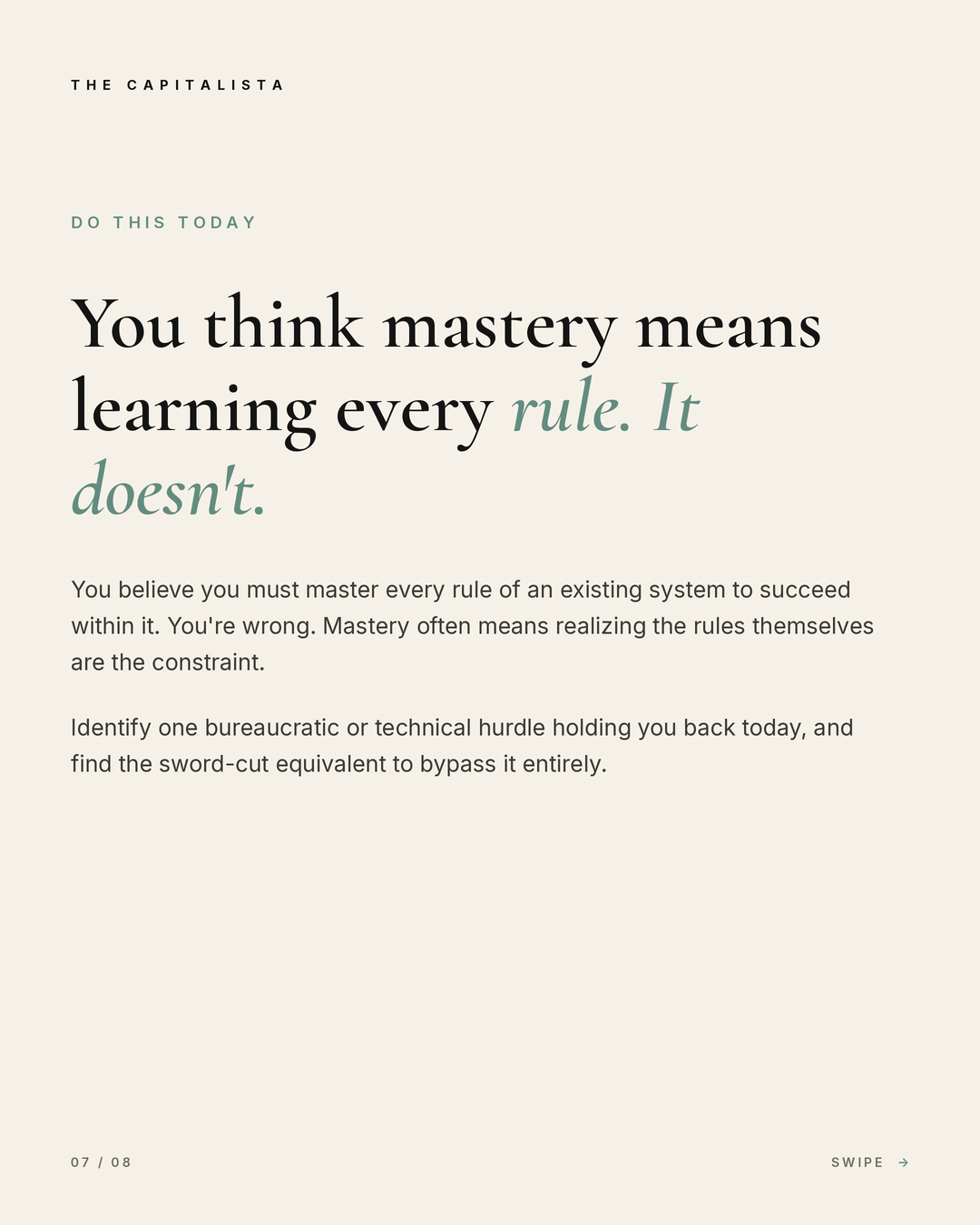
Consider what actually happens to most people who spend a decade mastering an industry's conventional rules. They become extremely skilled operators within a fixed set of constraints. They rarely become the ones who reshape the constraints themselves. The Gordian Knot teaches the opposite lesson: sometimes mastery isn't about depth of understanding within the system. It's about recognizing that the system's rules are themselves the actual constraint holding you back.
Real Examples of the Sword-Cut Strategy
This pattern shows up constantly in business, though it rarely gets described this directly.
When a company faces a regulatory approval process that takes years, most competitors accept the premise: work within the process, hire the right consultants, wait it out. Occasionally, a company looks at that entire premise and asks whether the regulatory category itself needs to apply to them at all, restructuring their product or business model to operate in an entirely different category with different rules. That's a sword cut, not a careful untangling.
When an entire industry assumes customers must be acquired through the same three or four channels everyone else uses, most companies compete harder within those channels, bidding up costs and fighting for the same attention. Occasionally, a company rejects the premise that those are the only channels worth using and builds an entirely different distribution model nobody else considered legitimate. That's a sword cut.
When a company faces an internal bureaucratic process that takes months to approve a decision, most executives accept the premise that the process must be followed as designed. Occasionally, someone asks why the process exists in its current form at all, and simply builds a different, faster path that bypasses it entirely for a specific class of decisions. That's a sword cut.
None of these are examples of ignoring real constraints like laws or safety requirements. They're examples of recognizing that many of the "rules" governing how business gets done are actually just historical conventions, not requirements. The distinction matters enormously, and conflating the two is how people get themselves into real trouble. Alexander didn't reject the existence of the knot. He rejected the unstated assumption about how it had to be solved.
How to Find Your Own Gordian Knot
Most people can't identify their own version of this trap because they're standing too close to it. The rules feel invisible precisely because everyone around you also accepts them without question. Here's how to surface them.
1. List the constraints you've never questioned
Write down every rule, process, or convention in your business or industry that you follow simply because "that's how it's done." Include internal bureaucracy, industry norms, customer acquisition assumptions, pricing conventions, hiring practices, everything. Most people have never actually written this list out, and doing so is uncomfortable because it exposes how much of your operating model is inherited rather than chosen.
2. Ask which constraints are real and which are assumed
For each item on the list, ask a simple question: is this a genuine legal, physical, or safety requirement, or is it just the way people have always approached it? Real constraints (laws, physics, contractual obligations) must be respected. Assumed constraints (industry conventions, internal processes, "best practices" nobody has re-examined in years) are candidates for rejection.
3. Identify the slowest, most painful process you accept without question
Usually the best candidate for a sword-cut solution is whatever bureaucratic or technical hurdle causes you the most pain on a recurring basis. If you've been "untying" the same knot for months or years using the accepted method, that's exactly where a rejected premise is most likely to unlock disproportionate value.
4. Ask what the "cut" version looks like
Instead of asking "how do we solve this within the current rules," ask "what would make this problem irrelevant entirely?" Sometimes the answer is a different business model. Sometimes it's a different market. Sometimes it's simply refusing to participate in a process everyone assumed was mandatory. The goal isn't cleverness for its own sake. It's recognizing that the fastest path to victory is sometimes rejecting the test altogether.
The Risk Nobody Talks About
It's worth being honest about the other side of this lesson. Rejecting the rules of a system is not free of risk, and it doesn't always work. Alexander's approach to the Gordian Knot became legendary because it succeeded and because he had the military and political power to make the interpretation of the prophecy work in his favor regardless of how literally anyone else viewed his solution.
Rejecting conventional rules without the position, resources, or conviction to make the rejection stick can look less like genius and more like recklessness. The distinction between a sword-cut strategy and a reckless gamble often comes down to whether you deeply understand which constraints are real and which are assumed, and whether you have a credible plan for what happens after you reject the premise.
This is exactly why most people default to "mastering the rules" instead of rejecting them. It's the safer, more legible path. But safety and legibility rarely produce category-defining outcomes.
What The Capitalista Does
Most businesses operate inside financial and operational rules they've never actually questioned: how pricing "should" work in their industry, how long a sales cycle "has to" take, what margin is "normal" for their category, which costs are simply "the cost of doing business."
The Capitalista is a fractional CFO service that helps you separate the constraints that are actually real from the ones that are just inherited convention. We:
- Audit your cost structure to identify which expenses are genuine requirements and which are just "how it's always been done"
- Challenge industry-standard pricing assumptions, so you're not leaving margin on the table because "that's the going rate"
- Find the bureaucratic and financial bottlenecks costing you the most time and money, and help you design the sword-cut alternative
- Build the financial case for rejecting a convention, so the move is a calculated strategy, not a reckless gamble
- Model what happens after the cut, so you know exactly what you're walking into before you make the move
The knot in front of your business right now is probably not actually unsolvable. It's just being approached with the wrong assumption about how it has to be solved.
Frequently Asked Questions
What is the Gordian Knot story actually about?
According to legend, a nearly impossible knot at the city of Gordium could only be untied by the future ruler of Asia. Generations of skilled people tried and failed to untie it using careful, precise methods. Alexander the Great instead drew his sword and cut the knot in half, rejecting the assumed rules of the challenge entirely.
What's the business lesson from the Gordian Knot?
The lesson is that many of the constraints businesses operate within are inherited conventions, not actual requirements. Winning often comes from recognizing which rules can be rejected entirely rather than mastered, and finding a completely different path around an obstacle instead of solving it on its original terms.
Isn't rejecting the rules just reckless behavior?
Not if you've done the work to distinguish real constraints from assumed ones. Rejecting a genuine legal or safety requirement is reckless. Rejecting an industry convention or internal process that nobody has re-examined in years, after understanding exactly why it exists and what happens if you bypass it, is strategic.
How do I know if a rule in my business is real or just assumed?
Ask whether the rule exists because of a law, contract, physical limitation, or safety requirement, or whether it exists because "that's how it's always been done" in your industry or company. Real constraints require compliance. Assumed constraints are candidates for a different approach entirely.
What's an example of a "sword cut" in modern business?
Any move that makes an entire category of problem irrelevant rather than solving it within its original rules. Building a different distribution model instead of competing harder in the same channels, restructuring a business to operate outside a slow regulatory category, or simply refusing to follow an internal process nobody can justify anymore.
The Bottom Line
Alexander the Great didn't win at Gordium because he was smarter than the generations of people who failed before him. He won because he refused to accept their premise. Everyone else was trying to solve a knot. He recognized the real test was whether you were willing to reject the rules of the game entirely.
Most businesses spend years mastering the existing rules of their industry, becoming highly skilled operators within a box someone else built. A smaller number of businesses ask a more dangerous question: which of these rules are real, and which are just convention nobody has ever challenged?
That question is uncomfortable. It's supposed to be. But it's usually the difference between incremental progress and the kind of result that changes everything.
What's the knot in front of your business right now? And are you trying to untie it, or is it time to draw the sword?