Every founder building something genuinely disruptive eventually has the same fantasy
the market embraces the idea immediately, the incumbents nod in respectful acknowledgment, and everyone moves gracefully into the new paradigm together.
That fantasy has never once happened in the history of business, and Greek mythology explained exactly why more than two thousand years ago.
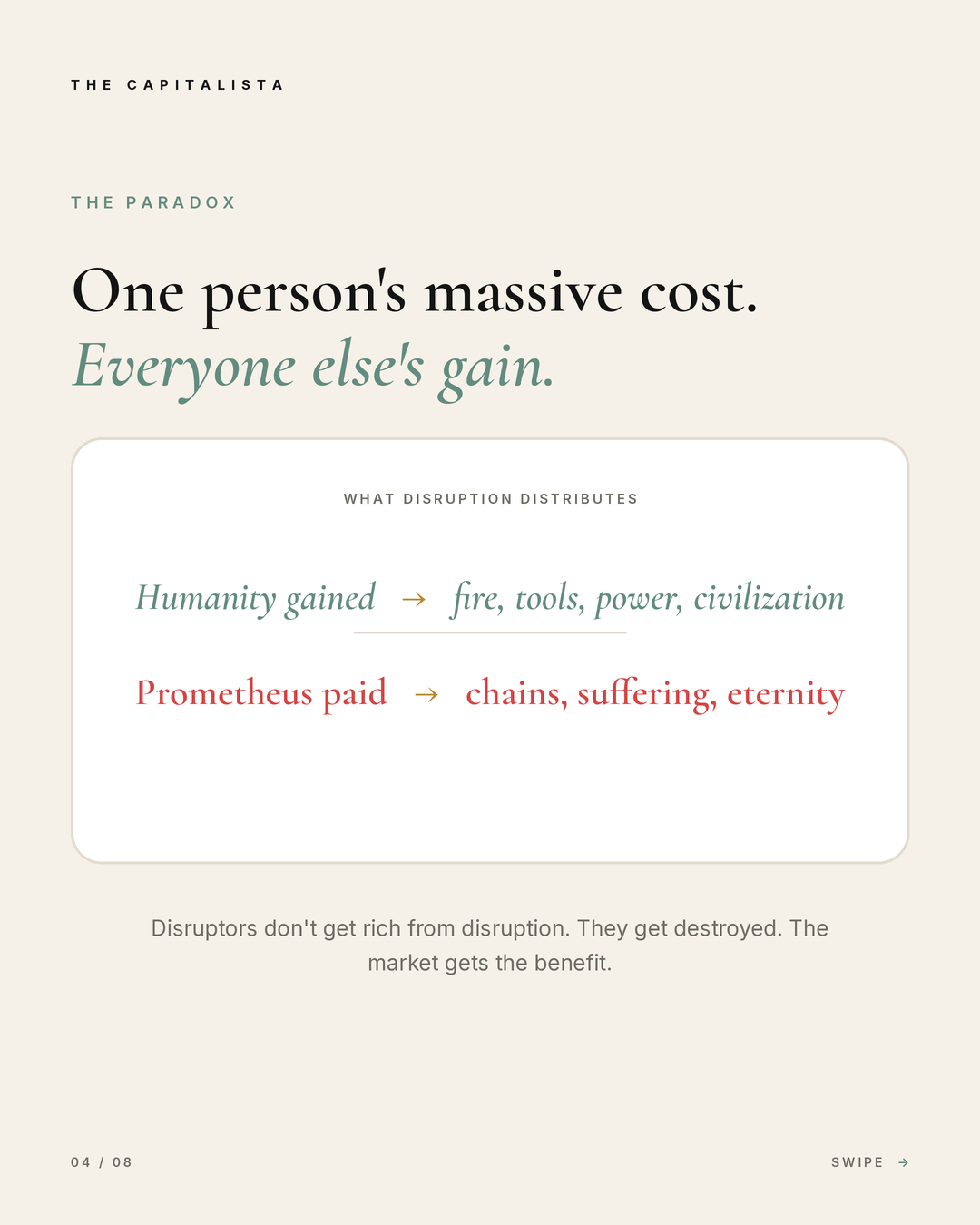
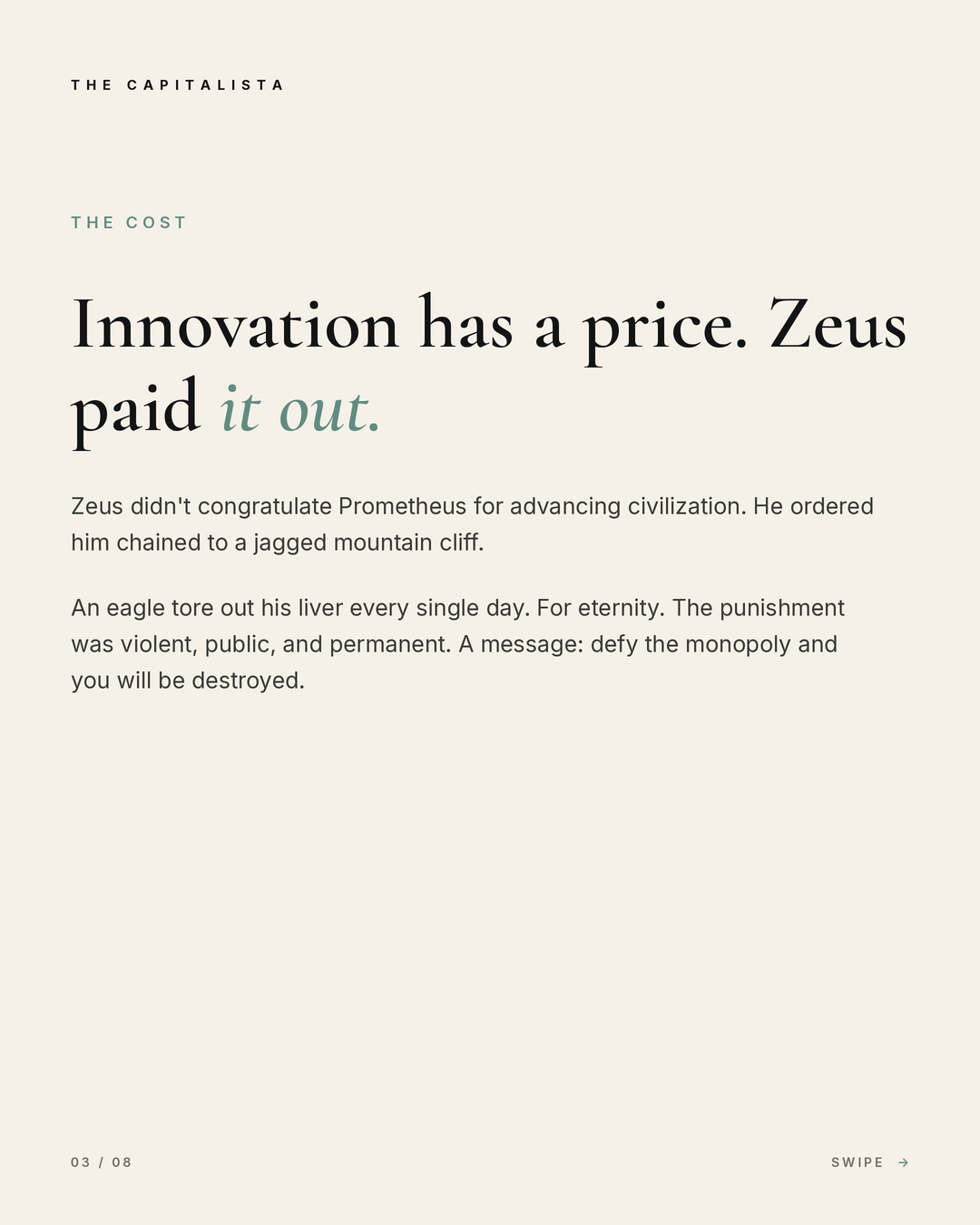
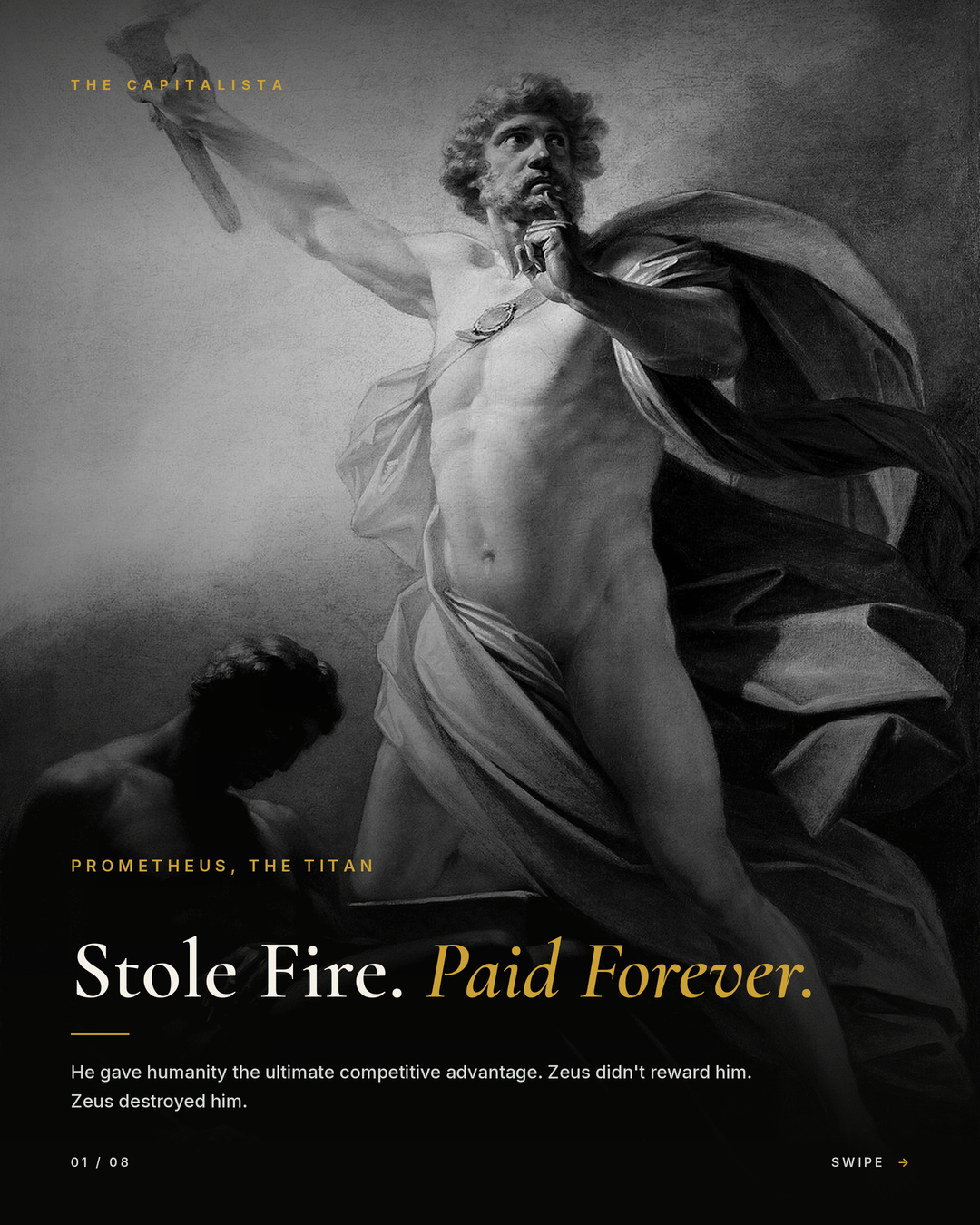
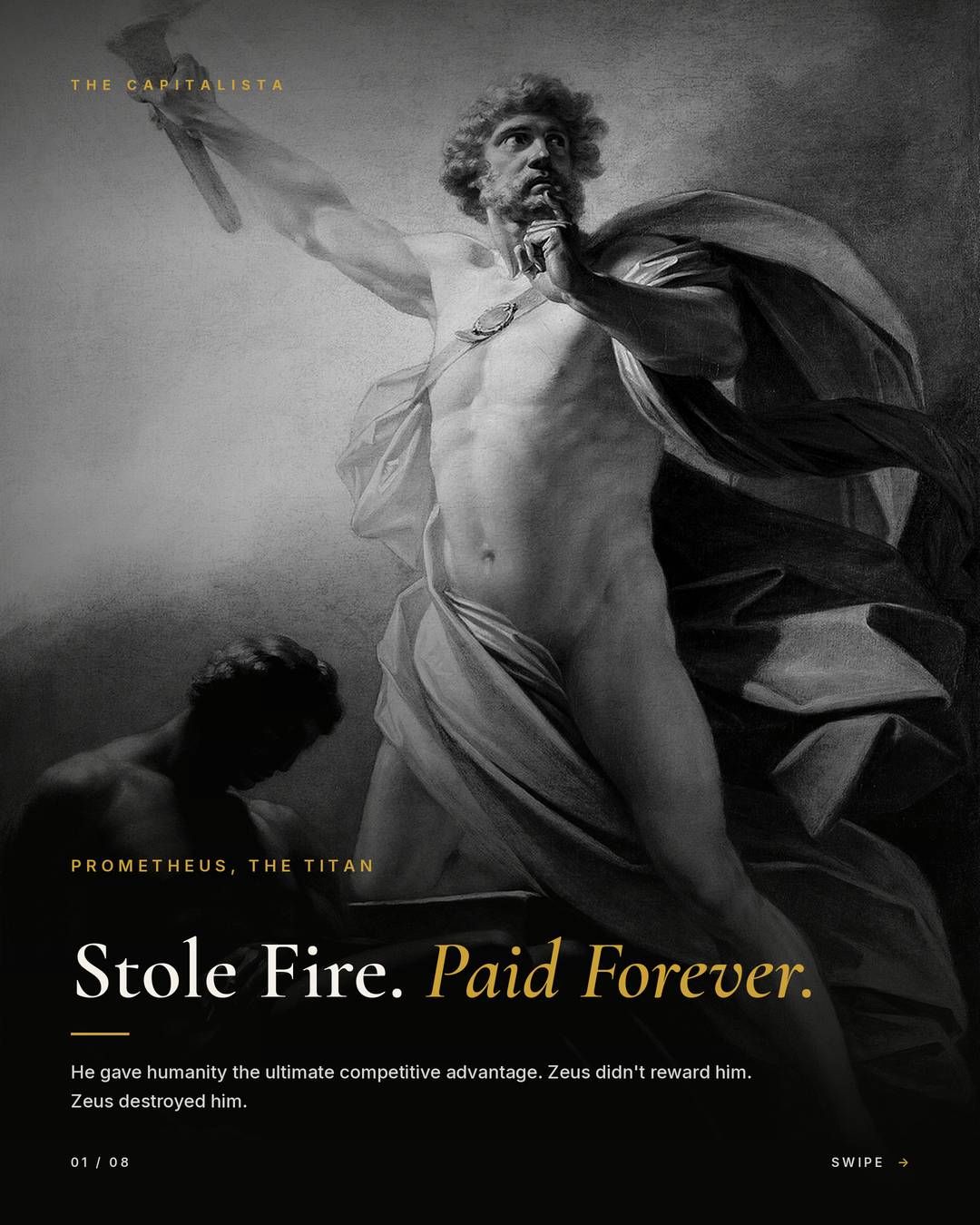
Prometheus was a Titan who looked down at early humanity and saw a species freezing, starving, and powerless in the dark. He didn't ask permission. He stole fire from Mount Olympus and handed civilization its first real technological advantage. He didn't get a medal. Zeus, the ruler of Olympus, ordered him chained to a jagged cliff, where an eagle tore out his liver every single day for eternity.
The punishment wasn't an overreaction. It was completely rational, from Zeus's perspective. And understanding why is the single most useful thing a disruptive founder can learn about how incumbents actually behave.
The Setup: A Genuine Act of Value Creation
It's worth being precise about what Prometheus actually did, because the myth is often flattened into a simple "he helped people" story. He didn't just perform an act of charity. He executed a massive technological transfer that fundamentally altered the balance of power between gods and humans.
Fire meant warmth. It meant cooked food, which meant better nutrition and longer lives. It meant protection from predators. It meant tools, metallurgy, and eventually every downstream technology built on the ability to generate and control heat. Prometheus didn't give humanity a nice gift. He gave humanity a foundational platform technology that made them meaningfully less dependent on the gods for survival.
This is the part that gets lost in the retelling. The gods weren't angry because Prometheus broke a rule for its own sake. They were angry because fire genuinely, materially reduced their leverage over humanity. Every future request humans might have made to the gods for warmth, protection, or survival was suddenly less necessary. Prometheus hadn't just been generous. He had disrupted a monopoly.
Why the Punishment Was So Severe
If Prometheus had done something trivial, the response would have been trivial. The severity of his punishment, permanent, public, excruciating, is direct evidence of how seriously Zeus understood the threat.
This is the pattern that repeats constantly in business and that most founders fail to anticipate: the intensity of resistance you face from an incumbent is not primarily about how annoying or inconvenient your product is. It's a direct signal of how much leverage you've actually taken from them.
A minor product improvement that doesn't threaten anyone's core business model gets ignored, or occasionally copied. A genuine paradigm shift, the kind that makes an incumbent's entire value proposition less necessary, gets fought with everything the incumbent has. Lawsuits. Lobbying. Smear campaigns. Aggressive pricing designed purely to bankrupt the new entrant rather than compete on merit. Sometimes, in extreme cases historically, actual violence or intimidation.
If you're building something genuinely disruptive and the incumbents in your space haven't reacted strongly, that's often a sign you haven't actually threatened anything real yet.
The Trap Most Founders Fall Into
Here's where the Prometheus myth becomes an uncomfortable mirror for how most founders actually operate. Most people building something disruptive unconsciously expect a version of the "credit and applause" outcome. They believe that if the innovation is good enough, obviously good enough, the market and the incumbents within it will eventually recognize the value and welcome the change.
This belief isn't just naive. It's actively dangerous, because it causes founders to structure their strategy around winning approval rather than around winning despite resistance. They spend energy trying to convince incumbents their innovation is good for the ecosystem. They wait for industry associations, established players, or regulatory bodies to bless their approach before scaling aggressively. They treat resistance as a signal that something is wrong with their idea, rather than a signal that something is right about it.
Prometheus didn't wait for Zeus's blessing. He couldn't have gotten it, because the entire point of his action was that it worked against Zeus's interests. The same logic applies to genuine business disruption. If your innovation requires the incumbents to voluntarily cede power, waiting for their approval means waiting forever.
The Pattern Repeats Every Time
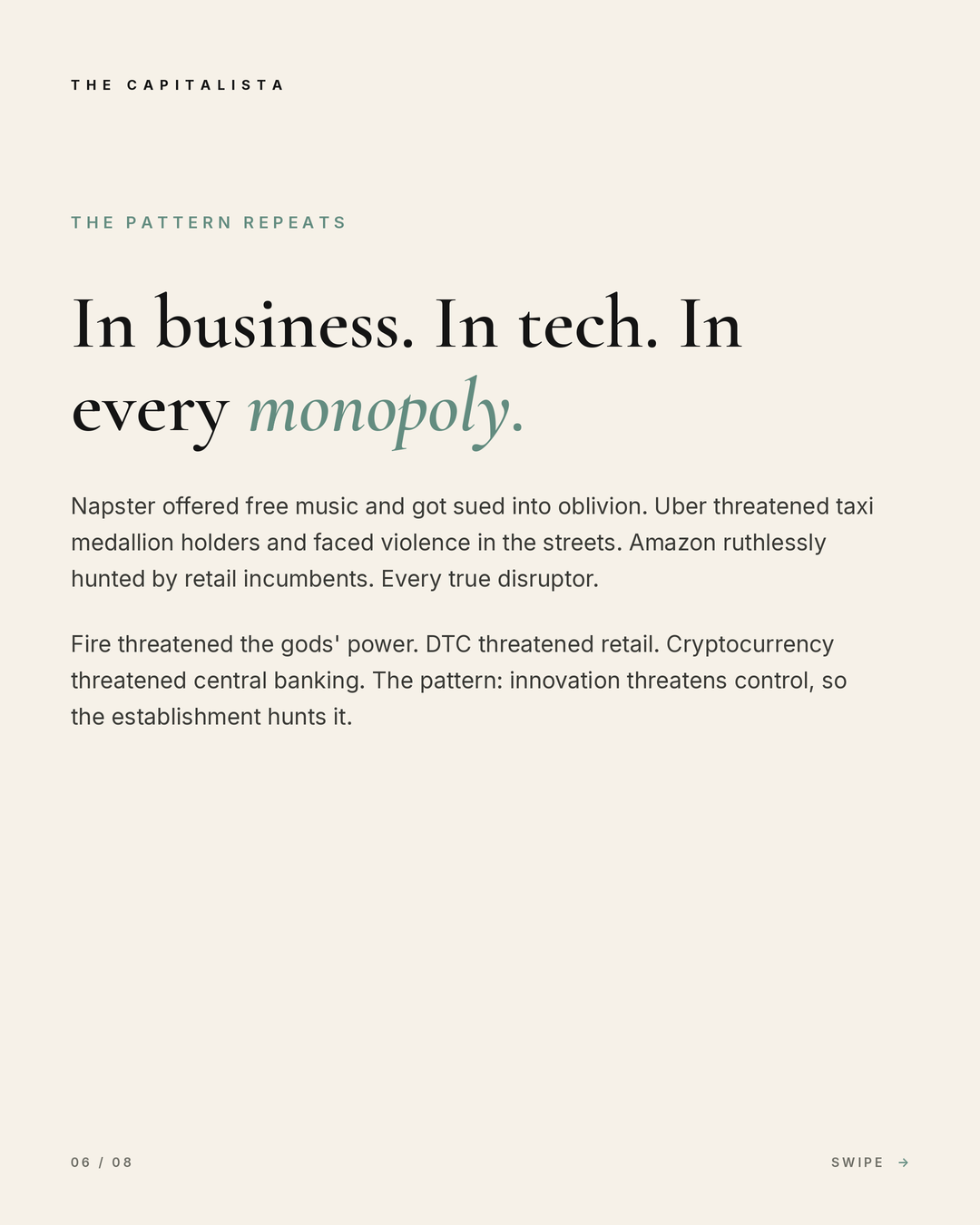
This isn't a one-time historical curiosity. It's the reliable pattern behind nearly every significant disruption in business history.
When peer-to-peer file sharing threatened the recorded music industry's entire distribution model, the response wasn't graceful adaptation. It was an aggressive legal campaign, including lawsuits against individual consumers, designed to make the new technology as costly and painful as possible for anyone who touched it.
When ride-sharing platforms threatened the economics of taxi medallion systems that had operated under fixed rules for decades, the response in many cities wasn't calm competition. It included regulatory battles, protests, and in some cases direct confrontation between drivers.
When direct-to-consumer brands threatened the margin structure that traditional retail had relied on for generations, legacy retailers didn't simply welcome the new entrants. They fought for exclusive supplier relationships, used their buying power to squeeze competitors, and lobbied for regulatory friction wherever they could find it.
In every case, the pattern is identical to the Prometheus myth. The innovation created genuine value for end users. The incumbents whose leverage depended on the old system fought back, not because the innovation was bad, but because it was working.
Why This Matters for How You Build
Understanding this pattern should change how you approach building something disruptive, in a few specific ways.
First, stop budgeting for approval. If your business model depends on convincing the incumbents in your space that your success is good for them too, you're building on a foundation that will collapse the moment your traction becomes real enough to threaten them. Plan for resistance as a certainty, not a risk.
Second, treat strong resistance as a positive signal, not a warning sign. When competitors escalate against you, that's usually confirmation that you've found genuine leverage, not evidence you should slow down. The absence of resistance is often the more concerning signal.
Third, build resilience into your model before the resistance arrives. Prometheus couldn't have anticipated the specific punishment Zeus would choose, but founders operating today have the benefit of watching this pattern play out repeatedly across industries. If you're disrupting an incumbent's core economics, assume legal challenges, aggressive pricing responses, and attempts to cut off your access to distribution or supply. Build your financial runway and operational structure to survive that resistance, not just to survive normal competitive conditions.
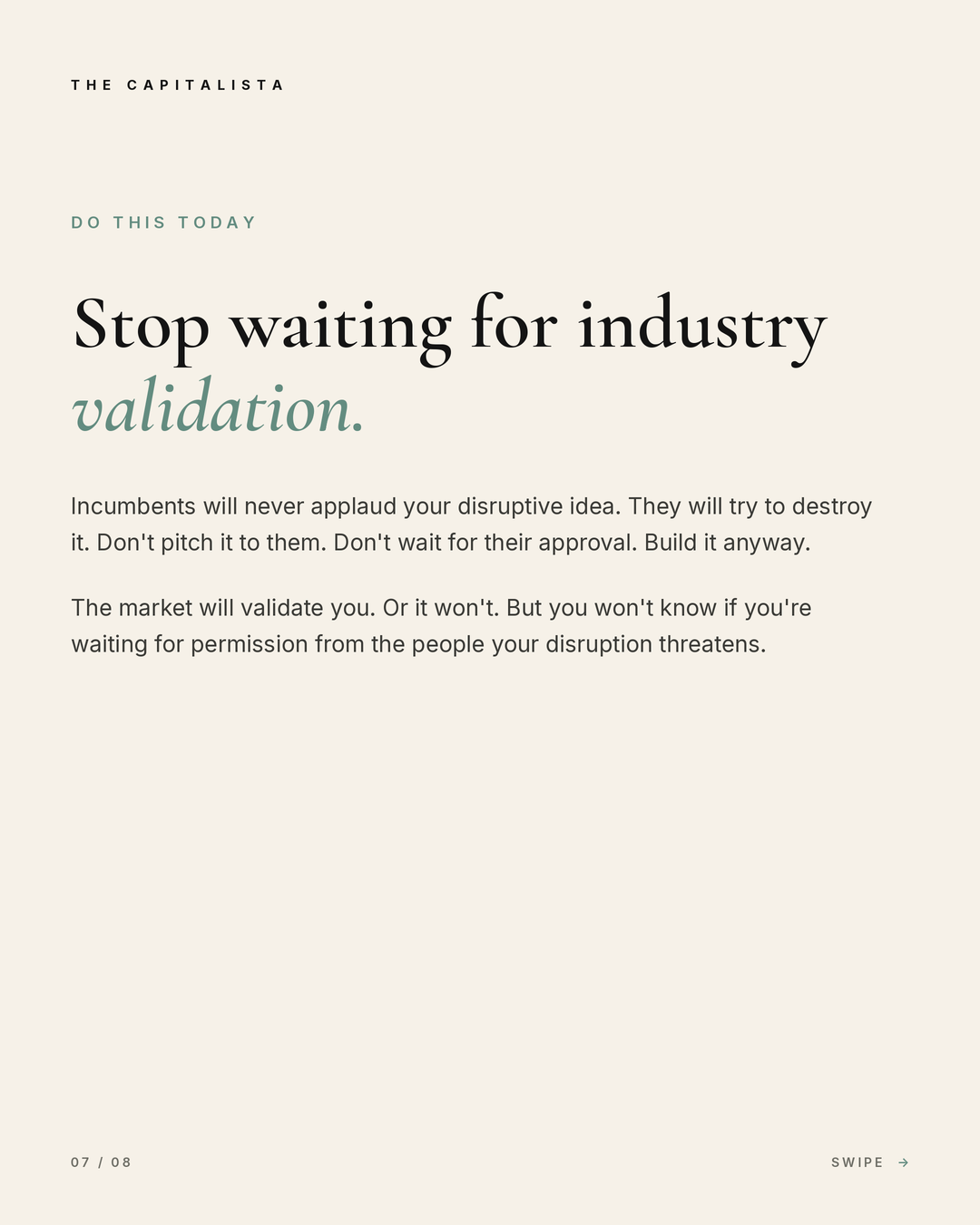
Fourth, stop waiting for validation before you commit fully. The businesses that win big disruptions are rarely the ones that moved cautiously while waiting for industry sign-off. They're the ones that moved with conviction while the resistance was still forming, and were far enough ahead by the time the incumbents mobilized that the fight was already winnable.
The Cost of Waiting
There's a version of this mistake that's even more common than open-eyed caution: founders who have a genuinely disruptive idea and simply never launch it, because some part of them is waiting for a signal of permission that will never come.
This is the modern equivalent of expecting Zeus's blessing before stealing the fire. If your idea genuinely threatens an existing power structure, there is no version of the future where the incumbents give you a green light. The permission you're waiting for isn't coming, because granting it would be against their own interest.
The founders who actually launch category-defining companies aren't the ones who resolved this tension by getting approval. They're the ones who accepted that meaningful disruption is inherently going to be unwelcome, and built the conviction and resources to launch anyway.
What The Capitalista Does
Disruptive ideas don't fail because the math doesn't work. They fail because founders don't build the financial resilience needed to survive the resistance that real disruption always provokes.
The Capitalista is a fractional CFO service that helps you pressure-test the numbers behind disruptive strategy before you launch, so you're prepared for what happens after the incumbents notice you. We:
- Model the true cost of resistance, including legal exposure, aggressive competitive pricing responses, and potential distribution or supply disruptions
- Build the cash reserves and runway needed to survive a prolonged fight, not just normal operating conditions
- Stress-test your unit economics against scenarios where incumbents respond aggressively rather than gracefully
- Structure your capital and financial strategy so you can move with conviction instead of waiting for validation that will never arrive
- Separate genuine financial risk from manageable resistance, so you know which battles are survivable and which require a different approach
Prometheus didn't get a medal for giving humanity fire. He got chained to a cliff, and the fire still changed the world. The value he created outlived the punishment. The businesses that make the same trade, real value in exchange for real resistance, are usually the ones that end up mattering most.
Frequently Asked Questions
What does the Prometheus myth teach about business disruption?
It illustrates that genuine innovation which threatens an existing power structure is met with punishment and resistance, not gratitude, regardless of how much value it creates. The intensity of that resistance is often a direct signal of how much real leverage the innovation has taken from incumbents.
Why do incumbents fight disruptors instead of adapting?
Because adaptation requires voluntarily ceding the leverage, pricing power, or market control that their existing business model depends on. It's usually more rational, in the short term, for an incumbent to fight the disruption than to accept a smaller, less profitable version of their business.
How do I know if my idea is disruptive enough to provoke resistance?
If your business model requires customers, suppliers, or regulators to behave differently than the current system assumes, and if your success would meaningfully reduce the profitability or relevance of existing players, you should expect resistance proportional to how much leverage you're taking.
Should I wait for industry validation before scaling?
If your innovation depends on ceding power that incumbents will never voluntarily give up, waiting for their validation means waiting indefinitely. The founders who succeed at genuine disruption typically move with conviction before the resistance fully organizes, rather than waiting for permission that isn't coming.
How do I prepare financially for incumbent resistance?
Build more runway than you think you need, model scenarios where competitors respond aggressively rather than passively, and structure your capital so a legal fight, a pricing war, or a supply disruption doesn't end your company. Resistance should be a planned-for cost of doing business, not a surprise that catches you unprepared.
The Bottom Line
Prometheus gave humanity its first real technological advantage and was punished for eternity because of it. The lesson isn't that innovation is punished randomly. It's that innovation which genuinely threatens existing power is punished predictably, every time, by the people who stand to lose the most from it.
Most founders building something disruptive quietly expect a different outcome. They expect that if the idea is good enough, the resistance will be minimal, or the incumbents will eventually come around. History, mythology, and every real disruption of the last several decades say otherwise.
The businesses that actually change their industries aren't the ones that avoided the fight. They're the ones that expected it, built the resilience to survive it, and launched anyway.
What disruptive move are you waiting to make until the resistance feels smaller? It's not going to get smaller. The only question is whether you're built to survive it when it arrives.