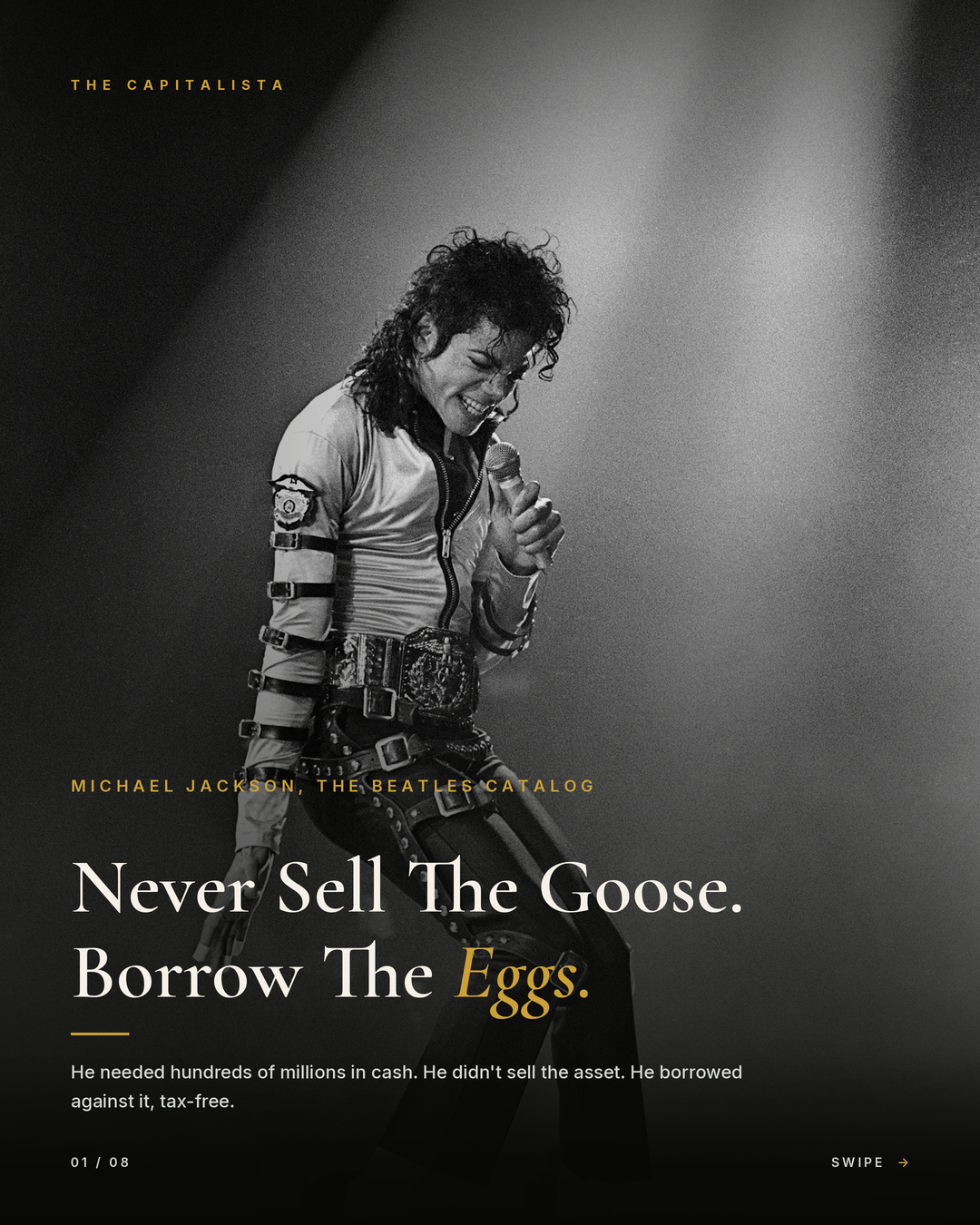
In 1985, Michael Jackson made a purchase that struck most of the industry as an eccentric, expensive curiosity
he bought the publishing rights to the Beatles' catalog for forty-seven million dollars. At the time, it looked like the kind of impulsive acquisition a global superstar makes because he can afford to, not because it makes strategic financial sense.
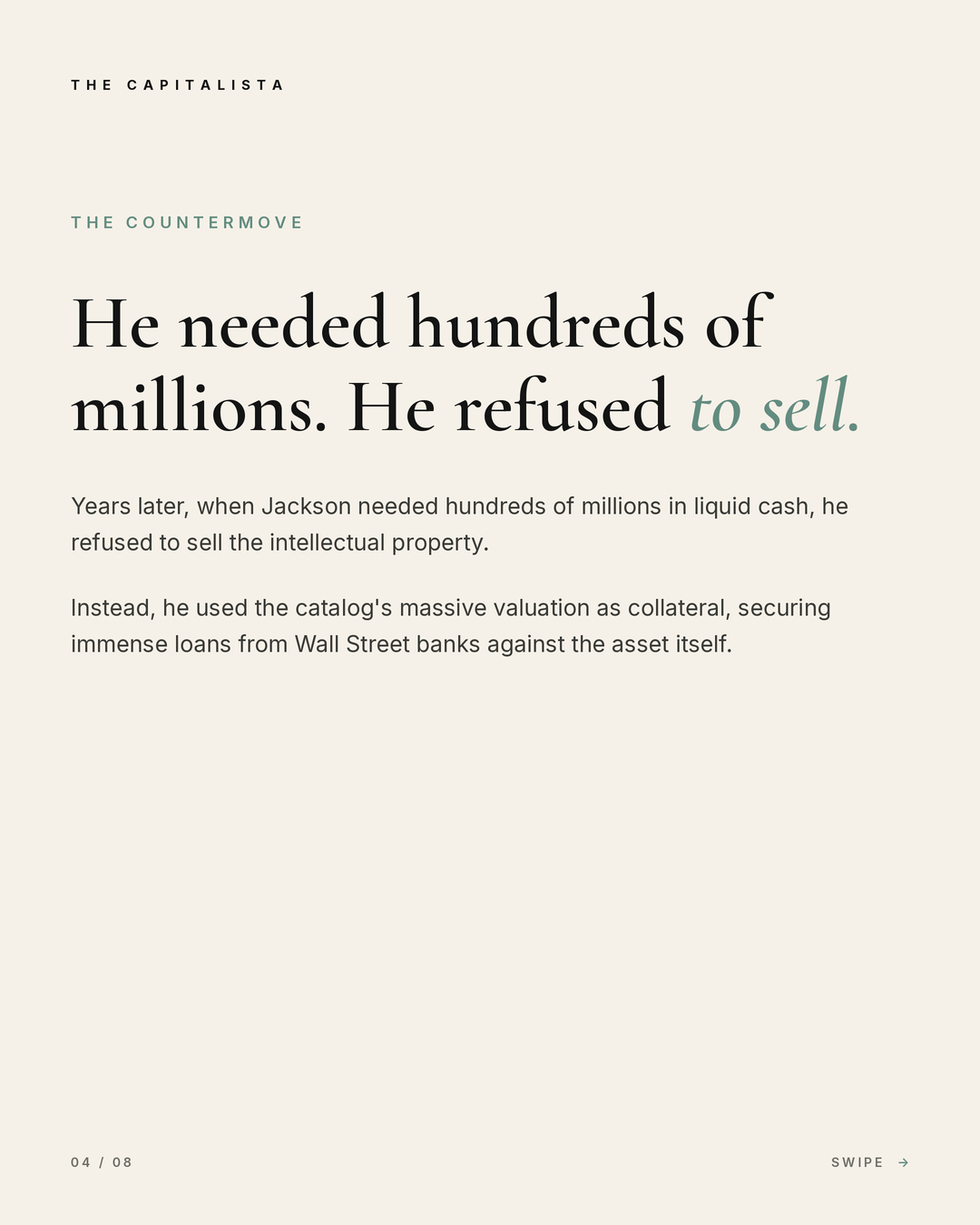
It was, in fact, one of the most disciplined financial decisions in music history, and the real lesson didn't reveal itself until years later, when Jackson needed hundreds of millions of dollars in liquid cash.
Most owners in that position would have sold the asset. It had appreciated enormously since 1985, and a sale would have delivered exactly the liquidity he needed, fast. Jackson refused. Instead, he used the catalog's soaring valuation as collateral and borrowed against it, securing enormous loans from Wall Street banks while keeping full ownership of the underlying asset.
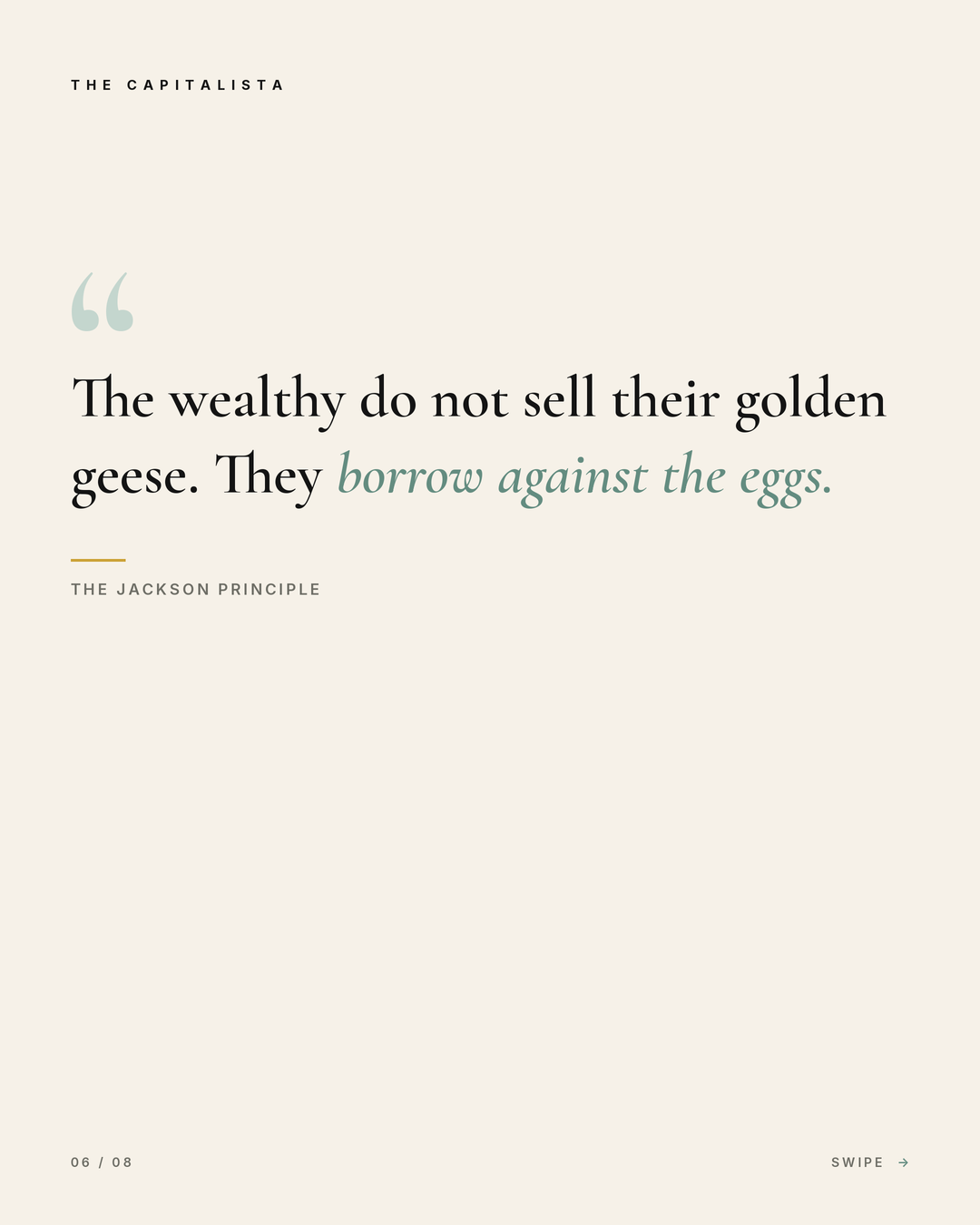
This decision, choosing to borrow against an appreciating asset rather than sell it outright, is a masterclass in a financial principle most business owners understand only vaguely, if at all: the wealthy do not sell their golden geese. They borrow against the eggs.
Why the Purchase Looked Strange in 1985
To understand why this story matters, it's worth remembering how the original acquisition was perceived at the time. Forty-seven million dollars was an enormous sum for a music publishing catalog in 1985, and Jackson's decision to buy it outright, rather than license pieces of it or invest more conservatively, struck many observers as exactly the kind of extravagant purchase a young superstar makes without fully thinking through the financial mechanics.
What that reaction missed was the fundamental difference between buying an asset for its cash flow and buying an asset for its long-term appreciation and optionality. Jackson wasn't simply purchasing a stream of royalty income. He was purchasing full, complete ownership of one of the most valuable and enduring intellectual property catalogs in modern music, an asset whose value would only continue to compound for decades as the Beatles' cultural relevance persisted.
Full ownership, as opposed to a partial stake or a licensing arrangement, is what made everything that came afterward possible. You cannot borrow meaningfully against an asset you don't fully own and control.
The Moment That Actually Mattered
The purchase itself wasn't the real lesson. The real lesson happened years later, at the moment Jackson needed a massive infusion of liquid cash and had to decide how to access it.
This is the exact moment where most asset owners make the wrong call, not out of stupidity, but because selling feels like the obvious, fastest path to cash. The asset has appreciated. A buyer would pay well for it. Selling converts that appreciation directly into liquid dollars, immediately, with a single transaction. It's simple, and it's the intuitive default.
Jackson rejected that default. Instead of selling the catalog, he used its now-enormous valuation as collateral for loans. The banks were willing to lend significant sums against the catalog specifically because its value was well-established and continuing to grow. Jackson got the liquid cash he needed. He also kept complete ownership of an asset that would continue appreciating for years afterward.
Why Selling Would Have Been the Costlier Choice
It's worth being explicit about exactly what selling the catalog would have cost him, because the difference isn't marginal, it's structural.
Selling an appreciated asset triggers a taxable event. A significant portion of the proceeds from any sale would have gone directly to capital gains taxes, meaning the actual usable cash from a sale would have been meaningfully less than the asset's full market value. On top of the tax cost, selling would have permanently forfeited all future appreciation. Every dollar the catalog's value increased after the sale would have belonged entirely to whoever bought it, not to Jackson.
Borrowing against the asset avoided both costs simultaneously. Loan proceeds are not considered taxable income, so Jackson accessed the capital essentially tax-free. And because he never transferred ownership, every subsequent dollar of appreciation in the catalog's value remained his. He got the liquidity he needed in the moment, without giving up any of the asset's long-term upside, and without handing a meaningful percentage of the proceeds to the tax authorities in the process.
The Mechanism, Broken Down Simply
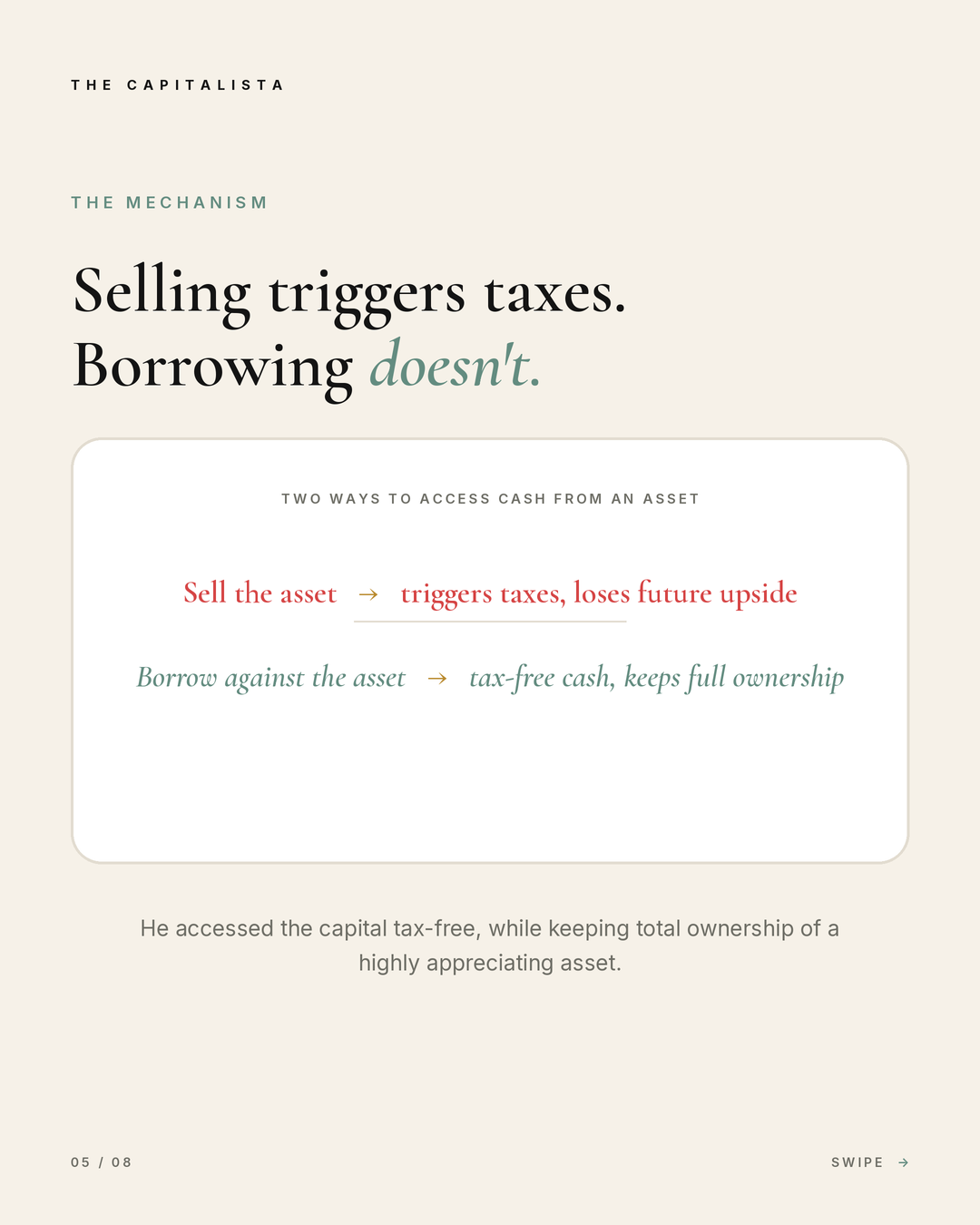
There are only two fundamentally different ways to convert an appreciated asset into usable cash, and understanding the difference between them should inform nearly every major liquidity decision a founder or asset owner makes.
The first path is selling the asset. This triggers taxes on the gain, and it permanently forfeits any future upside the asset would have generated. It's fast and simple, and it's also the more expensive path in almost every case where the asset is expected to continue appreciating.
The second path is borrowing against the asset. This provides tax-free cash, because loan proceeds aren't taxable income, and it preserves full ownership, meaning all future appreciation still belongs to you. It requires more financial sophistication to arrange, and it requires the discipline to manage debt responsibly, but it captures liquidity without sacrificing the underlying value driver.
Jackson's decision illustrates exactly why sophisticated asset owners, family offices, and institutional investors overwhelmingly favor the second path whenever an asset is expected to keep appreciating. Selling a golden goose gets you one large payment. Borrowing against its eggs gets you a stream of usable capital while the goose keeps producing.
Why Most Business Owners Default to Selling Anyway
If borrowing against an appreciating asset is so clearly the more efficient path, why do so many founders and owners still default to selling when they need cash? Because selling feels certain, immediate, and psychologically simple, while borrowing feels more complex, more risky, and requires access to financial relationships and structuring most owners haven't built.
Selling also has the appeal of finality. Once the transaction closes, there's no ongoing obligation, no debt service, no risk of the asset's value declining while a loan remains outstanding. Borrowing requires actively managing that risk, understanding the terms of the debt, and having the financial infrastructure in place to secure favorable lending terms against the asset in the first place.
This is precisely why the strategy is underused rather than unknown. It's not a secret. It's simply harder to execute well than writing a single sales agreement, and most business owners never build the financial relationships or sophistication required to access it before they're in an urgent cash crunch and sell out of necessity instead.
How to Apply This to Your Own Business
1. Identify your most valuable, appreciating asset
This might be intellectual property, real estate, equity in another company, or any holding whose value has grown substantially and is expected to continue growing. Review it today, specifically as a candidate for leverage rather than liquidation.
2. Understand what selling it would actually cost you
Calculate, honestly, what you'd lose to taxes on a sale, and estimate what you'd forfeit in future appreciation if the asset kept growing after you sold it. Most owners have never actually run this number, and it's often larger than expected.
3. Research what the asset could support as collateral
Not every asset is easily borrowed against, and lenders will have specific requirements around valuation stability, documentation, and structure. Understand what it would take to make your asset lending-ready before you're in an urgent cash situation.
4. Build the relationships before you need the capital
Jackson didn't secure asset-backed loans in a moment of crisis with no prior relationships in place. Sophisticated lending against appreciating assets requires financial relationships and structuring that take time to build. Start those conversations before liquidity becomes urgent, not after.
5. Manage the debt with real discipline
Borrowing against an asset only works as a strategy if the debt is managed responsibly. Overleveraging an asset, or borrowing against something whose value isn't stable, recreates the exact risk this strategy is meant to avoid. Leverage is a tool, not a free source of money, and it requires the same discipline any debt does.
What The Capitalista Does
Most founders facing a liquidity need default immediately to selling equity or a valuable asset, simply because it's the path they understand and can execute quickly. That default is often the most expensive option available, both in taxes paid and in future upside permanently forfeited.
The Capitalista is a fractional CFO service that helps you see the full menu of options before you default to selling. We:
- Identify which of your assets are strong candidates for asset-backed financing, rather than outright sale
- Model the true cost of selling versus borrowing, including tax impact and forfeited future appreciation, so the decision is based on real numbers, not instinct
- Build the financial documentation and relationships needed to make your assets lending-ready before a cash crunch forces a rushed decision
- Structure debt responsibly, so leverage strengthens your position instead of creating a new risk
- Help you access capital without giving up equity or ownership in assets you expect to keep appreciating
Michael Jackson didn't need to sell a legendary catalog to access hundreds of millions of dollars. He needed the financial sophistication to borrow against it instead, and that sophistication is exactly what most founders are missing when they reach for the fastest, costliest option available to them.
Frequently Asked Questions
What is the business lesson from Michael Jackson and the Beatles catalog?
The lesson is that when you need liquidity from an appreciating asset, borrowing against it is often far more efficient than selling it outright. Selling triggers taxes and forfeits all future appreciation, while borrowing provides tax-free cash and preserves full ownership of the asset's ongoing upside.
Why is borrowing against an asset more tax-efficient than selling it?
Because loan proceeds are not considered taxable income, while the gain on a sale typically is. Selling an appreciated asset triggers capital gains taxes on the difference between its original cost and its current value, meaning a meaningful portion of the sale proceeds never reaches the seller.
Is borrowing against an asset always the better choice?
Not automatically. It requires the asset to have a stable, well-supported valuation, and it requires the borrower to manage the resulting debt responsibly. Overleveraging an asset or borrowing against something with unstable value can recreate significant financial risk. The strategy works best with genuinely strong, appreciating assets and disciplined debt management.
What kinds of assets can be used this way?
Intellectual property, real estate, equity stakes, and other appreciating holdings with an established, defensible valuation can potentially serve as collateral for asset-backed lending. The specific terms and feasibility depend on the asset type, its valuation stability, and the lender's requirements.
How do I start applying this strategy in my own business?
Identify your most valuable appreciating asset, calculate what selling it would actually cost you in taxes and forfeited future upside, and start building the financial relationships and documentation needed to use it as collateral before you're facing an urgent liquidity need.
The Bottom Line
Michael Jackson needed hundreds of millions of dollars, and he had a straightforward, obvious way to get it: sell the Beatles catalog. He refused, because he understood something most asset owners never fully internalize. The wealthy do not sell their golden geese. They borrow against the eggs.
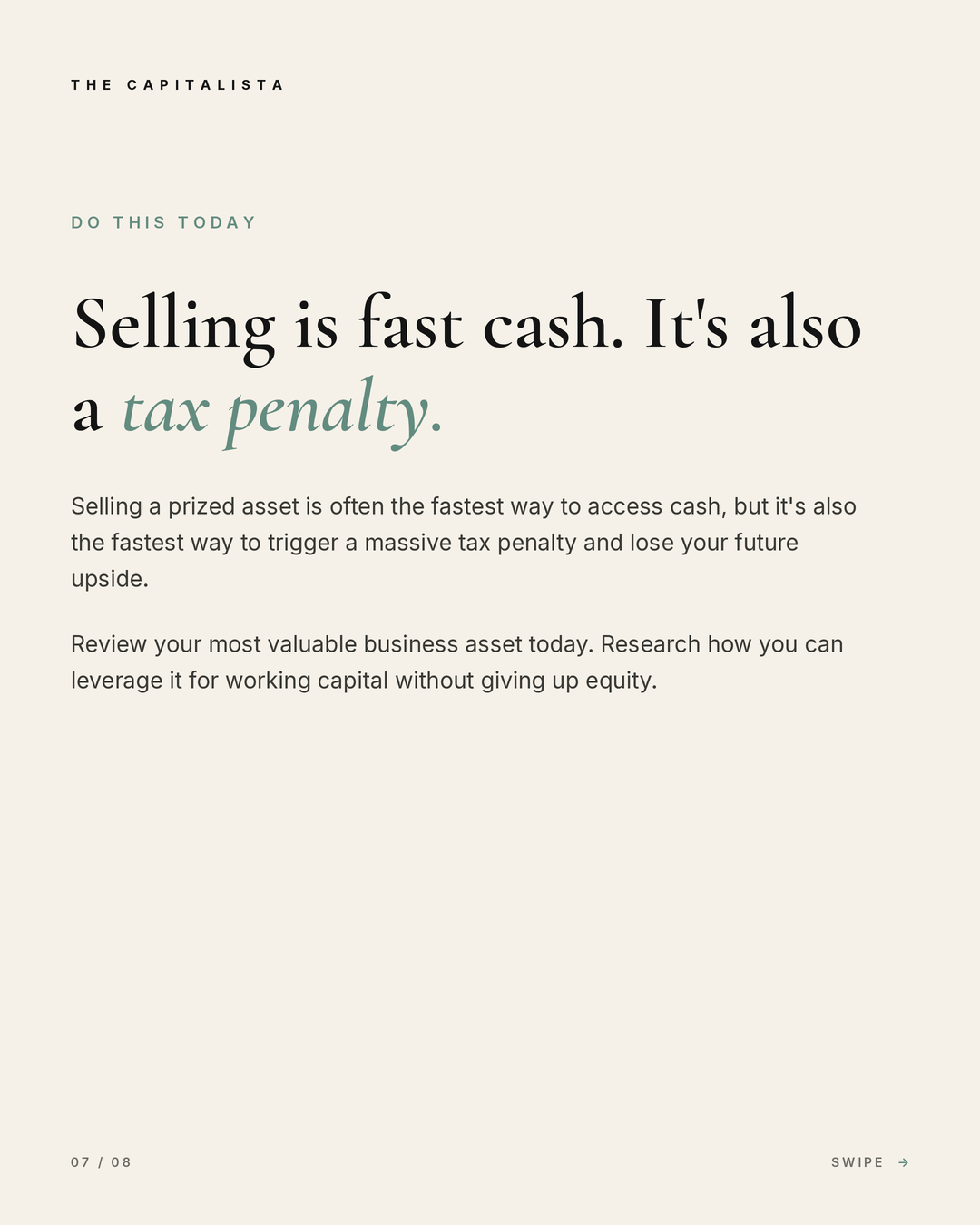
Selling a prized asset is often the fastest way to access cash. It's also the fastest way to trigger a significant tax penalty and permanently lose your future upside. The businesses and individuals who build lasting wealth are usually the ones who resist that fast, costly default, and take the time to structure leverage instead.
What's your golden goose? And are you about to sell it, or are you ready to learn how to borrow against the eggs instead?