In 1920, Charles Ponzi promised investors a 50% return in 45 days. The supposed vehicle was international postal reply coupons — an obscure arbitrage on global postage rates.
There was just one problem: Ponzi never actually bought the coupons in any meaningful quantity. There was no engine.
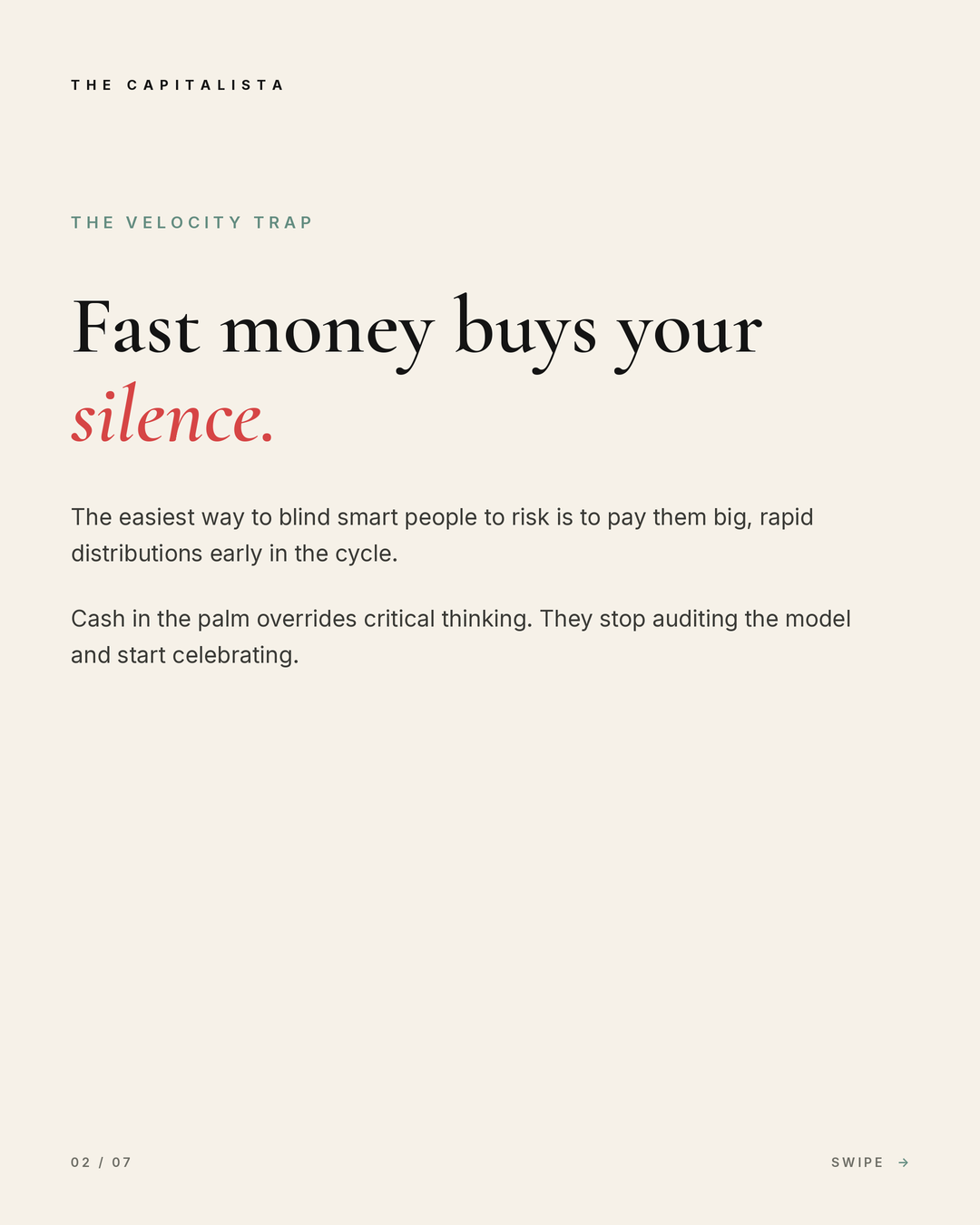
What he did instead was elegant in its simplicity and devastating in its consequences. He took capital from new investors and used it to pay early backers ahead of schedule. Those early investors watched real cash land in their hands, on time, exactly as promised. And the moment they saw the money, something predictable happened: their critical thinking switched off.
They stopped auditing the business model. They reinvested their life savings. Many became Ponzi's most aggressive, unpaid marketing force — recruiting friends and family with the irrefutable evidence of their own returns. The scheme grew explosively until new money slowed, the payouts stopped, and the entire structure collapsed in a matter of weeks.
A century later, the mechanics haven't changed, and neither has the human vulnerability they exploit. The fastest way to blind intelligent people to structural risk is to pay them large, rapid distributions early in the cycle. Understanding why this works — and how to defend against it — is essential due diligence for any founder, investor, or operator entering a new partnership, joint venture, or investment structure.
Why early payouts override good judgment
A Ponzi scheme is not primarily a financial fraud. It's a psychological one. The financial structure is almost crude; the genius is in the behavioral engineering.
When you receive an early, unexpectedly fast payout, your brain registers proof. The abstract promise becomes a concrete deposit. That tangible evidence is far more persuasive than any spreadsheet, prospectus, or risk disclosure — and it quietly rewrites your assessment of the entire opportunity. You stop asking "Does this actually work?" and start asking "How much more can I put in?"
This is why sophistication offers so little protection. Highly intelligent, financially literate people fall for these structures constantly, not because they can't read a balance sheet, but because the early cash gives them a reason not to. Greed, or even simple relief that an investment is performing, overrides the instinct to verify.
The technical name for the error is mistaking payout velocity for institutional permanence. You see money moving quickly and conclude the underlying business must be durable. In reality, speed of distribution tells you nothing about whether a real engine exists. It may only be telling you how fast new money is arriving.
The red flags: how to spot a Ponzi scheme
Most fraudulent or fragile structures share a recognizable signature. None of these is proof of fraud on its own, but together they should trigger immediate, ruthless scrutiny.
Returns that are too consistent or too high. Real markets are volatile. A vehicle that delivers smooth, outsized returns regardless of conditions is describing something that doesn't exist in legitimate finance. Abnormally high, suspiciously stable yields are the classic signature.
Opacity around the actual mechanism. If you cannot get a clear, verifiable explanation of how the money is generated — or if questions about the "engine" are deflected with jargon, secrecy, or appeals to trust — treat that as a critical alert, not a minor inconvenience.
Pressure to reinvest rather than withdraw. Healthy businesses can return your capital. Schemes depend on capital staying in, because withdrawals drain the pool that pays everyone else. Subtle or overt encouragement to keep compounding rather than cash out is a structural tell.
Recruitment baked into the returns. When existing investors are incentivized to bring in new investors, the line between marketing and the mechanism itself starts to blur. New participants funding old participants is the definition of the structure.
Payouts that arrive faster than any real operation could produce them. If the distribution schedule outpaces what the supposed underlying activity could plausibly generate, the money is coming from somewhere else.
Payout velocity versus real returns
The single most useful mental model here is the difference between the cash you receive and the engine that produces it.
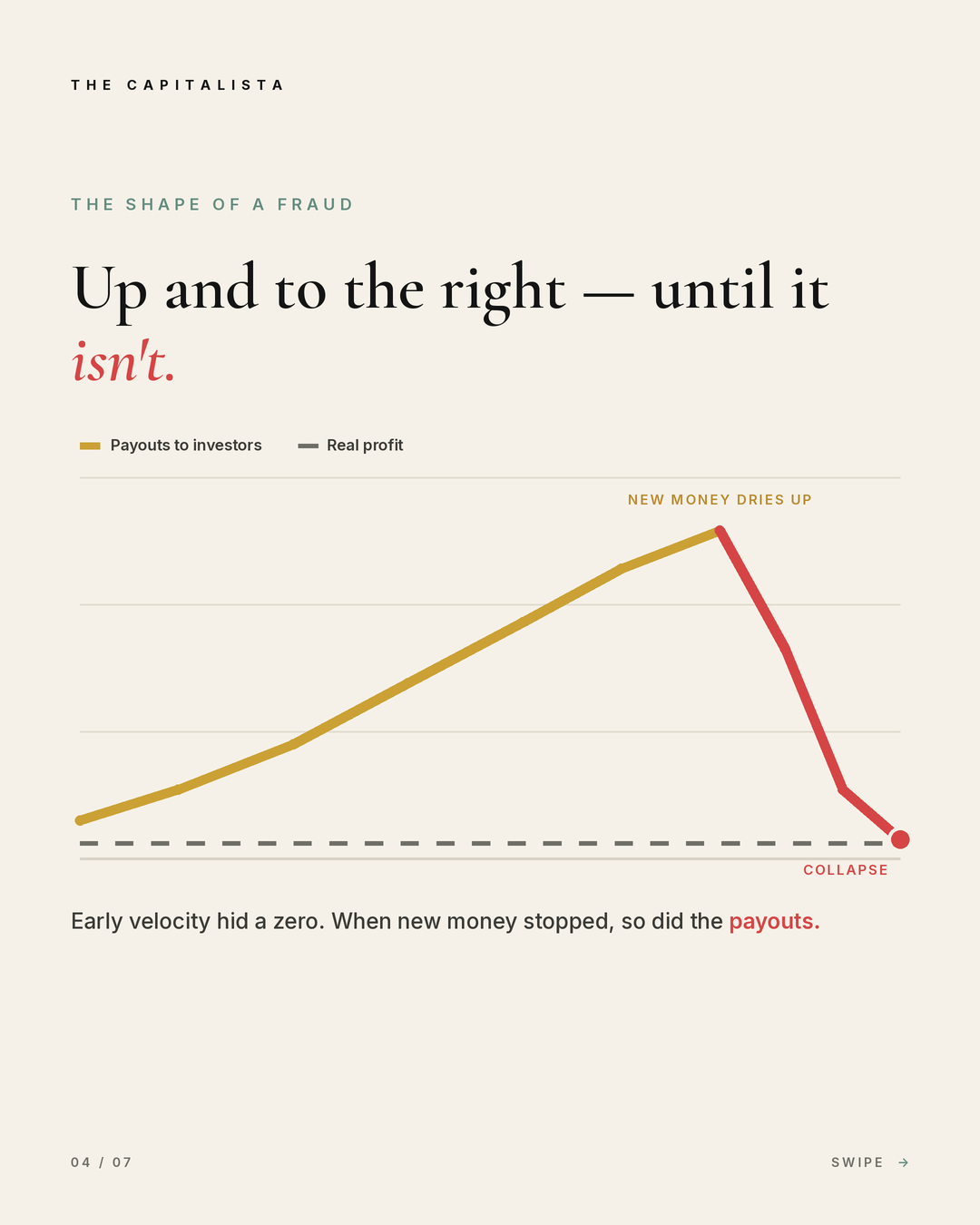
Picture two lines on a chart. The first is your payouts: rising steadily, on schedule, reassuring. The second is the actual operating profit of the underlying business. In a legitimate venture, the second line supports the first — distributions are a consequence of real value being created. In a Ponzi structure, the second line is flat on the floor at zero. The payouts are real; the engine behind them is fiction.
For a while, the gap is invisible. Early velocity hides the zero. But the structure has a fixed mathematical destiny: it requires ever-increasing inflows to sustain its outflows. The moment new money slows, the payouts that felt like proof evaporate — and the people who reinvested at the peak lose the most.
The lesson generalizes well beyond outright fraud. Plenty of legitimate-but-fragile partnerships and ventures run on the same emotional dynamic: impressive early distributions that lull stakeholders into treating a shaky structure as permanent. The discipline is identical. Never let quick, superficial wins soothe you into compliance.
How to audit the engine before you reinvest
Defending yourself doesn't require paranoia. It requires a fixed habit: separating the income you're celebrating from the data that explains it.
Demand a direct look at the underlying mechanism. Before adding capital to any structure, insist on a transparent, verifiable explanation of exactly what generates the returns. If the answer is evasive, that evasion is your answer.
Verify with independent, third-party data. Don't accept the operator's own dashboards as proof. Seek custody statements, audited financials, regulatory registrations, and confirmations from parties who aren't paid by the structure. Independent verification is the entire point.
Reconcile the payouts to a real source of value. Trace the distributions back to a plausible, documented operation. Can the stated activity actually produce these returns at this scale and speed? If the math doesn't reconcile, the gap is your risk.
Treat your own enthusiasm as a warning light. The moment you find yourself emotionally invested because of how good the early returns feel, slow down. That feeling is exactly the cognitive blind spot these structures are engineered to create.
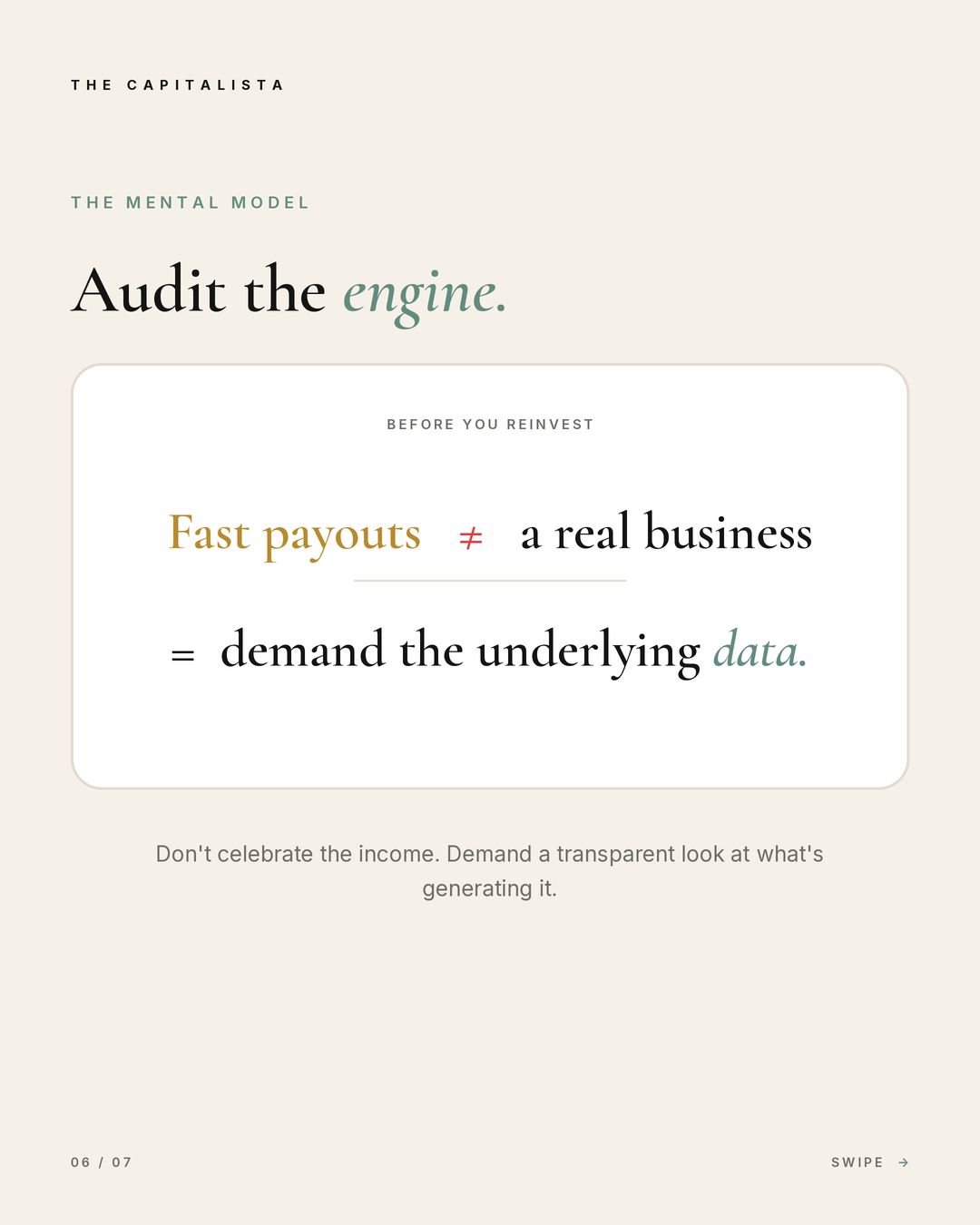
Audit existing positions, not just new ones. Review your current partnerships and joint ventures with the same scrutiny you'd apply to a cold pitch. Request a direct look at the baseline data driving your payouts rather than simply celebrating the income.
The takeaway: celebrate the data, not the deposit
Charles Ponzi understood something timeless about human behavior: give people enough early cash and they will stop looking at the engine. A hundred years on, that vulnerability is unchanged, and it costs disciplined, intelligent operators dearly every year.
True financial security doesn't come from the size or speed of your distributions. It comes from verifying the source of them. The payout in your hand is not evidence of a sustainable business — it's just a deposit, and a deposit can be funded by the very risk you're failing to see.
So when the income is flowing and the temptation is to celebrate, do the unglamorous thing instead. Ignore the early hype, demand a transparent audit of the underlying operational engine, and reconcile every payout to a real source of value. Cash in your palm proves nothing about the engine behind it.
Frequently asked questions
How can you spot a Ponzi scheme early? Watch for abnormally high and suspiciously consistent returns, opacity about how the money is actually generated, pressure to reinvest rather than withdraw, recruitment incentives built into the returns, and payouts that arrive faster than any real operation could plausibly produce them.
Why do intelligent investors fall for Ponzi schemes? Because early, tangible payouts function as psychological proof. Receiving real cash overrides the instinct to verify, and investors mistake payout velocity for institutional permanence — assuming that fast distributions mean the underlying business is durable.
What is the difference between payout velocity and real returns? Payout velocity is the speed and consistency of distributions you receive. Real returns are produced by a genuine underlying operation. In a Ponzi structure the payouts are real but the operating engine is effectively zero, with distributions funded by new investor money rather than actual profit.
How do I audit a partnership or investment before reinvesting? Demand a transparent explanation of the mechanism, verify with independent third-party data such as custody statements and audited financials, reconcile payouts to a documented source of value, and apply the same scrutiny to existing positions that you would to a new pitch.