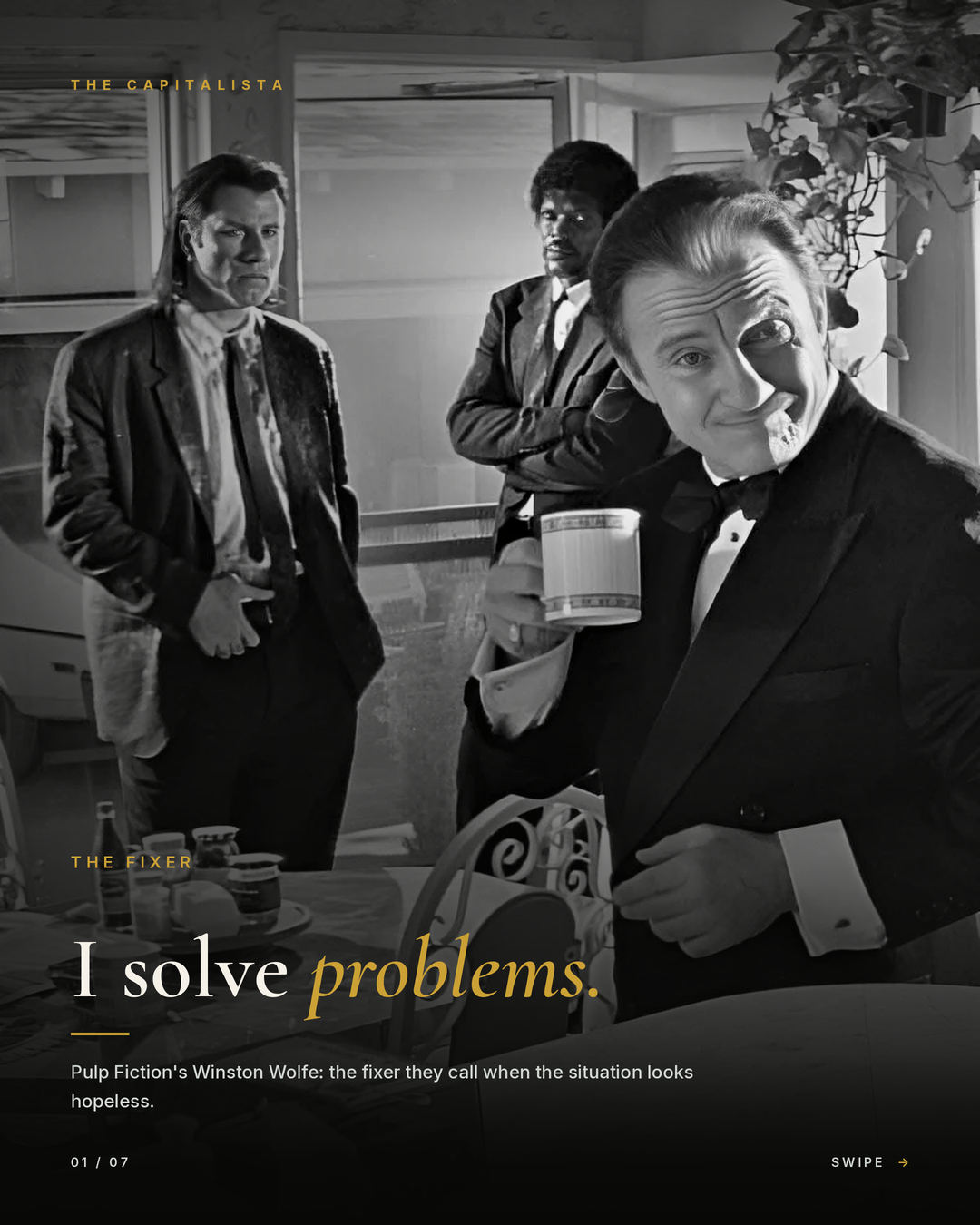
He arrives at eight in the morning, in a tuxedo, and doesn't waste a word.
Two professionals are standing over a catastrophe — a body in the back of a car, blood everywhere, a clock ticking toward disaster. They're panicking. He isn't. He introduces himself with one of the most quoted lines in film:
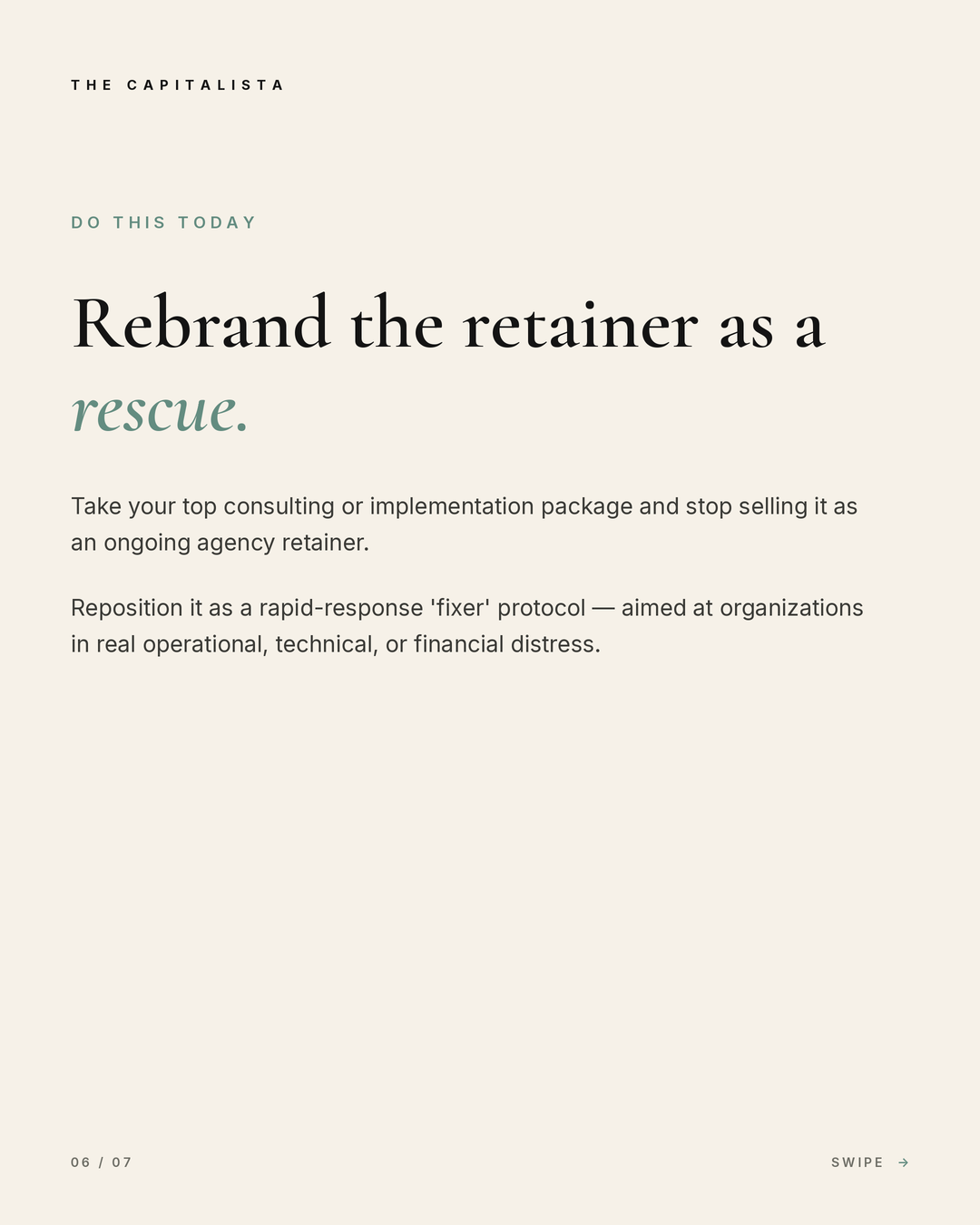
"I'm Winston Wolfe. I solve problems."
That's it. No small talk, no blame, no lecture about how it happened. Within minutes, an unsolvable crisis becomes a to-do list.
Winston Wolfe — "The Wolf," played by Harvey Keitel in Pulp Fiction — is fiction. But the way he operates is the single most valuable posture an operator can adopt in business: when everyone else panics, the person who stays clinically calm becomes the most valuable, and most expensive, person in the room.
This post breaks down who Winston Wolfe is, why "I solve problems" is a masterclass in positioning, and how to turn the "fixer" archetype into a repositioned, premium-priced offer — whether you sell consulting, implementation, or financial strategy.
Who Is Winston Wolfe?
For anyone who hasn't seen the film: in Pulp Fiction, two hitmen, Vincent and Jules, accidentally shoot a man in the back of their car in broad daylight. They have a corpse, a blood-soaked vehicle, and roughly forty minutes before they're discovered. They freeze — arguing, blaming, burning time they don't have.
Enter The Wolf. He's a "fixer," called in by his boss to make the problem disappear. He doesn't ask why it happened. He notes exactly how much time is left, assigns specific tasks — clean the car, hide the seats, change your clothes — and executes with total composure. The crisis that paralyzed two professionals becomes, in his hands, a simple sequence of steps.
The scene is a perfect distillation of a truth every high-value operator eventually learns: the crisis is rarely the real problem. The real problem is that the people handling it have lost their nerve.
"I'm Winston Wolfe. I Solve Problems." — Decoded
Look closely at that introduction, because it's a positioning statement as tight as any brand has ever produced.
He doesn't say, "I have twenty years of experience in crisis remediation." He doesn't list credentials, frameworks, or a methodology. He states an outcome: I solve problems. Three words that promise exactly one thing — the result you desperately need.
Compare that to how most experts introduce themselves: a wall of qualifications, a tour of their process, a spec sheet of services. The Wolf sells the destination. Everyone else sells the map.
When you're the person a client calls at their worst moment, you don't need to prove you're smart. You need to prove you're steady. "I solve problems" does that in one breath.
The Anatomy of a Fixer
What exactly does The Wolf do that the two professionals couldn't? Strip away the drama and it's a repeatable operating system:
- He detaches from the emotion. No judgment about the mess, no interest in whose fault it is. Blame is a luxury a crisis can't afford.
- He quantifies the constraint. The first thing he establishes is time: how much is left, and what has to happen inside it. "If I'm curt with you, it's because time is a factor."
- He converts chaos into steps. An overwhelming disaster becomes a short, mechanical checklist. Each task is concrete and assignable.
- He gives clear, unambiguous orders. No hedging, no "maybe we could." Direction removes the paralysis of too many options.
- He owns the outcome, not the excuses. He's there to get them out — full stop.
None of this is magic. It's the deliberate application of calm and structure to a situation that's screaming for both. That combination — composure plus a system — is the entire product.
Why Calm Is the Product
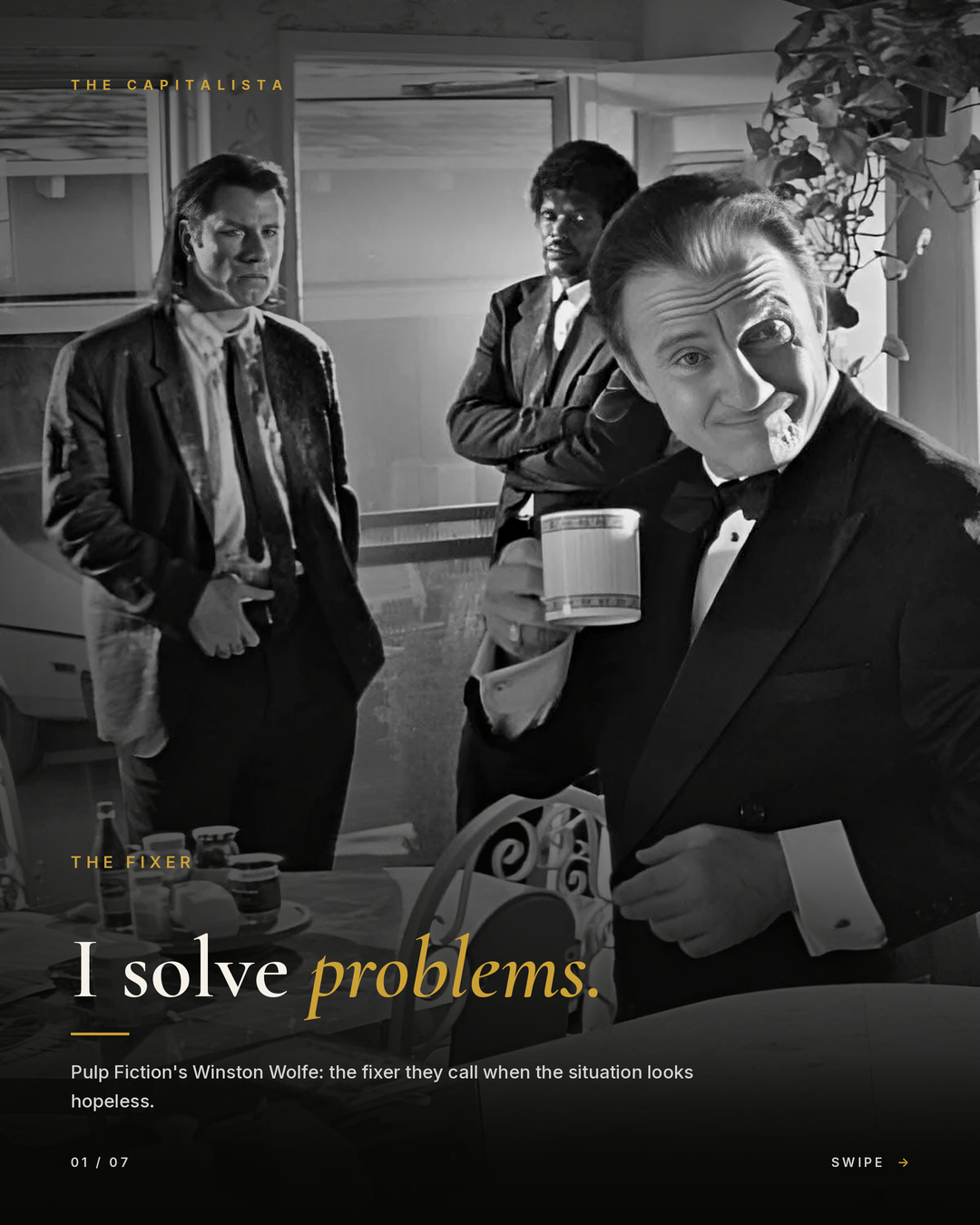
Here's the counterintuitive part: The Wolf isn't paid for the cleanup. Anyone with instructions can scrub a car. He's paid for the calm that makes the cleanup possible under pressure.
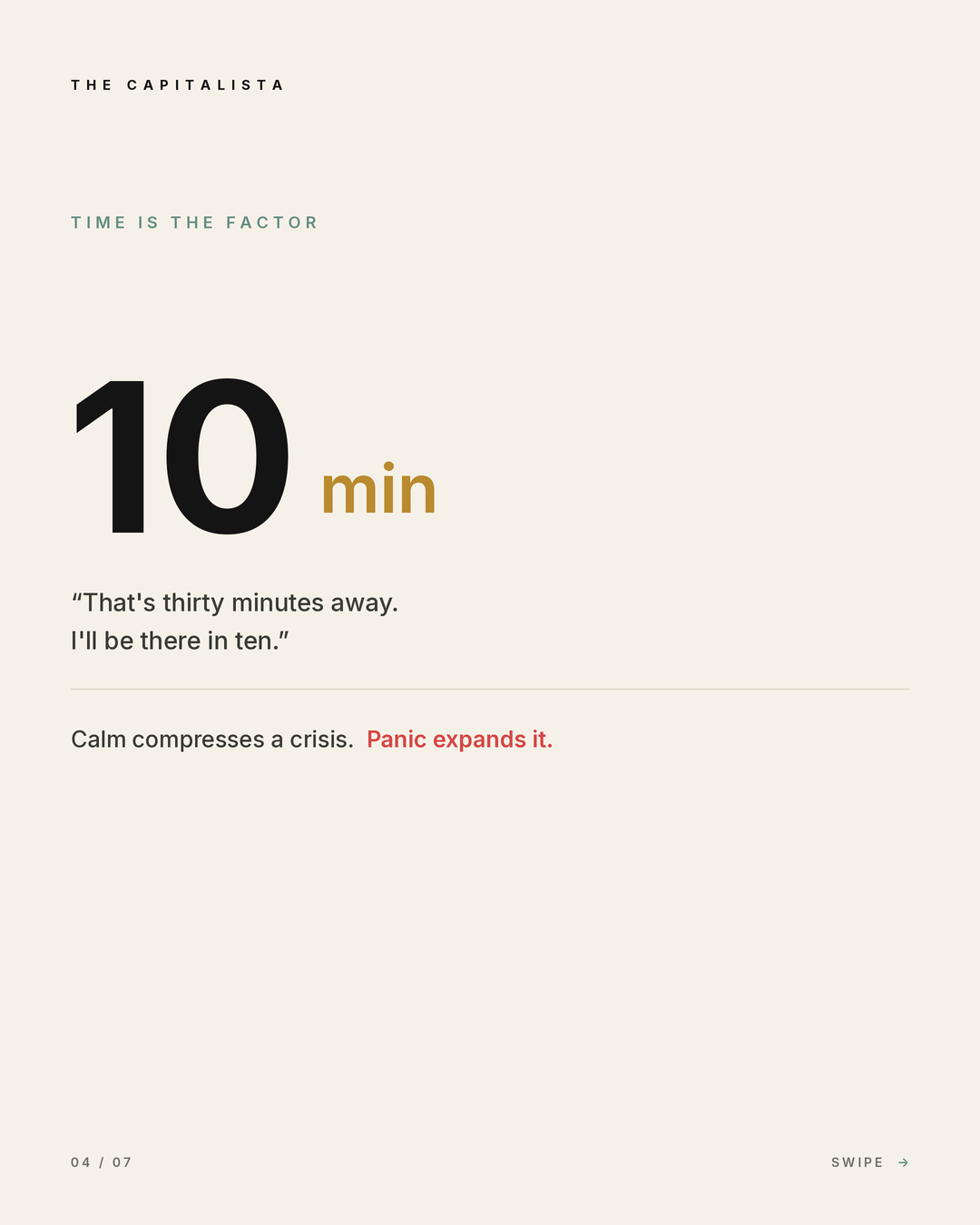
When disaster hits an organization — a financial shortfall, a failed launch, a key client threatening to walk, a compliance emergency — standard operators do three destructive things. They panic. They react emotionally. And they burn critical energy assigning blame. Calm compresses a crisis. Panic expands it.
The elite operator's edge isn't more knowledge. It's the ability to stay clinical while everyone else spirals — to treat a chaotic, terrifying mess as nothing more than a math problem with a deadline. That detachment is rare, and rarity is what commands a premium.
The Business Lesson: Sell the Calm, Not the Cleanup
Most consultants and specialized service providers market themselves as an ongoing, steady-state relationship: a monthly retainer, a standing agency arrangement, a nice predictable engagement. It's comfortable. It's also where fees go to die, because "ongoing help" is easy to compare, negotiate, and cut.
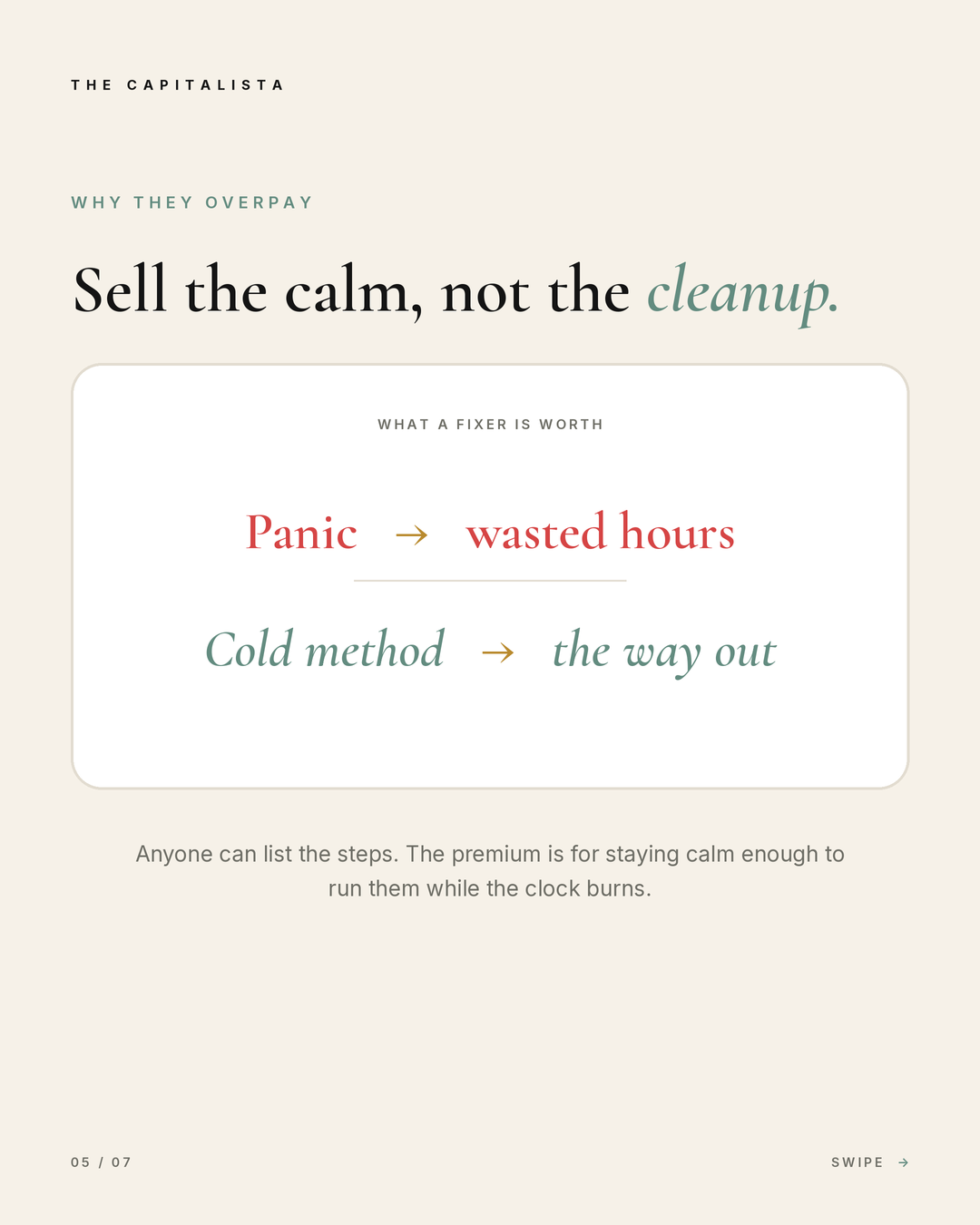
The Winston Wolfe move is to reposition your highest-tier offer as an emergency "fixer" protocol — a rapid-response service aimed at organizations experiencing acute operational, technical, or financial distress. You're not selling steady maintenance. You're selling the calm, clinical elimination of someone's worst-case scenario.
When the corporate house is on fire, nobody haggles over the price of the person who can put it out. They pay whatever it takes for the individual who walks in, stays composed, and turns the catastrophe into a checklist.
How to Reposition Your Service as a "Fixer" Protocol
You don't need a new skill set. You need a new frame. Here's how to build it.
1. Name the worst-case scenario you eliminate
Every expertise maps to a specific disaster. A financial expert prevents insolvency. An ops expert prevents a delivery collapse. Identify the single most terrifying outcome your ideal client faces, and make that the thing you solve.
2. Rewrite your offer around speed and outcome
Stop describing your process. Describe the result and the timeline. "We stabilize businesses hemorrhaging cash within 30 days" beats "monthly financial consulting" every time.
3. Build the repeatable blueprint
The Wolf works fast because he already has the sequence in his head. Turn your crisis response into a documented, repeatable protocol — the steps, the order, the deadlines. A named system signals institution, not improvisation.
4. Lead with calm authority in every touchpoint
Your intake, your first call, your proposal — all of it should radiate composure and command. Diagnose fast, assign clear next steps, and let the client feel the panic drain out of the room. That feeling is the sale.
Who to Target: Organizations in Distress
A fixer's market isn't "everyone who could use help." It's the narrow, urgent segment currently on fire. Actively target companies showing signs of acute distress:
- Sudden revenue drops or cash-flow crises
- A botched product launch or system failure
- Leadership turnover creating an operational vacuum
- Regulatory, compliance, or reputational emergencies
- Missed targets with a board or investors demanding answers
These prospects don't need convincing that the problem is real. They're living it. Your job is simply to be the visible, credible, calm operator who can make it stop.
Why Fixers Command Premium Fees
Pricing follows urgency and scarcity. A routine service competes on rate. A crisis service competes on how fast the pain stops — and when the alternative is catastrophe, price sensitivity evaporates.
The Wolf charges a fortune because he brings something almost nobody else can supply in the moment it's needed most: order imposed on chaos. When you position your business as the elite system that eliminates a specific disaster, you stop being a contractor billing for hours and become a structural powerhouse charging for outcomes.
The CFO Parallel: A Financial Fixer
Nowhere does the Winston Wolfe archetype fit more cleanly than money. When a business hits a financial crisis — cash running out, margins collapsing, a fundraise falling through, numbers the founder can't explain to the board — panic sets in fast, and it's the most expensive kind of panic there is.
A CFO is the Wolf for your finances. Not a bookkeeper recording what already happened, but the calm operator who walks in, notes exactly how much runway is left, and converts financial chaos into a clear sequence: where the money is leaking, what to cut, what to protect, what to do first.
That's what The Capitalista provides — a fractional CFO who owns your margins, cash flow, and financial strategy, and brings clinical order to the numbers when it matters most. When your finances are on fire, you don't want more reports. You want someone who solves problems.
Frequently Asked Questions
Who plays Winston Wolf in Pulp Fiction?
Winston Wolfe — "The Wolf" — is played by Harvey Keitel. Quentin Tarantino wrote the role specifically for him.
What does "I'm Winston Wolfe, I solve problems" mean?
It's the character's introduction as a criminal "fixer." The line works because it promises a single, clear outcome — problem solved — with no wasted words. It's become shorthand for calm, results-first crisis management.
What is a "fixer" in business?
A business fixer is a specialist brought in to resolve an acute crisis quickly — financial, operational, or reputational. Unlike an ongoing consultant, a fixer is defined by speed, composure, and a clear focus on eliminating a specific worst-case scenario.
What can businesses learn from Winston Wolfe?
Stay calm under pressure, detach from blame, quantify the constraint (especially time), break chaos into a clear checklist, and give unambiguous direction. And commercially: package your elite service as a rapid-response fixer offer, because crisis work commands premium fees.
Is Winston Wolfe based on a real person?
The character is fictional, written by Quentin Tarantino for Pulp Fiction (1994). The "fixer" archetype, however, is very real across law, finance, PR, and corporate turnaround.
The Bottom Line
"I'm Winston Wolfe. I solve problems." Six words that outperform a hundred credentials, because they promise the one thing a panicking client actually wants: someone who will stay calm and make the disaster go away.
The lesson isn't to handle crises better in silence. It's to build your business around that value — to become the fixer people call when the house is on fire, and to charge accordingly. Detach from the panic, impose the checklist, and let your composure be the most expensive thing you sell.