When the digital book revolution arrived, publishers faced an obvious decision. Amazon offered instant access to hundreds of millions of buyers.
The math looked simple: hand over your catalog, get distribution, collect revenue. Nearly every major publisher took the deal.
J.K. Rowling didn't.
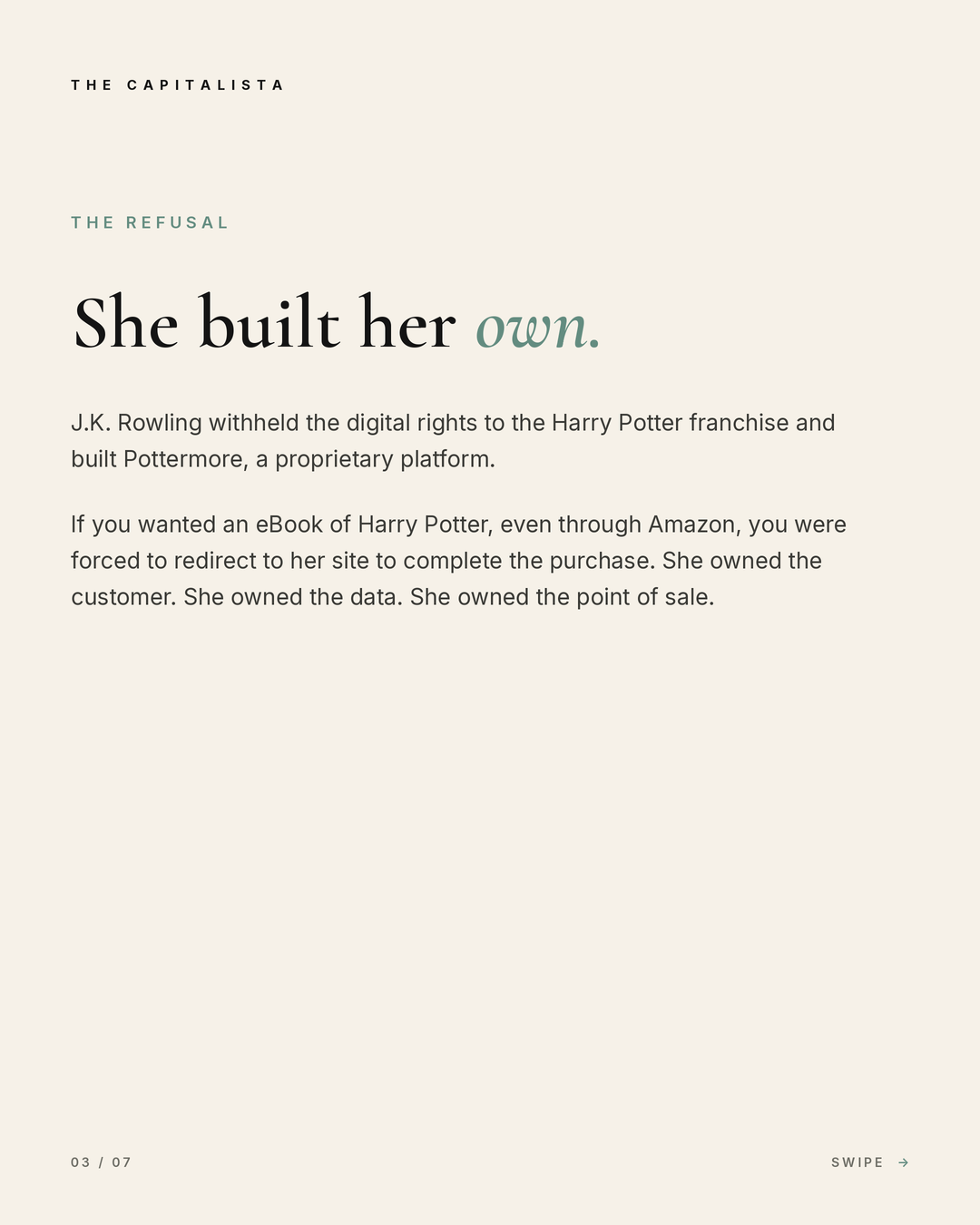
Instead of licensing the digital rights to Harry Potter directly through Amazon's ecosystem, she built Pottermore, her own proprietary platform. If a customer wanted to buy a Harry Potter eBook, even if they discovered it through Amazon, they were redirected to Rowling's own site to complete the purchase.
She kept the reach. She sacrificed nothing. And she kept something almost every other publisher gave away without a second thought: the customer relationship itself.
This decision holds one of the most underappreciated lessons in modern business: the platform you sell through matters far less than who owns the customer at the end of the transaction.
The Trap Publishers Walked Into
When digital distribution exploded, publishers were solving for a very specific problem: how do we reach as many readers as possible, as fast as possible? Amazon's answer was compelling. Instant access to a massive built-in audience, sophisticated logistics, and a proven purchase funnel.
So publishers said yes. They handed over their catalogs. They gained distribution.
What they didn't fully account for was what they gave up in the process: the point of sale, the customer data, and the entire relationship with the reader. Every transaction happened on Amazon's platform, under Amazon's terms, inside Amazon's ecosystem. The publisher became a supplier. Amazon became the business the customer actually had a relationship with.
This is the trap that catches founders and operators across every industry, not just publishing. You optimize for reach and unconsciously surrender control.
What Rowling Did Differently
Rowling's decision wasn't about resisting technology or refusing digital distribution. She embraced eBooks. What she refused to do was let a third-party platform own the transaction and the customer relationship.
By building Pottermore, she created a proprietary checkout experience. Customers could discover Harry Potter eBooks anywhere, including through Amazon's search and marketing engine, but the actual purchase happened on infrastructure she controlled.
This gave her three things most publishers never had:
First, she owned the customer data. She knew who was buying, what they were buying, and how to reach them directly in the future, without paying a platform fee or being subject to a platform's rules about customer communication.
Second, she owned the point of sale. The actual transaction, the checkout, the payment processing, all of it ran through infrastructure she controlled. She wasn't dependent on a third party's willingness to keep her catalog visible, prioritized, or even listed.
Third, she owned the relationship. When a customer bought a Harry Potter eBook, they weren't an Amazon customer who happened to buy Harry Potter. They were Rowling's customer, full stop.
The Real Distinction: Marketplace Versus Sovereign Platform
This decision illustrates a distinction every founder needs to internalize: the difference between distributing through a marketplace and building a sovereign platform.
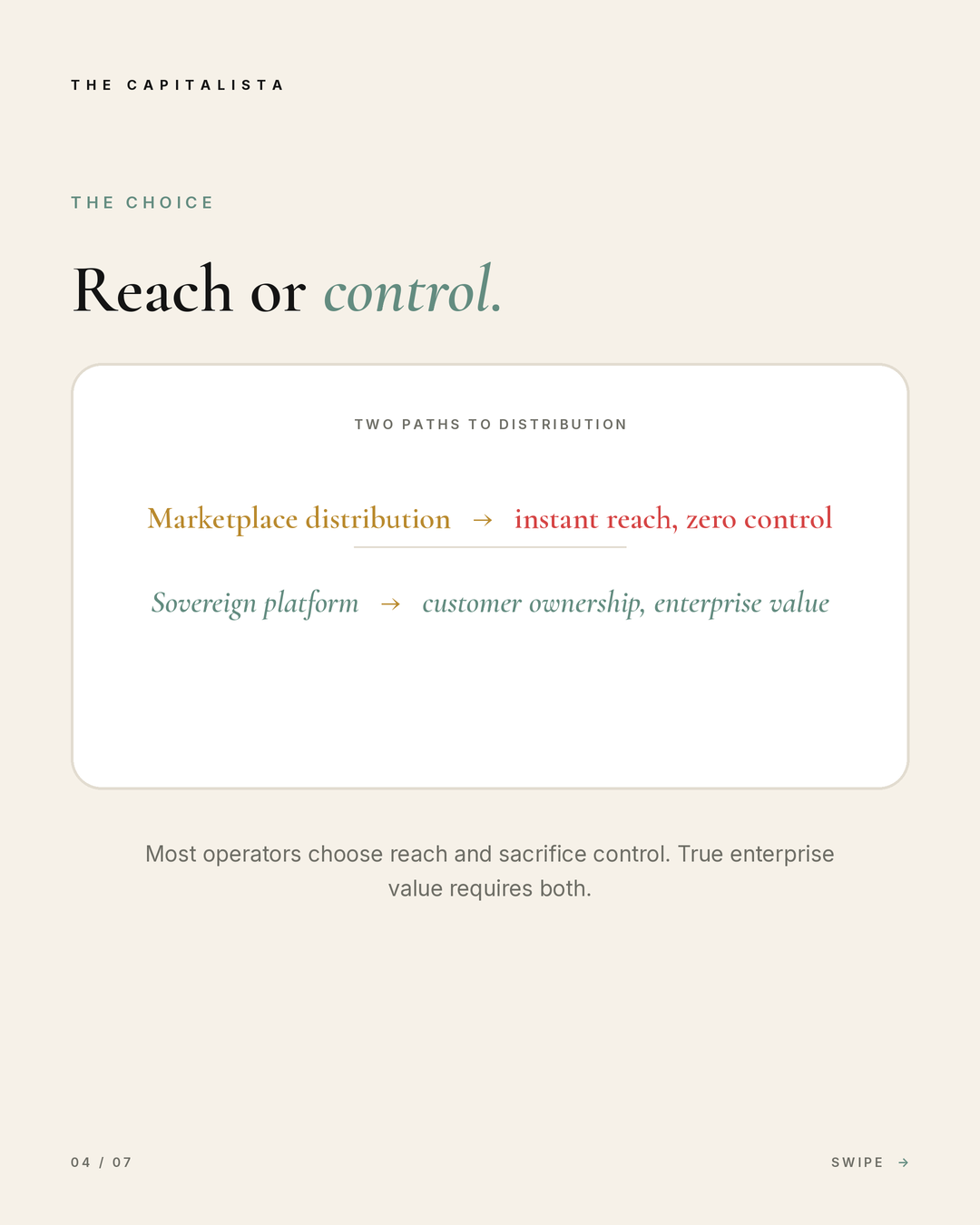
A marketplace gives you reach instantly. Amazon, Etsy, Shopify's app ecosystem, any major retail platform, any app store. You plug into an existing audience and existing purchase infrastructure. It's fast, it's low-friction, and it can generate revenue quickly.
But a marketplace also means you're a vendor, not a partner. The platform sets the rules. The platform can change the algorithm, adjust the fee structure, deprioritize your listing, or in the worst case, delist you entirely. You don't own the customer relationship. The platform does.
A sovereign platform is slower to build and harder to gain initial traction on. But every customer who transacts on it is genuinely yours. You control the data, the relationship, the economics, and the terms.
Most businesses need some presence in marketplaces for discovery and reach. The mistake is treating the marketplace as the entire strategy, rather than as a funnel into a relationship you actually own.
Why This Matters More Than Most Founders Realize
The consequences of this decision compound over time, and they show up in ways that aren't obvious until it's too late.
If your entire customer base exists only inside a marketplace, you have no ability to communicate directly with them outside the platform's rules. You can't email them a new product launch. You can't build a loyalty program on your own terms. You can't retarget them independently. The platform owns that channel, and they'll use it to promote your competitors right alongside you.
If the marketplace changes its algorithm or fee structure, your entire revenue stream is at the mercy of a decision you had no part in making. Businesses that rely entirely on Amazon FBA, app store distribution, or any single marketplace channel have experienced this directly: a policy change, an algorithm shift, or a fee increase can gut a business overnight, and there's no recourse.
If you ever want to sell your business, this distinction dramatically affects your valuation. A business with owned customer relationships and proprietary data is worth significantly more than a business that's entirely dependent on a third-party platform for its customer access. Acquirers know the difference between a business and a vendor relationship with a platform.
The "You're Not a Partner, You're a Vendor" Reality
This is the uncomfortable truth most businesses operating inside marketplaces don't want to hear: you are not a partner to the platform you sell through. You are a vendor.
Partners negotiate as equals. Vendors accept terms. Partners have leverage. Vendors get replaced when a better or cheaper option appears. Partners own their customer relationships. Vendors rent access to someone else's customers.
The moment you fully understand this distinction, the decision to build sovereign infrastructure, even a slower, harder, more expensive version of it, starts to look less like a luxury and more like a survival requirement.
How to Apply This to Your Business
You don't need to abandon marketplaces entirely. Few businesses can or should. The goal is to make sure you're not entirely dependent on infrastructure you don't control.
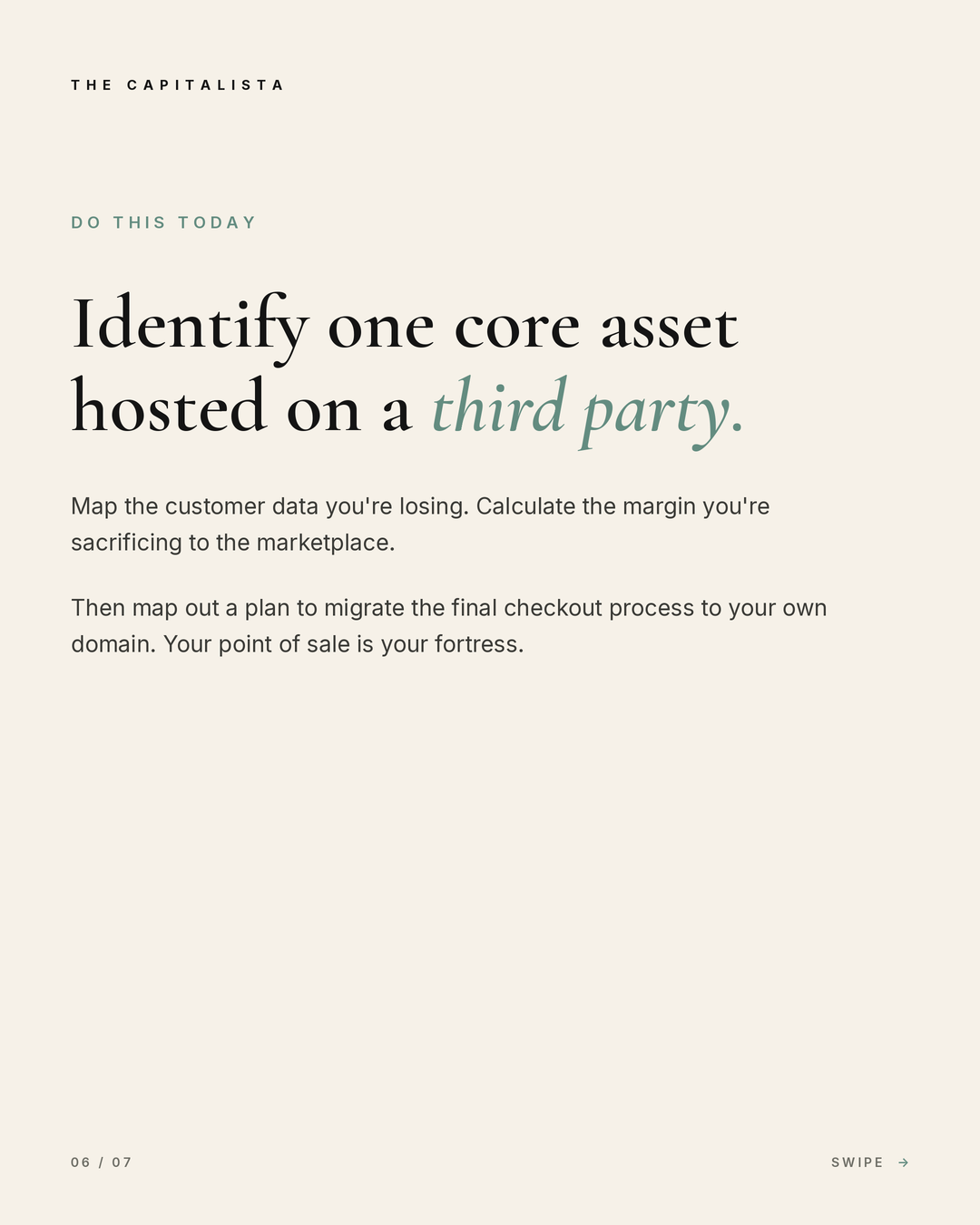
1. Identify every customer touchpoint currently owned by a third party
Map out every part of your business where a platform sits between you and your customer: payment processing, communication, data collection, fulfillment. Anywhere a third party owns that layer is a point of vulnerability.
2. Calculate what you're actually losing
Quantify the platform fees you're paying. Estimate the value of the customer data you don't have access to. Calculate the cost of not being able to communicate directly with your customer base. This number is usually much larger than founders expect.
3. Build the checkout you control
You don't need to abandon marketplace discovery. But work toward directing transactions, even a portion of them, to infrastructure you own: your own website, your own payment processing, your own customer database.
4. Capture the data at every opportunity
Even within a marketplace relationship, look for legitimate ways to capture customer information: post-purchase communication, loyalty programs, direct outreach where platform rules allow it. Every piece of first-party data increases your independence.
5. Treat your point of sale as core infrastructure, not an afterthought
The checkout process isn't just a transaction mechanism. It's the single most valuable piece of infrastructure in your business. Protect it, invest in it, and never fully outsource it to a party whose incentives don't align with yours.
What The Capitalista Does
Rowling's decision to build Pottermore instead of fully ceding her catalog to Amazon is a case study in protecting enterprise value. Most founders never stop to calculate what they're giving up in exchange for marketplace reach.
The Capitalista is a fractional CFO service that helps you see this trade-off clearly. We:
- Identify which customer relationships are trapped on third-party platforms, and calculate exactly what that dependency is costing you
- Quantify the margin you're sacrificing to marketplace fees, algorithm dependency, and lost direct-communication opportunities
- Build a migration strategy to reclaim your point of sale without sacrificing the reach that got you here
- Model the enterprise value impact of owning versus renting your customer relationships
- Structure your financial operations so sovereign infrastructure is a realistic, funded priority, not just an aspiration
Rowling didn't reject digital distribution. She just refused to let someone else own the relationship with her readers. That distinction protected decades of enterprise value that a purely marketplace-dependent strategy would have surrendered.
Frequently Asked Questions
What does "owning your backend" actually mean?
It means controlling the infrastructure behind the transaction: the point of sale, the customer data, and the ongoing relationship with the buyer, rather than having a third-party platform sit permanently between you and your customer.
Why did J.K. Rowling build Pottermore instead of just selling through Amazon?
She wanted to retain ownership of the customer relationship and data for the Harry Potter digital catalog rather than fully surrendering it to a marketplace. Pottermore let her benefit from Amazon's discovery and reach while still completing the actual transaction, and owning the customer, on her own platform.
Is it bad to sell on marketplaces like Amazon or Etsy?
Not inherently. Marketplaces provide valuable reach and discovery, especially for new or smaller businesses. The risk comes from total dependency, where a business has no owned customer relationships or alternative revenue channels outside the marketplace.
How do I know if I'm too dependent on a marketplace?
If a policy change, fee increase, or delisting from a single platform would threaten your business's survival, you're over-dependent. A healthy business has diversified customer acquisition and at least some owned, direct customer relationships.
What's the first step to reducing marketplace dependency?
Start by capturing customer data wherever legitimately possible, and build a direct communication channel (email, SMS, loyalty program) outside the marketplace. Then work toward directing a growing share of transactions to infrastructure you control.
The Bottom Line
Publishers who handed their entire digital catalog to Amazon gained fast, easy reach. They also gave up the customer relationship, the data, and the leverage that comes with owning your own point of sale.
J.K. Rowling chose differently. She built her own infrastructure and made sure that no matter how a customer discovered Harry Potter, the actual relationship, the data, and the transaction stayed hers.
That decision is a lesson every founder should take seriously: reach without ownership is rented success. It can disappear the moment the platform decides to change the rules.
Before you optimize your next channel for maximum reach, ask yourself: who actually owns this customer at the end of the transaction? If the answer isn't you, it's worth asking what that's costing you, and what it will cost you later.