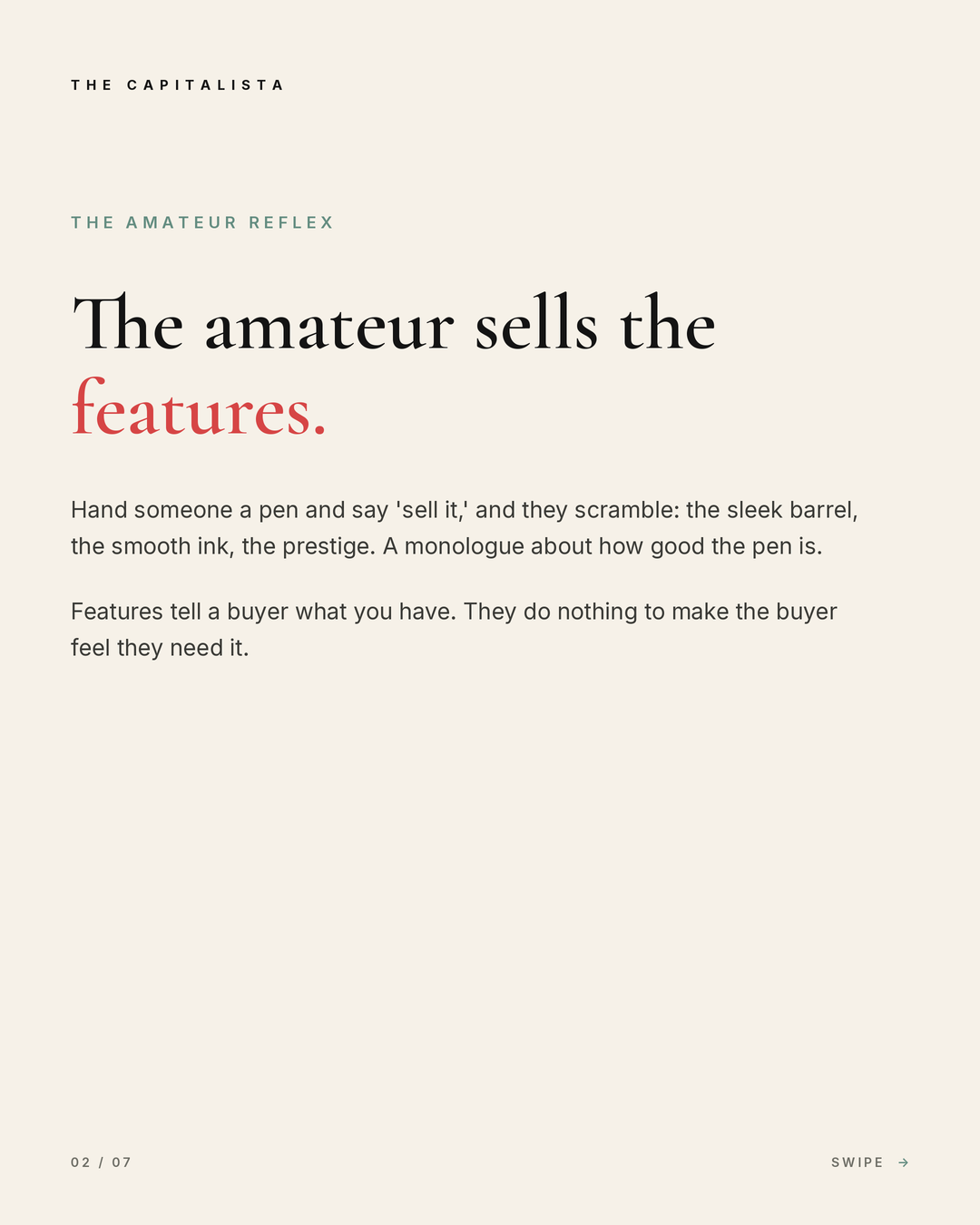
Hand someone a pen, say "sell me this pen," and watch what happens.
Most people freeze for half a second, then start listing: the sleek barrel, the smooth ink, the satisfying click, the premium finish. It feels productive. It is almost always wrong.
"Sell me this pen" is the most famous sales test in pop culture, made iconic by The Wolf of Wall Street. It's also one of the most misunderstood. The people who fail it think they're being asked to describe a pen. The people who pass it understand they're being asked to reveal a need.
This post breaks down what the challenge actually tests, the best answer you can give (in an interview or a real sales call), why feature-pitching quietly kills deals, and how to rebuild your own sales process around the principle underneath it all.
What "Sell Me This Pen" Really Tests
The question is a trap disguised as a prompt. On the surface it asks, "Can you make this object sound good?" Underneath, it asks something far more revealing: Do you understand how buying decisions actually get made?
Nobody buys a pen because it has a smooth ink flow. They buy a pen because they need to write something — a signature, a phone number, a deal. Features describe the product. Needs describe the buyer. Amateurs talk about the product. Closers talk about the buyer.
So when an interviewer or a prospect says "sell me this pen," they're checking whether you instinctively reach for features (weak) or for the buyer's situation (strong). It's a personality test for salespeople, and most fail it in the first five seconds.
The Movie Scene, Decoded
There are two "sell me this pen" moments in The Wolf of Wall Street, and people constantly conflate them.
At the end of the film, Jordan Belfort (Leonardo DiCaprio) hands a pen to seasoned salespeople in a seminar and asks them to sell it. They fumble. The scene is designed to show that even "pros" default to feature-pitching under pressure.
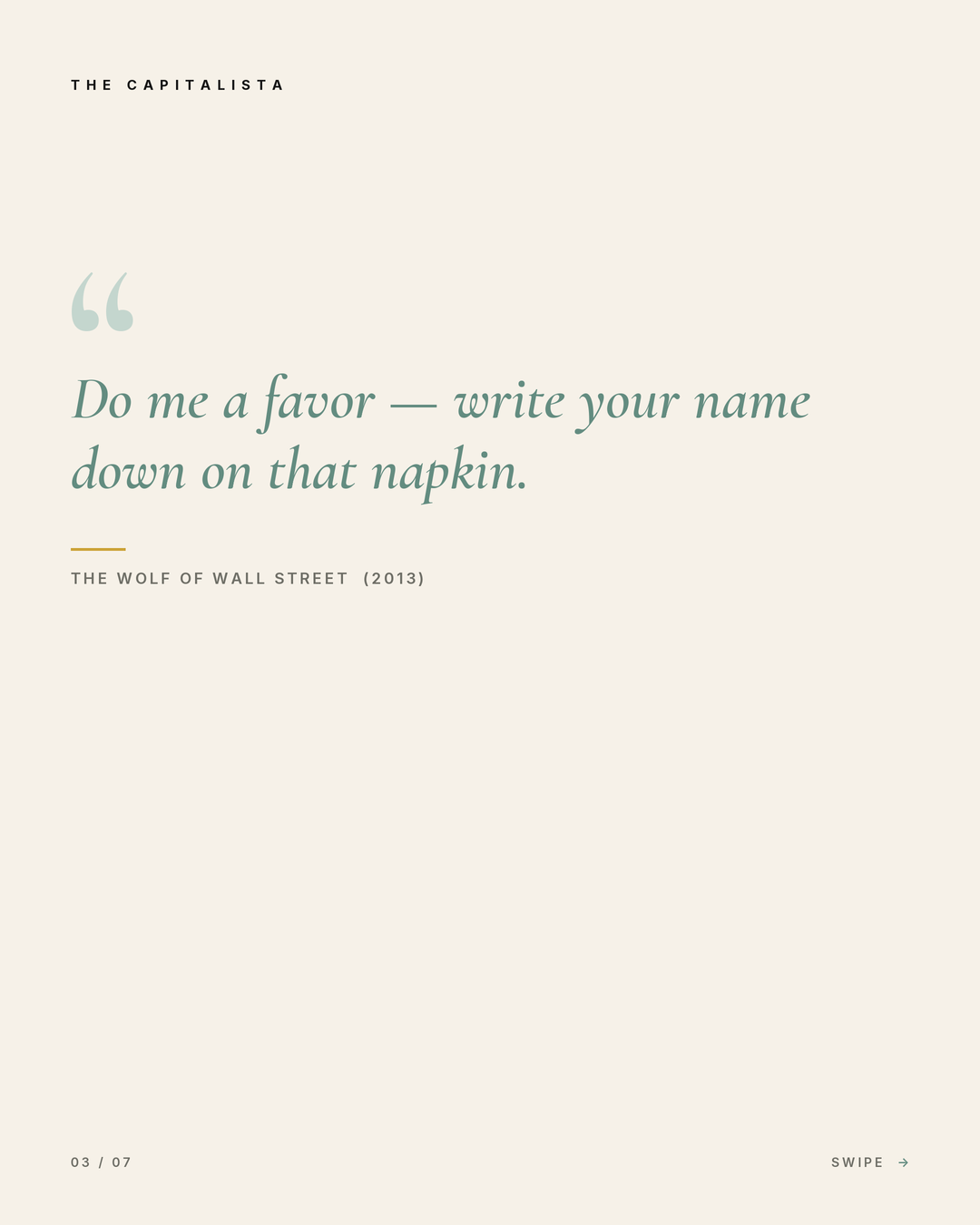
The sharper moment happens earlier, at a diner. Belfort challenges his friend Brad to sell him a pen. Brad doesn't describe anything. He simply says:
"Do me a favor — write your name down on that napkin."
Belfort replies that he can't; he doesn't have a pen.
"Exactly. Supply and demand."
In one move, Brad stops selling and creates a moment where the buyer feels the absence of a pen. He didn't argue that the pen was valuable. He engineered a situation where its value became obvious. That's the whole lesson in ten seconds: you don't describe the need into existence — you reveal it.
What the Amateurs Get Wrong: Pitching Features
Here's the psychology of why feature-pitching fails. When you list features, you're answering a question the buyer hasn't asked yet. You're supplying information about a product before you've established any demand for it. It's like handing someone a detailed spec sheet for a raincoat on a sunny day.
Feature-pitching has three fatal flaws:
- It centers you, not them. Every sentence starts with "this pen has..." instead of "you need..."
- It creates zero urgency. A great feature the buyer doesn't need is just noise.
- It invites comparison. The moment you compete on features, you compete on price. There's always a smoother pen for less money.
This is exactly the trap high-ticket consultants and service providers fall into on their websites. They list frameworks, certifications, years of experience, and a tidy methodology — a spec sheet for a raincoat — and then wonder why prospects "need to think about it."
The Real Jordan Belfort's Answer
Here's the twist most people miss: the real Jordan Belfort answers "sell me this pen" completely differently from the movie.
In a 2015 interview with Piers Morgan, when handed a pen and asked to sell it, Belfort didn't manufacture drama. He asked questions:
"How long have you been in the market for a pen? What kind of pens do you normally use?"
His explanation is the actual masterclass:
"Before I'm even going to sell a pen to anybody, I need to know about the person. I want to know what their needs are, what kind of pens they use, do they use a pen, how often do they use a pen."
The movie dramatizes the lesson (create urgency). The real Belfort operationalizes it (ask qualifying questions to uncover the need, then position the pen as the answer). Both agree on the core truth: the sale is about the buyer, never the object. The difference is that in real life, you get to the need by asking — not by staging a napkin trick.
This is consultative selling, and it's the backbone of every serious sales methodology — SPIN, MEDDPICC, BANT, SPICED. They all start in the same place: understand the need before you present the solution.
How to Answer "Sell Me This Pen" in an Interview
If you're facing this in a job interview, the interviewer is testing your instincts, not your creativity. Here's the best answer, as a repeatable structure:
- Ask, don't pitch. Start with questions: "Before I do — when's the last time you needed a pen and didn't have one? What do you mostly use pens for — signing, notes, quick reminders?"
- Listen for the pain. Let them hand you the need. Maybe they sign contracts daily. Maybe they lose pens constantly. Maybe they want something that feels premium in front of clients.
- Sell the outcome, not the object. "You mentioned you sign contracts in front of clients. This pen writes cleanly every time and looks the part — so you never fumble in a moment that matters."
- Close. "Want to keep this one, or should I set you up with a few?"
Notice what you did: you turned a monologue about a pen into a short conversation about the buyer. That's the entire skill. An interviewer who knows sales will stop you at step one and hire you, because you did the one thing 90% of candidates don't: you asked a question first.
Why Diagnostic Questions Win
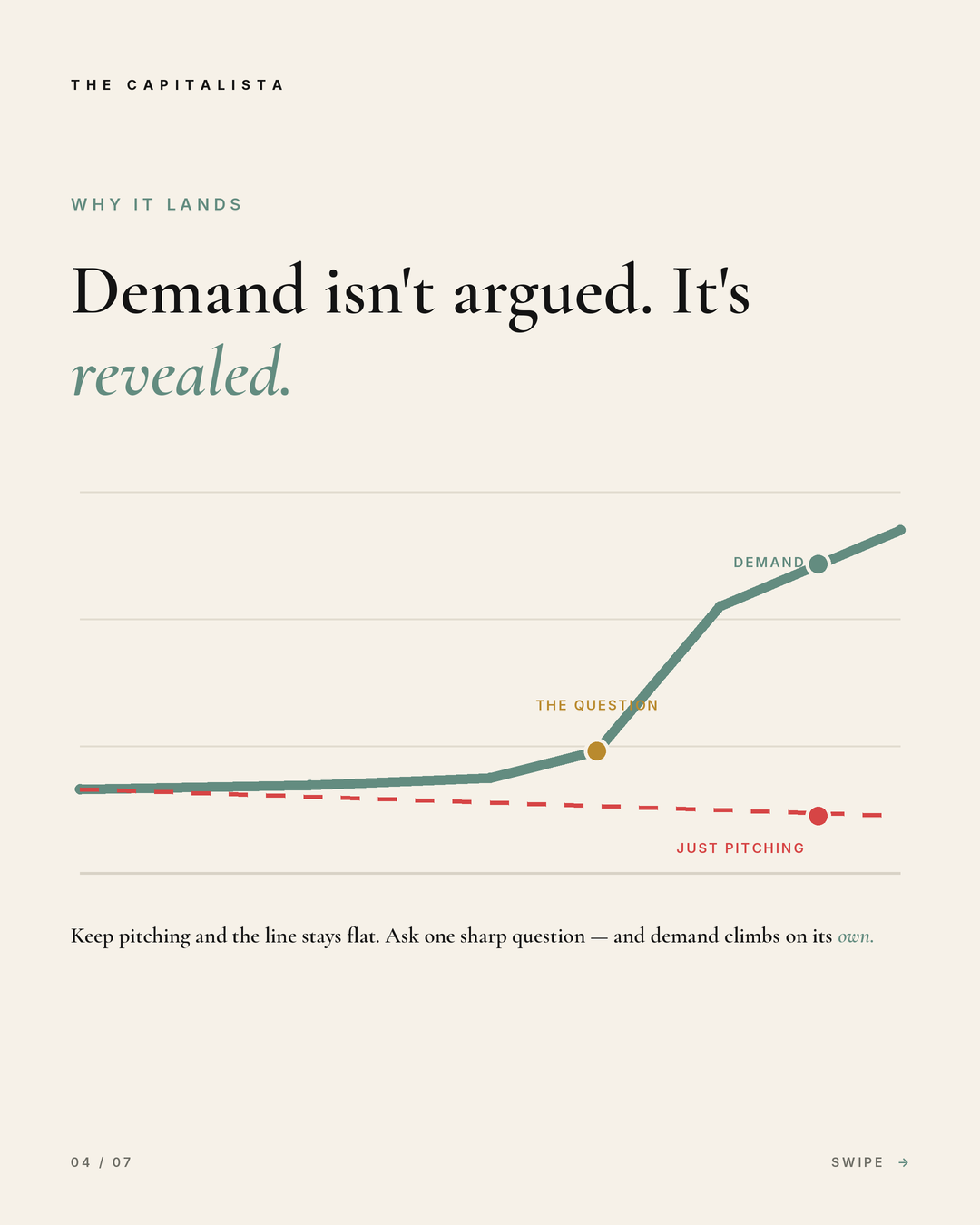
There's a reason this works at a psychological level. People don't act to gain a benefit nearly as hard as they act to close a gap they can feel. A benefit is abstract. A gap is personal.
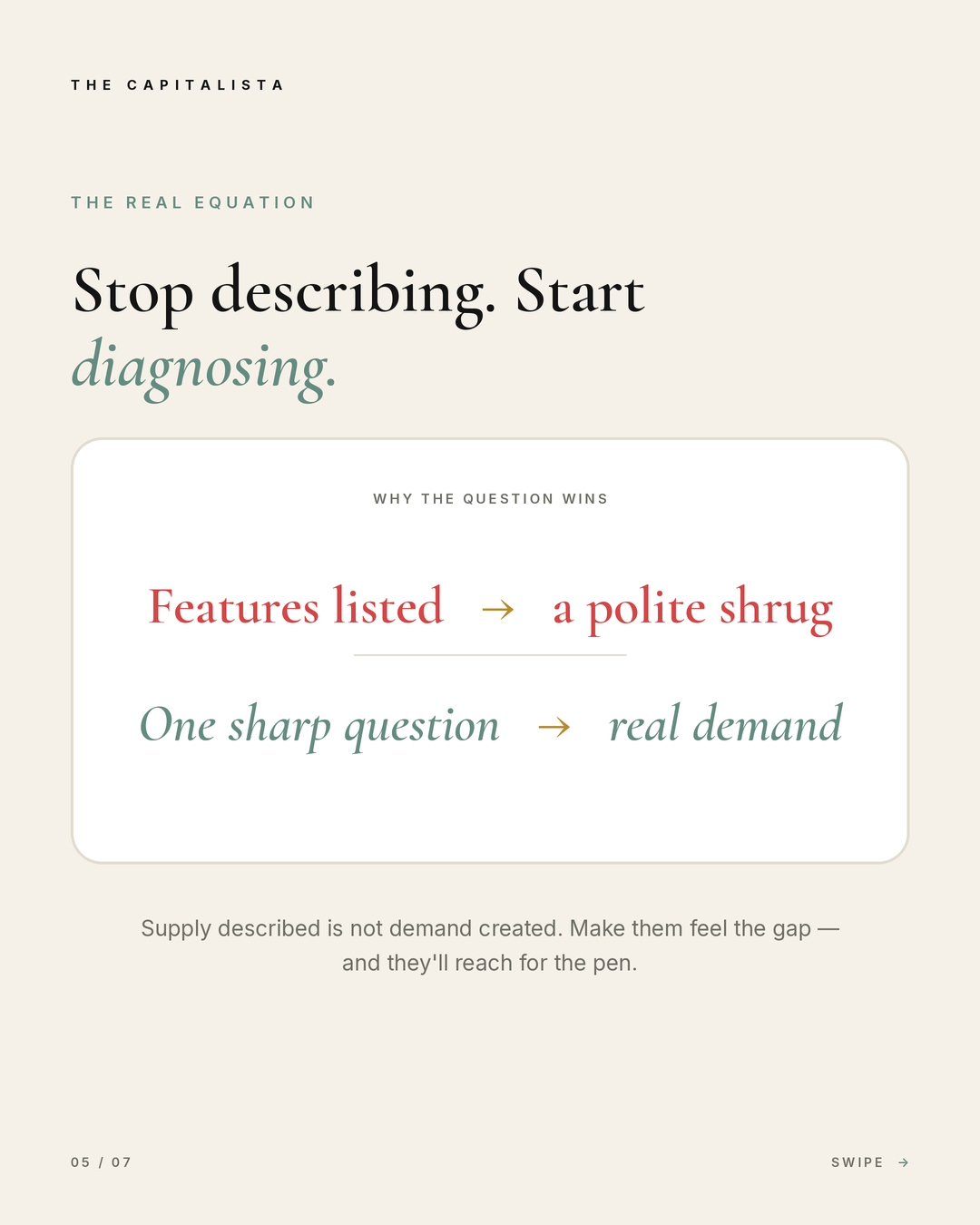
When you ask a sharp, diagnostic question, you make the prospect articulate the gap themselves — out loud, in their own words. And people believe what they say far more than what they're told. You're not arguing them into wanting your solution. You're helping them discover a problem they now can't unsee.
Supply described is not demand created. A feature is supply. A question that surfaces a painful gap is demand.
How to Rebuild Your Sales Process Around This
The "sell me this pen" lesson isn't a party trick for interviews. It's a diagnosis of your entire go-to-market. Here's how to apply it.
1. Audit your landing page and sales script
Read them as a stranger. Count how many sentences describe you (your framework, your credentials, your process) versus how many describe the prospect's problem. If the ratio is upside down, you're pitching the pen.
2. Replace one pitch paragraph with one diagnostic question
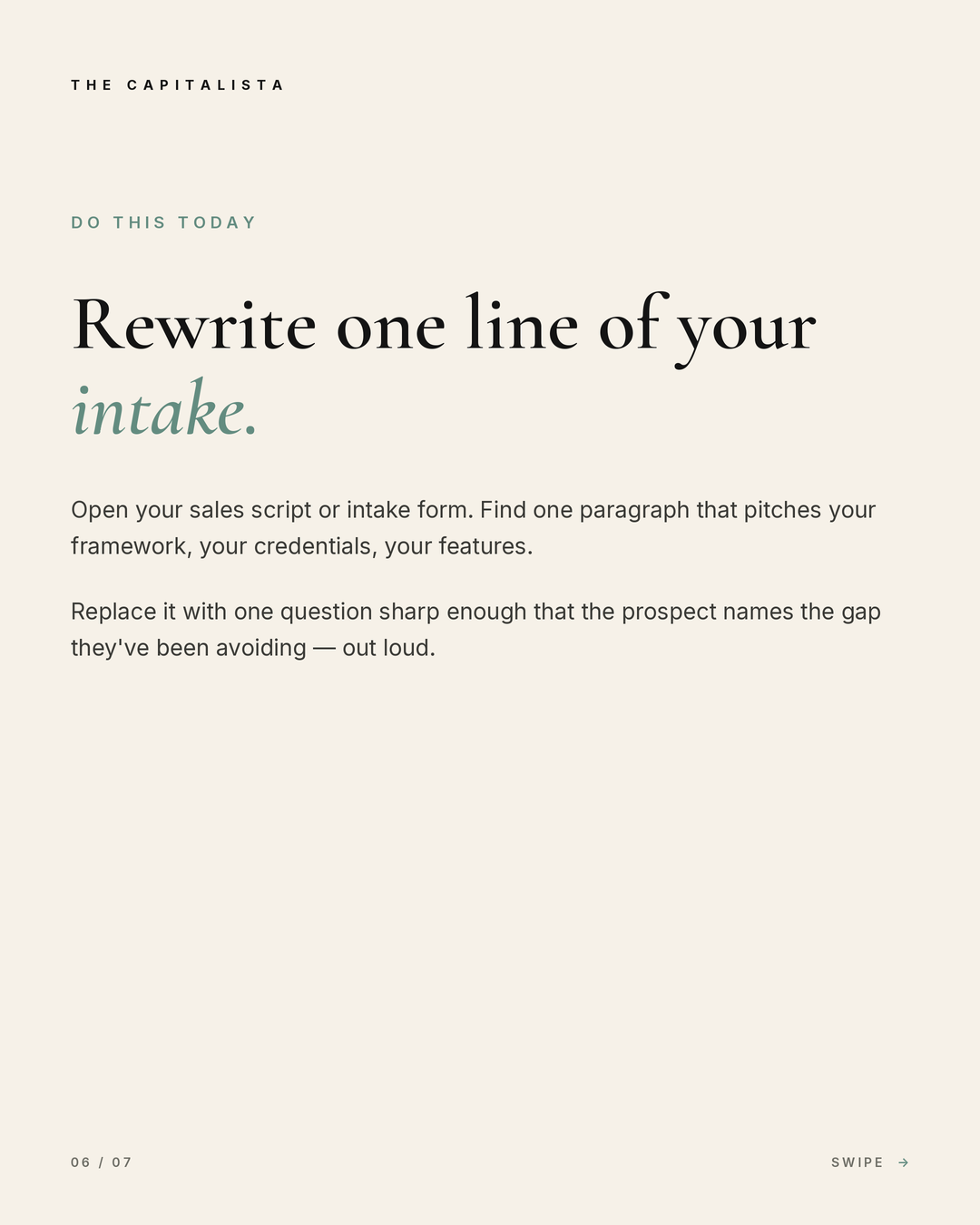
You don't need to burn it all down. Find the single most feature-heavy paragraph in your intake form or discovery call and swap it for a question sharp enough that the prospect names the gap they've been avoiding.
3. Build a short bank of diagnostic questions
Great discovery isn't improvised. Keep a handful of questions that reliably surface pain. Steal these and adapt them:
- "What's this problem costing you every month it goes unsolved?"
- "What have you already tried, and where did it fall short?"
- "If nothing changes in the next 90 days, what happens?"
- "Who else feels this problem inside the company?"
- "On a scale of 1 to 10, how urgent is fixing this — and what would make it a 10?"
4. Let the buyer close themselves
Once a prospect has said the problem out loud and quantified its cost, your solution stops being a pitch and starts being the obvious next step. You're no longer selling the pen. They're reaching for it.
Common Mistakes (Even Pros Make These)
- Asking questions, then ignoring the answers. Discovery is worthless if you pivot straight back into your script.
- Leading with your credentials. Nobody cares about your certifications until they care about their problem.
- Manufacturing fake urgency. The napkin trick works in a movie. In real life, forced urgency reads as manipulation. Real urgency comes from a real, quantified gap.
- Confusing features with outcomes. "Cloud-based dashboard" is a feature. "You'll see exactly where your money is leaking, in real time" is an outcome.
From Sales Tactic to Business Strategy
Zoom out and the pen stops being about sales calls at all. The same principle governs how you position an entire business.
Amateur operators lead with what they have: the deliverables, the tooling, the process. Elite operators lead with the gap they close and the cost of leaving it open. That reframing is what lets a service provider charge like an institution instead of a freelancer — because the conversation is no longer "here's what I do" but "here's the expensive problem only I'm positioned to solve."
At The Capitalista, this is exactly how we think about financial positioning: your numbers, margins, and cash strategy aren't features to list — they're the proof that makes you the only logical choice. When your results speak first, the pitch takes care of itself.
Frequently Asked Questions
What is the best answer to "sell me this pen"?
The best answer is to ask questions before you sell. Find out when and why the person uses a pen, uncover a specific need, then position the pen as the solution to that need. Never open by listing the pen's features.
What does "sell me this pen" actually test?
It tests whether you instinctively sell by describing a product (weak) or by understanding the buyer (strong). Interviewers use it to see if you grasp consultative, needs-based selling.
Who says "sell me this pen" in The Wolf of Wall Street?
Jordan Belfort (played by Leonardo DiCaprio) uses the challenge. The most-quoted answer comes from his friend Brad, who tells Belfort to write his name on a napkin — proving he needs a pen he doesn't have.
Is the movie's answer the "correct" one?
The movie's napkin scene is a great illustration of creating demand, but the real Jordan Belfort answers differently: he asks qualifying questions to understand the buyer first. In real sales, asking beats manufacturing urgency.
How do I use this in my own business?
Audit your website and sales script for feature-pitching, replace one pitch paragraph with a diagnostic question, and build a small bank of questions that surface your prospect's most expensive problem.
The Bottom Line
"Sell me this pen" was never about the pen. It's a test of whether you sell to the product or to the person. Amateurs describe features and hope. Closers ask questions, surface the gap, and let the buyer talk themselves into the solution.
So look at your own pitch today. Find one place where you're describing the pen — and replace it with a question that makes your prospect reach for it.