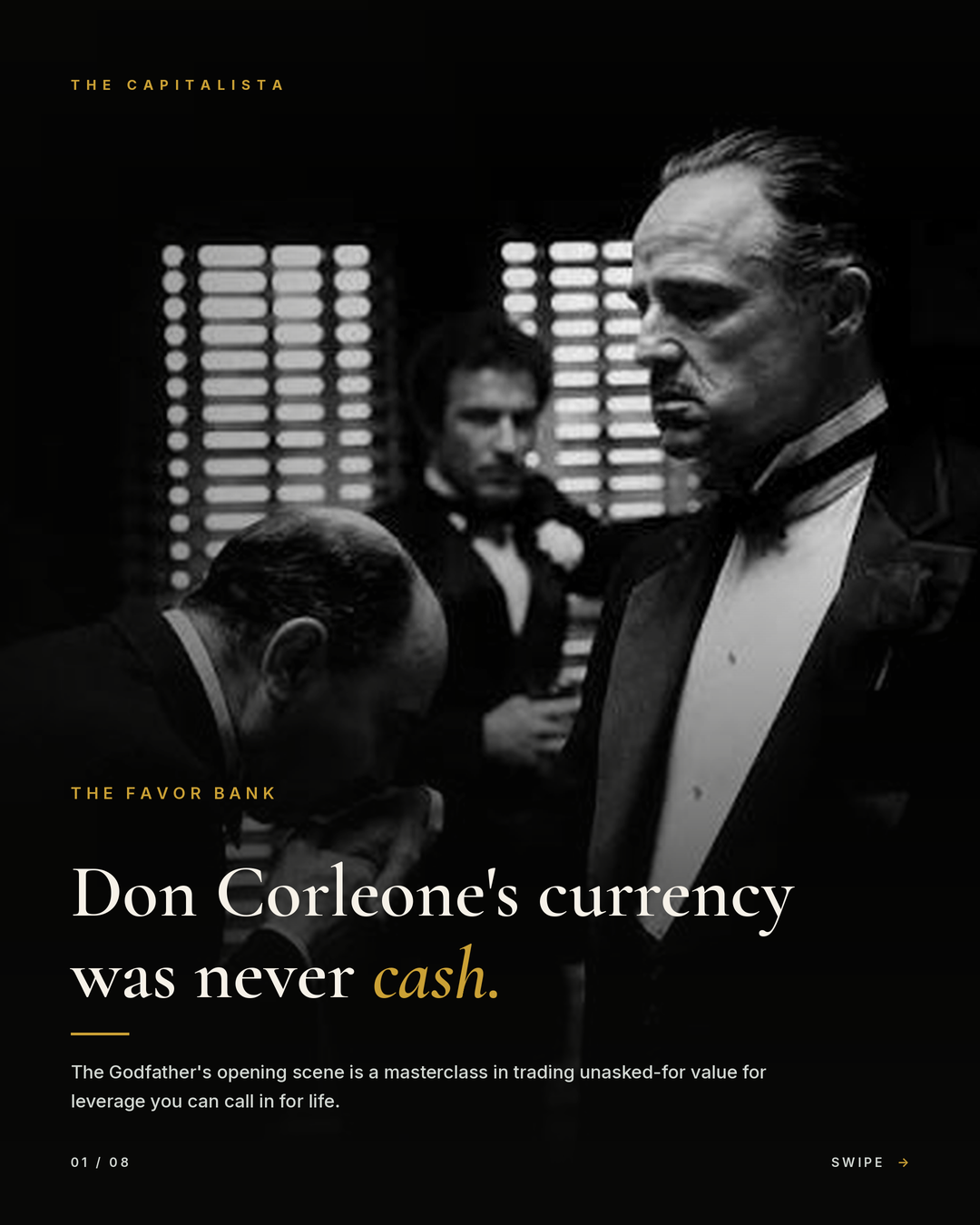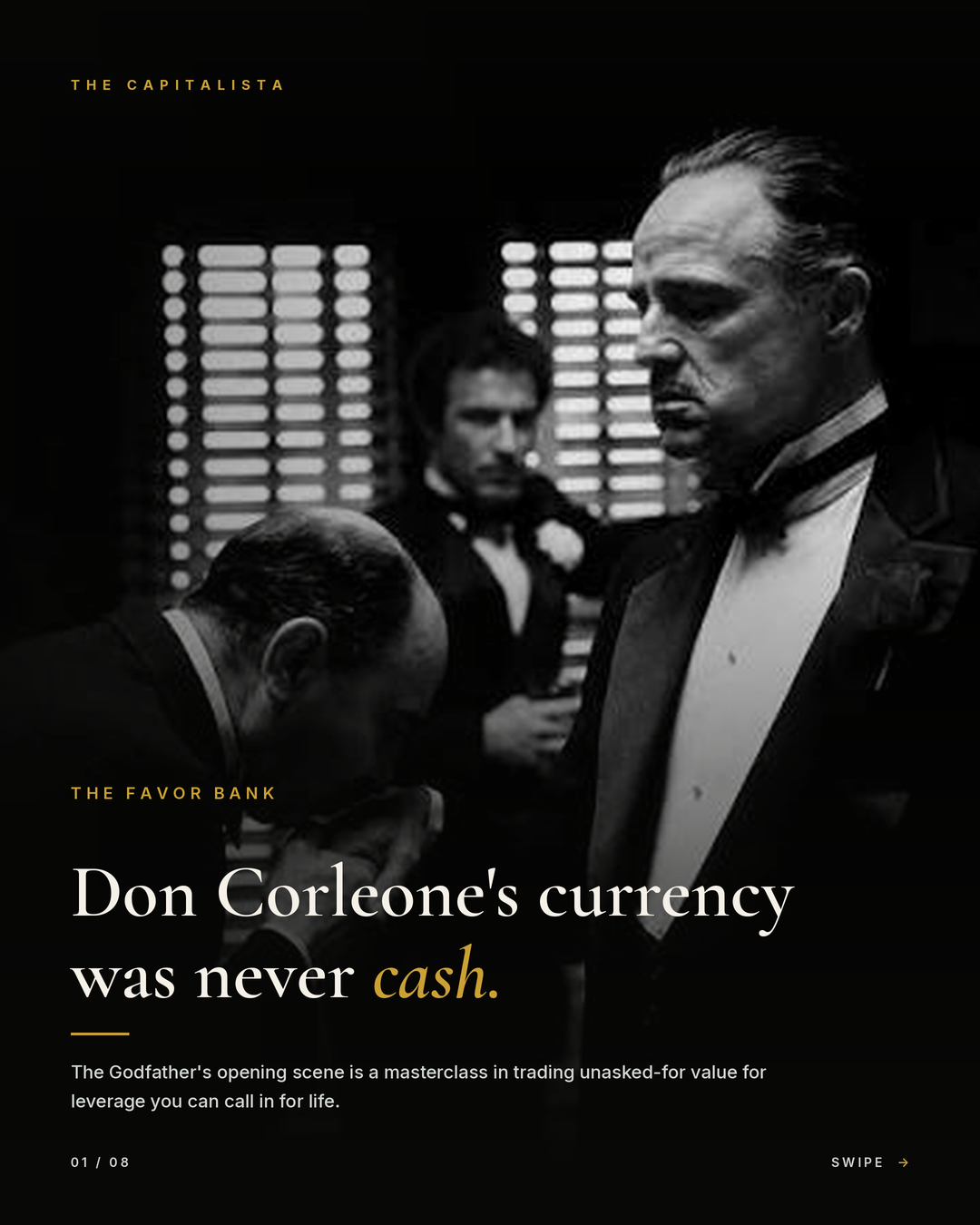
Don Corleone never sold a favor. He banked them and built a moat no rival could buy.
In the opening scene of The Godfather, an undertaker named Bonasera comes to Don Vito Corleone with a stack of cash and a simple request: avenge the men who assaulted his daughter. He wants a transaction — money in, justice out. The Don refuses the money. What he does instead is one of the most quietly instructive scenes in business strategy ever filmed, and it has almost nothing to do with crime. It is a masterclass in relationship capital: the compounding asset that separates operators who own their market from vendors who merely rent it one invoice at a time.
Most businesses run on financial capital — cash for service, the moment it is needed. It is clean, fair, and almost completely without leverage. Relationship capital is the opposite. It is the goodwill, trust, and unspoken obligation you accumulate by delivering real value before anyone asks and before anyone pays. Don Corleone understood that a favor freely given is worth far more than a fee collected. This article breaks down why that is true, what the psychology actually says, and exactly how to build your own favor bank — without any of the menace.
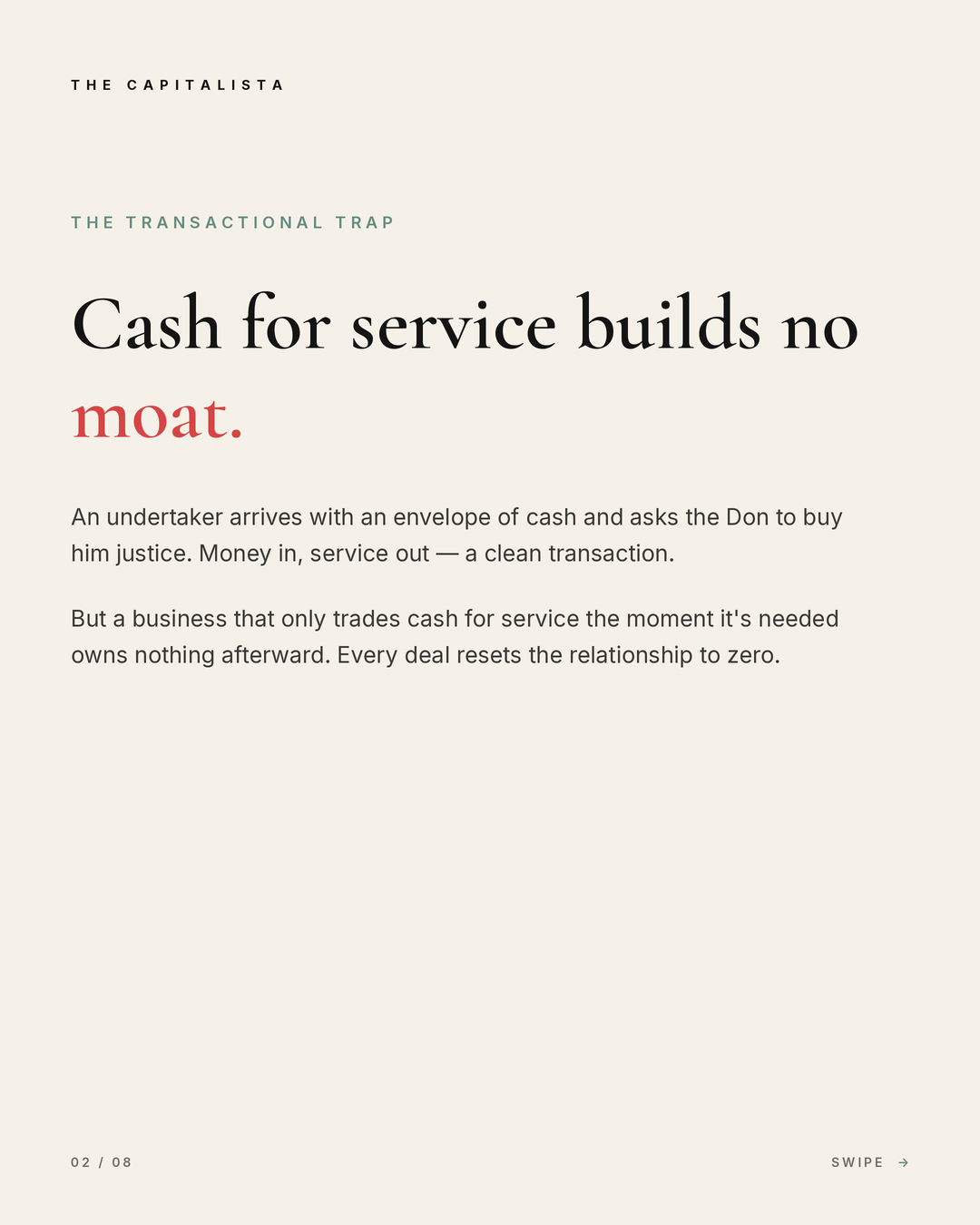
The Transactional Trap: Why Cash-for-Service Builds No Moat
A purely transactional business is the most fragile kind there is. You deliver, you invoice, the client pays, and the relationship resets to zero. Nothing accrues. The next project starts from a cold quote, competing on price against anyone willing to name a lower number. In the language of strategy, you have no switching costs and no moat — the customer owes you nothing the instant the wire clears.
Bonasera makes exactly this mistake. He treats the Don as a vendor: here is my money, perform the service. He has no relationship to draw on because he never built one — he only appeared when he was desperate. The Don even names the error to his face:
“You never wanted my friendship. And you were afraid to be in my debt.”
Translated into plain business English: you wanted a transaction, so a transaction is all you will ever get. The trap is seductive because transactions feel efficient — no messy obligations, no long game, just deliverables and payment. But efficiency and durability are different things. A transaction optimizes the deal in front of you. Relationship capital optimizes every deal that could ever come after it. Companies that only sell cash-for-service are, in accounting terms, running their single most valuable asset account at a permanent balance of zero.
The Favor Bank: What Don Corleone Understood About Leverage
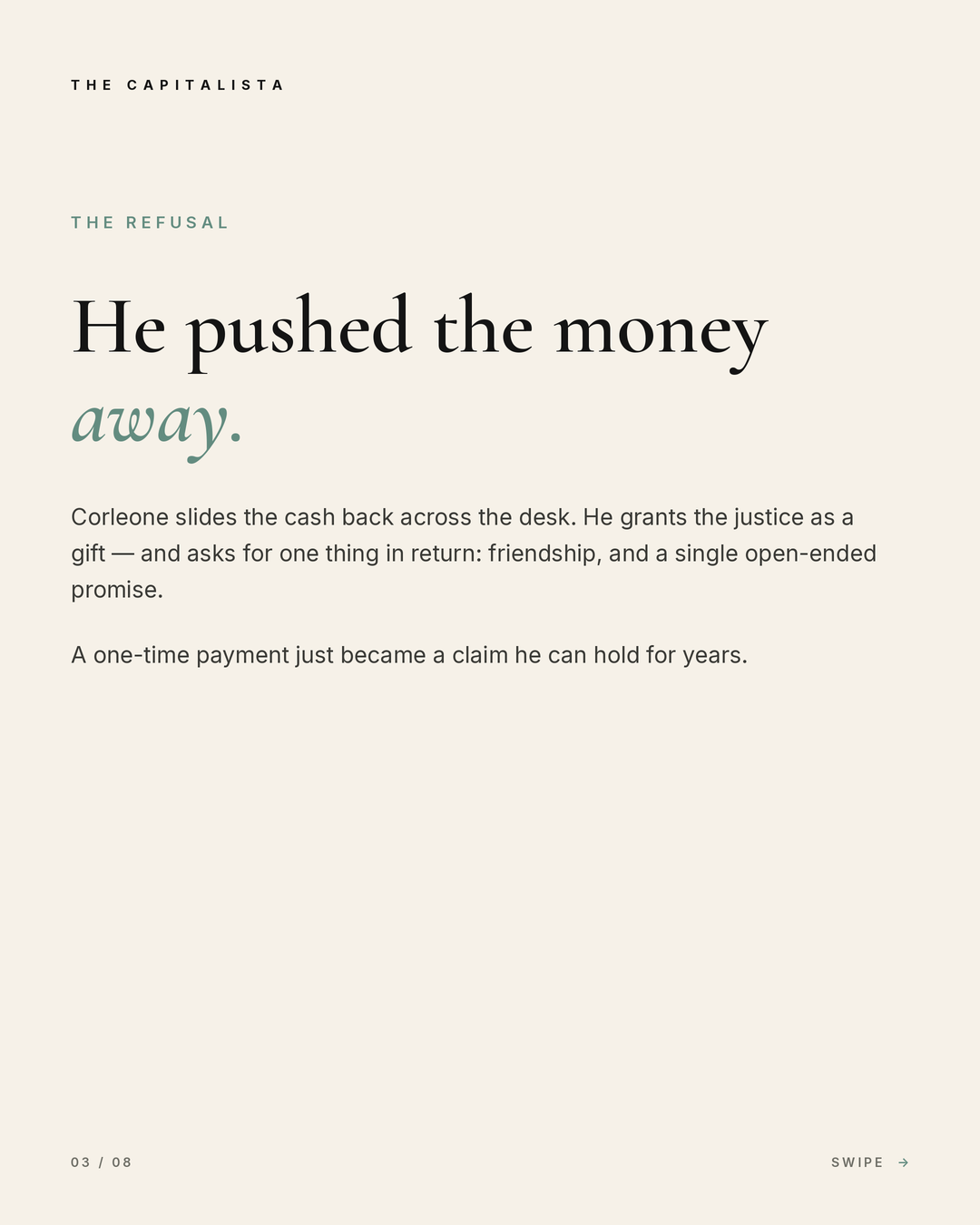
The Don does something that looks, on the surface, like generosity and is in fact the shrewdest possible investment. He pushes the cash back across the desk and grants the justice as a gift. Then he makes a single request in return — not money, but a standing claim.
The Refusal
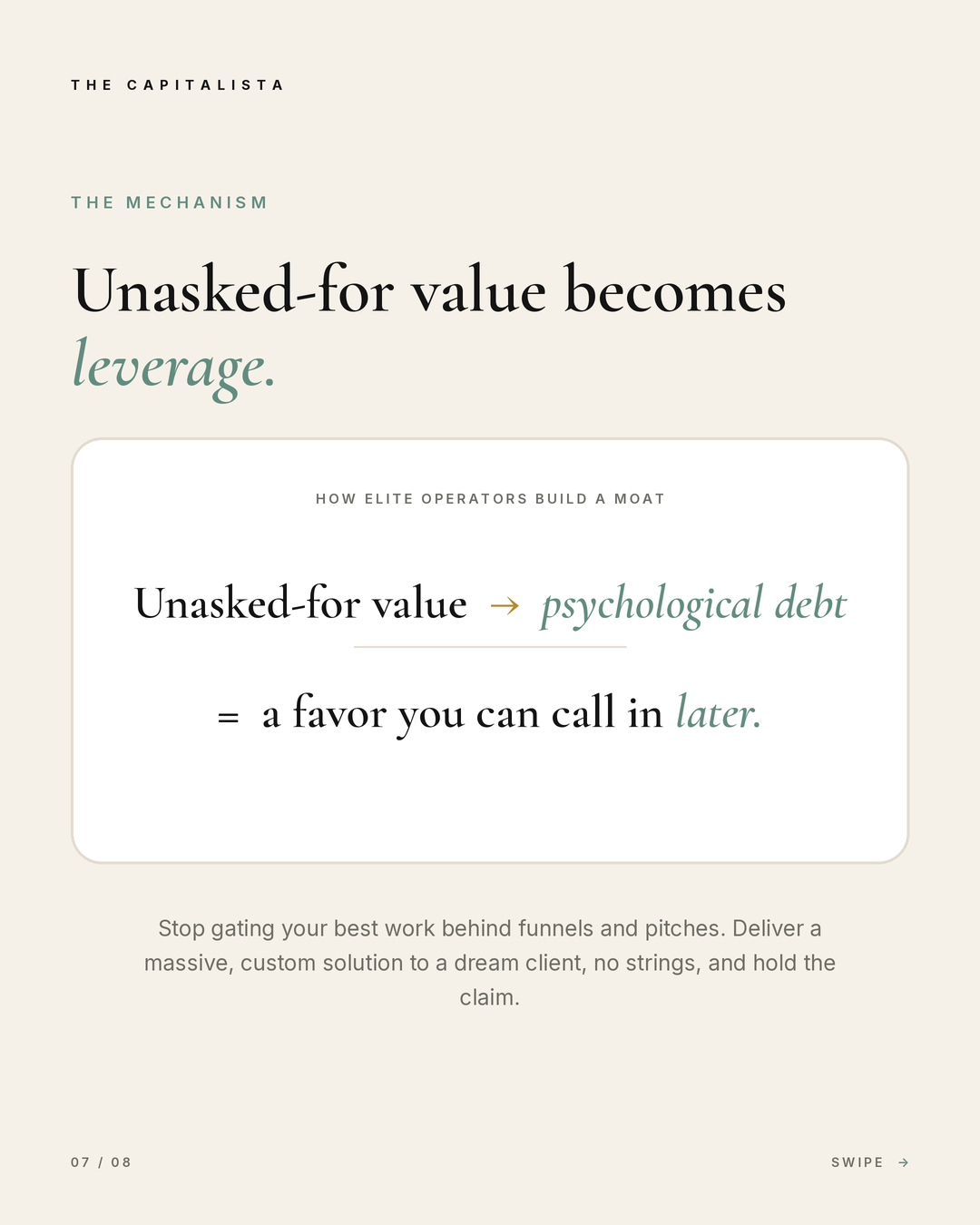
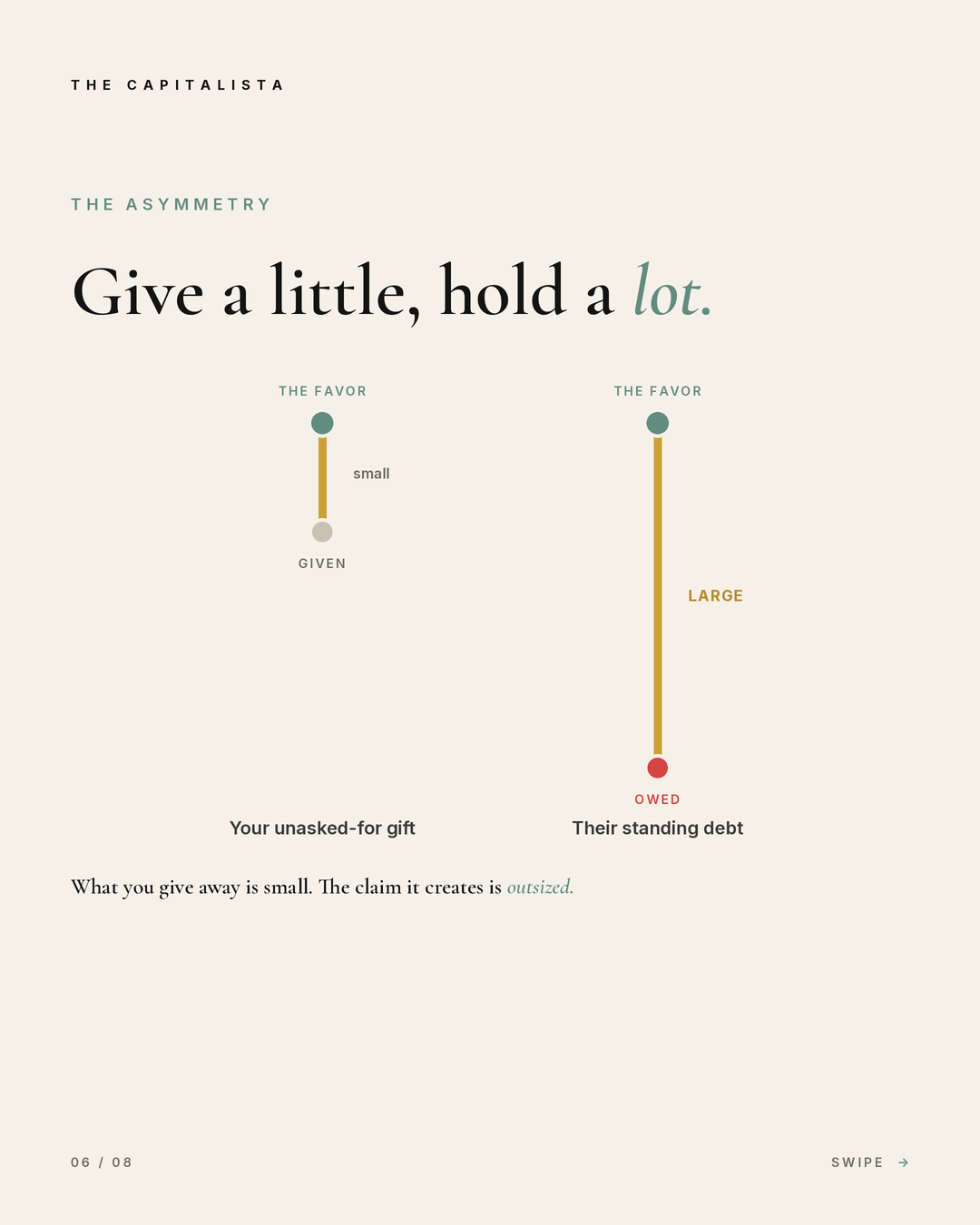
By refusing payment, Corleone changes the very nature of the exchange. A paid favor is closed the instant it is paid; both parties are square and the ledger is clear. An unpaid favor stays open. It sits on Bonasera’s conscience as a debt — not a legal debt, a psychological one — and psychological debt does not expire, does not get invoiced, and cannot be discharged with a check. The Don has traded a one-time fee for an asset that appreciates while he holds it.
The Deferred Claim
Then comes the most quoted line in the film:
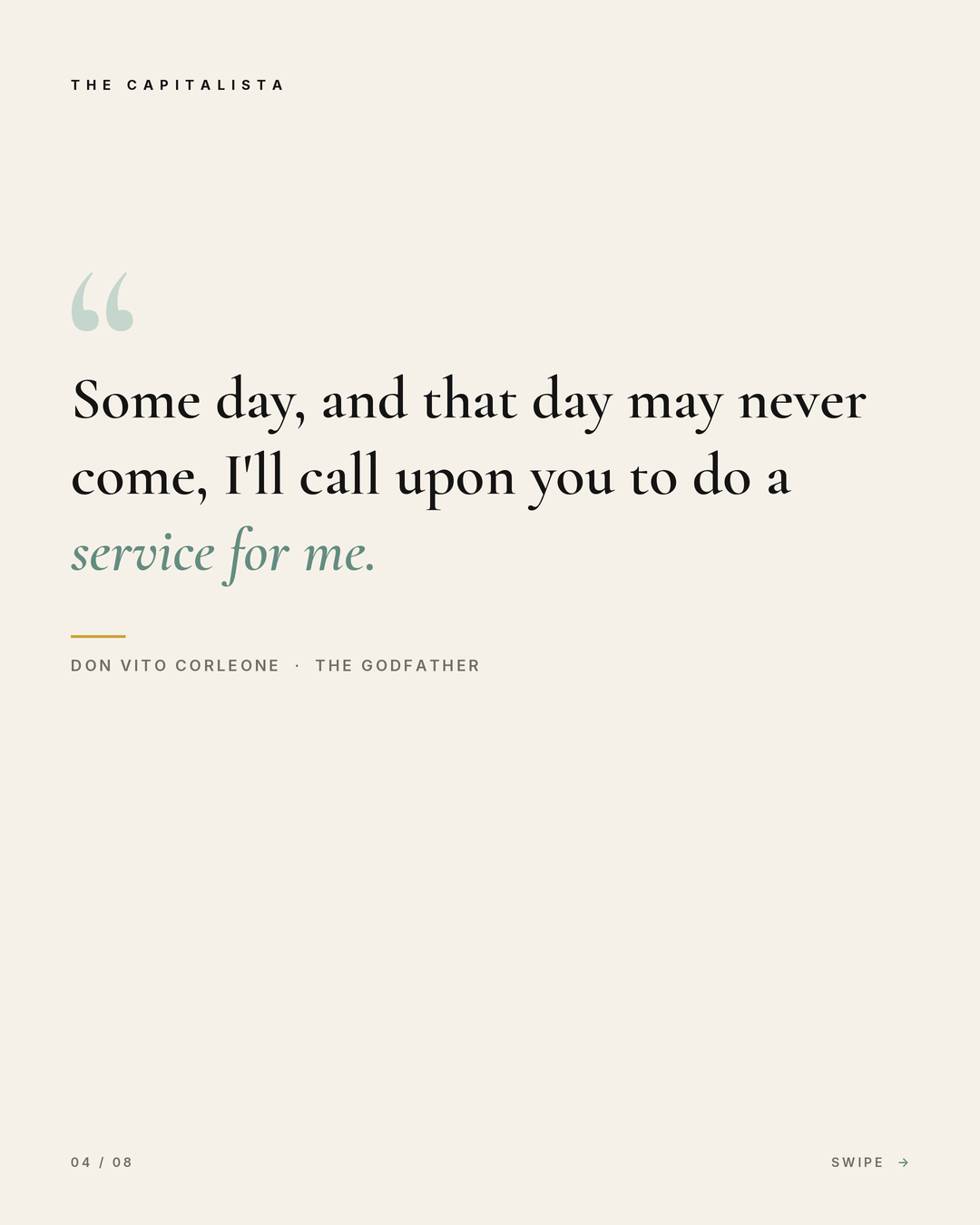
“Some day, and that day may never come, I’ll call upon you to do a service for me.”
Notice the terms. No amount is specified. No date. No scope. The Don has created the most valuable instrument on any balance sheet — an option. He can exercise it whenever he chooses, for whatever he needs, and until then it costs him nothing to hold. That is relationship capital in its purest form: value stored now, redeemable later, entirely on your terms.
The Reckoning
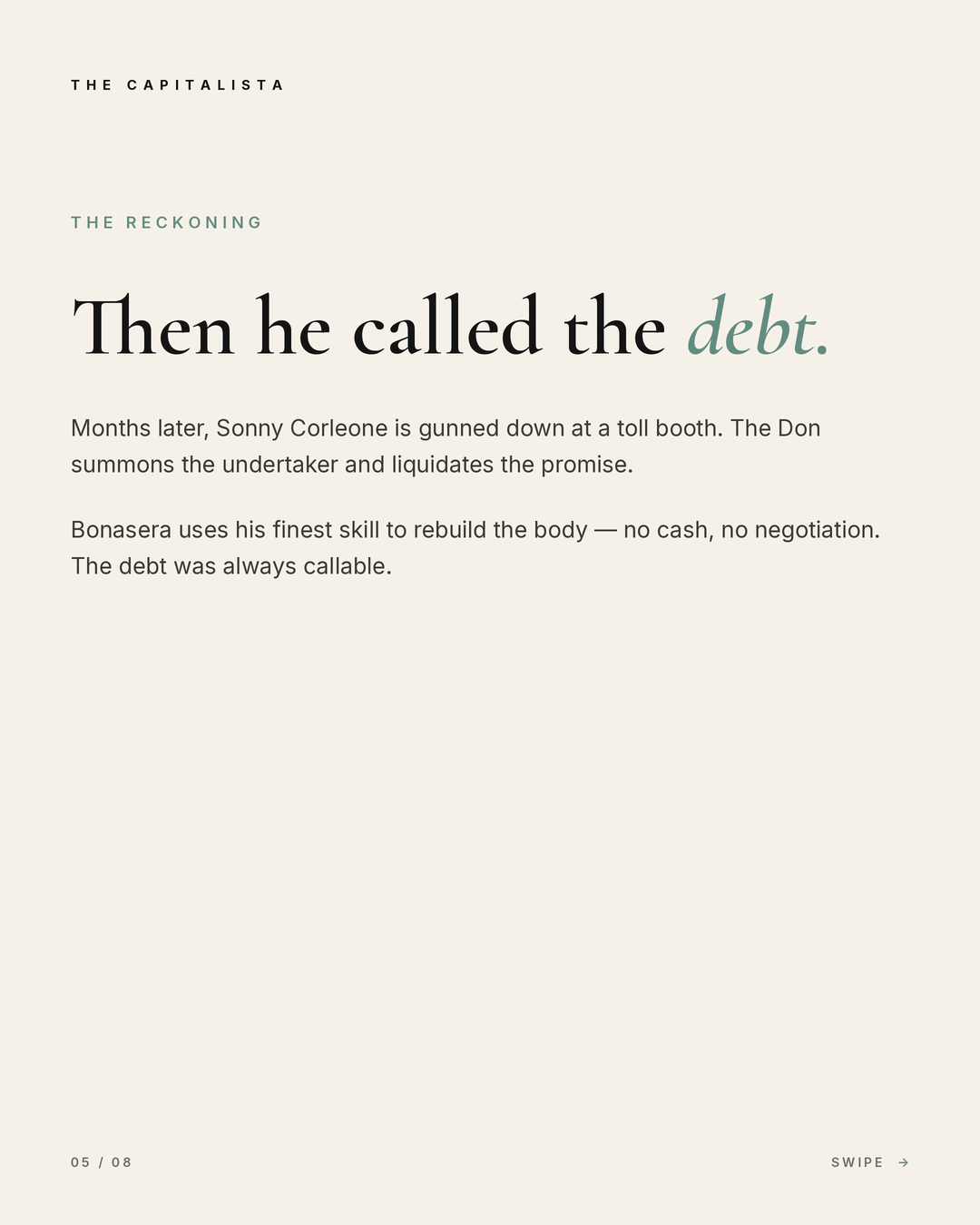
Months later, the Don’s son Sonny is murdered. Corleone summons Bonasera and calls the debt due, asking him to use his skill as an undertaker to repair the body so a grieving mother will not have to see what was done to her boy. There is no negotiation and no fee. The favor, banked in the first five minutes of the film, is liquidated at the precise moment it matters most. That is the entire mechanism: give value before it is asked, and you can draw on it exactly when you need it and could never buy it.
The Science Behind the Scene: Reciprocity and Relationship Capital
This is not merely cinematic mythology; it is well-documented human psychology. Robert Cialdini, in his landmark work on influence, identified reciprocity as one of the most powerful drivers of human behavior: when someone gives us something of value, we feel a deep, almost involuntary need to give back. The obligation is real, it shows up across virtually every culture, and it is disproportionately large — people routinely repay favors with far more than they originally received.
Organizational psychologist Adam Grant extended the idea in his book Give and Take. He divides the professional world into takers (who angle to get more than they give), matchers (who keep a careful one-for-one ledger), and givers (who contribute to others without keeping score). His counterintuitive finding is that over a long enough horizon, it is the givers who rise to the top. Generosity, not extraction, is the winning long-game strategy — precisely because givers accumulate the relationship capital that takers and matchers never do.
But Grant attaches a warning that is easy to miss and expensive to ignore: reciprocity curdles the instant it feels manipulative. If people sense you are giving only to manufacture obligation — that the “gift” is really a trap with a string attached — the goodwill inverts into resentment. This is the crucial gap between the metaphor and the method. Don Corleone is a useful illustration, not a role model. The durable version of his strategy is genuine generosity that happens to create goodwill, not calculated generosity engineered to extract it.
Relationship Capital vs. Financial Capital: The Balance Sheet You Aren’t Tracking
Every business tracks financial capital obsessively — revenue, margin, cash on hand. Almost none track relationship capital, even though it often decides which companies survive a downturn and which introductions, endorsements, and second chances you can reach for when you need them.
Think of it as a second balance sheet. Every time you deliver unexpected value, share a hard-won insight for free, make a warm introduction, or solve a problem that was not yours to solve, you make a deposit. Every time you ask for a favor, cash in a connection, or lean on someone’s goodwill, you make a withdrawal. Most people are quietly overdrawn: they withdraw — asking for referrals, intros, discounts, endorsements — far more often than they deposit, then wonder why the network feels thin the moment they actually need it.
The operators with real leverage run the account in permanent surplus. They have banked so much goodwill across so many high-value people that when they finally need something — a critical introduction, a tier-one endorsement, a supplier who moves them to the front of the line — they do not have to pitch for it. They simply make a withdrawal from an account they spent years funding. That is the moat cash-for-service can never build.
How to Build Relationship Capital: The Give-Value-First Playbook
Understanding the principle is easy. The discipline is in the execution. Here is how to build a favor bank deliberately rather than by accident.
1. Identify your highest-value targets
You cannot overdeliver to everyone; generosity at scale becomes noise. Instead, name the specific people whose goodwill would change your trajectory — the dream clients, the enterprise leaders, the connectors and category kings in your niche. Relationship capital is most valuable when it is concentrated in a short list of people with genuine reach.
2. Deliver massive, unasked-for value
The deposit has to be real. A templated newsletter is not a gift; anyone can get it. A bespoke, obviously effortful solution to a problem that specific person actually has — a custom teardown, a piece of original research, an introduction they could not make themselves — is. The value should be large enough that the recipient’s first reaction is, “Why would they do all this for me?”
3. Make it cost you something
Gifts signal exactly as much as they cost the giver. Free advice that took five minutes registers as five minutes of care. Work that visibly took real time, thought, and expertise registers as significant — and creates proportionally more goodwill. The effort is the message, so let the effort show.
4. Attach no strings and keep no visible ledger
This is where most people fail. The moment you give with an obvious ask stapled to it — “I made you this; now will you…” — you convert a gift into an invoice and destroy the reciprocity. Give cleanly. No pitch, no call-to-action, no “just following up.” The obligation forms on its own, precisely because you did not demand it. Trust the mechanism.
5. Let it compound, then withdraw with grace
Relationship capital compounds. One generous act becomes a reputation; a reputation attracts opportunities you never engineered. Let the deposits sit and accrue. And when the day comes that you genuinely need something, ask directly, specifically, and without over-apologizing. People who have received real value from you will want to reciprocate — you are simply giving them the chance to settle a debt they have quietly been waiting to repay.
The Ethical Line: Generosity, Not Manipulation
It would be easy to read all of this as a formula for manufacturing obligation — and that reading will eventually cost you everything you built. Grant’s research is unambiguous: strategic giving that people can smell as strategic backfires hard. The distinguishing variable is intent, and humans are remarkably good at detecting it.
The healthy version is simple: give value you would be glad you gave even if nothing ever came back. Help because you can, to people you respect, in ways that genuinely serve them. The goodwill that accrues is a byproduct, not the point — and, paradoxically, that is exactly why it works. Don Corleone’s world runs on coercion; yours does not have to, and it is far more durable for it. The undertaker’s debt was extracted under implied threat. Your favor bank should be funded by generosity that needs no threat to be repaid.
Five Mistakes That Bankrupt Your Favor Bank
- Only showing up when you need something. Like Bonasera, you cannot open an account and make a withdrawal on the same day. Deposits come first — and they land hardest when you visibly need nothing in return.
- Giving generic value. Mass-produced “gifts” create no obligation because they cost you nothing and signal nothing. Bespoke beats broadcast every single time.
- Attaching a pitch. The fastest way to void goodwill is to staple an ask to your gift. Give first; let the relationship, not the invoice, carry the return.
- Keeping an obvious scoreboard. Reminding people what you have done for them (“after everything I…”) collects the debt at a steep discount and poisons the well for good.
- Under-withdrawing. The opposite failure: banking enormous goodwill and never once asking. Relationship capital you never draw on is a savings account you die without spending. When the moment is right, make the withdrawal.
Frequently Asked Questions
What is relationship capital?
Relationship capital is the accumulated trust, goodwill, and reciprocal obligation you build with other people by delivering value over time. Like financial capital, it can be deposited, grown, and — when needed — withdrawn in the form of introductions, endorsements, referrals, and favors that money alone cannot buy.
What does “give value first” mean in business?
Giving value first means leading with generosity — delivering something genuinely useful before asking for anything in return. It is the operating principle behind content marketing, free tools, and unsolicited help, and it works because of the reciprocity principle: people who receive real value feel a natural pull to reciprocate.
Is using the reciprocity principle manipulative?
It can be, and when it is, it backfires. Research by Adam Grant shows that giving people perceive as a calculated ploy generates resentment rather than goodwill. The ethical — and more effective — approach is to give value you would be happy to give regardless of the return; the obligation it creates is a byproduct, not the objective.
How do you measure relationship capital?
There is no line item on a P&L, but a simple test works well: when you need a critical introduction, endorsement, or favor, how many high-value people would gladly help without being pitched? A long list means a healthy account; a short one means you have been withdrawing faster than you deposit.
How is this different from networking?
Traditional networking is often transactional and withdrawal-first — collecting contacts in order to extract value later. Building relationship capital is deposit-first: you lead with substantial, specific generosity and let the returns compound. One feels like taking; the other feels like giving — and that difference is exactly why the second one works.
The Bottom Line
Don Corleone’s genius was never the violence; it was his understanding that leverage is built long before it is ever used. He refused a transaction because a transaction ends, and he wanted something that would last: a claim he could hold until the day it mattered most. You can build the very same asset without a trace of the menace — by identifying the people who matter most in your market and delivering them real, unasked-for value, no strings attached.
Stop gating your best work behind funnels and high-ticket calls. Find one high-value player in your niche this week and send them a bespoke piece of high-leverage work — free, with no pitch attached. Do it again next week, and the week after. You are not giving your value away. You are banking it — and one day, when you need it, you will be very glad the account is full.
Ready to find the hidden leverage in your own business? Book a Business Health Check at thecapitalista.com.