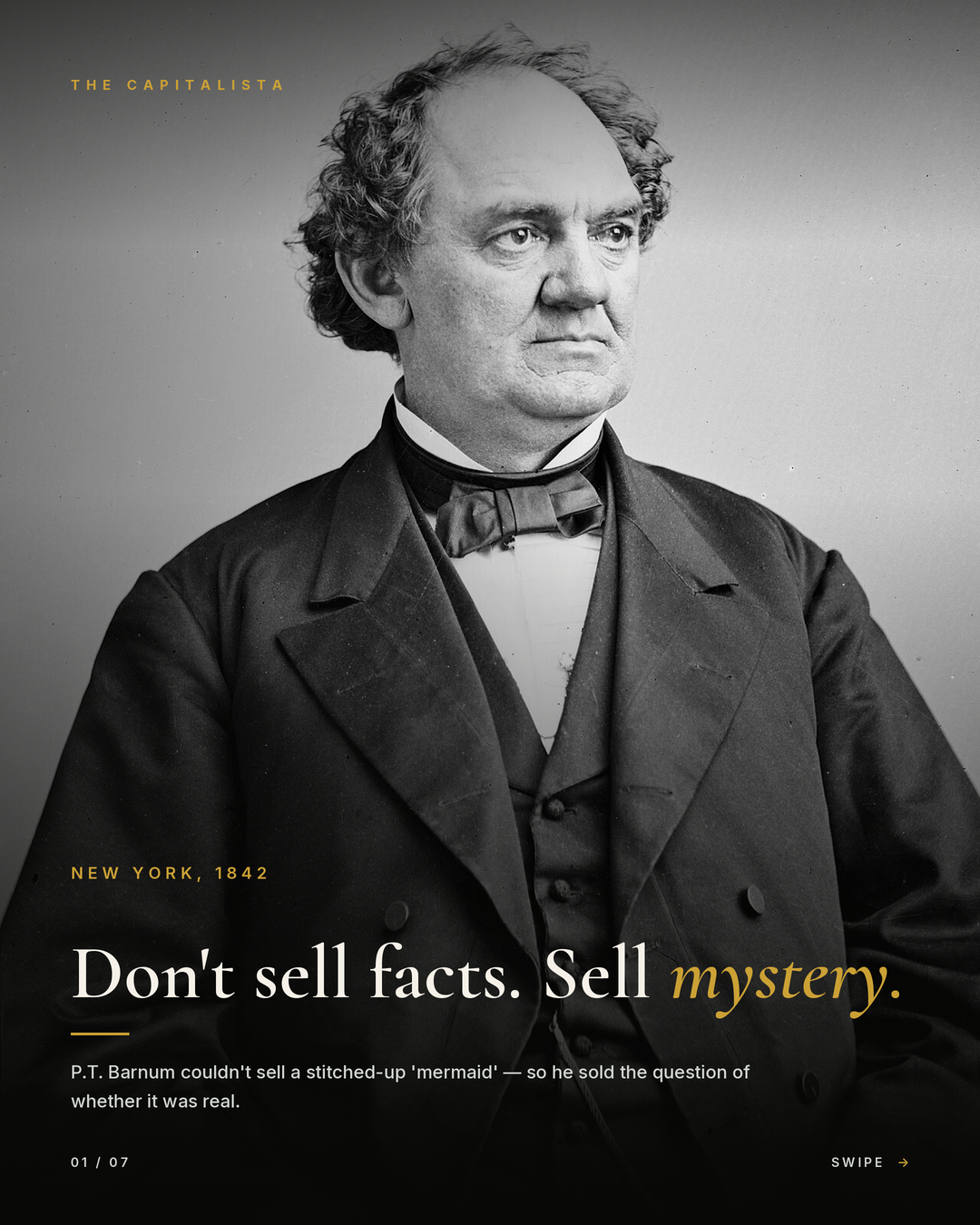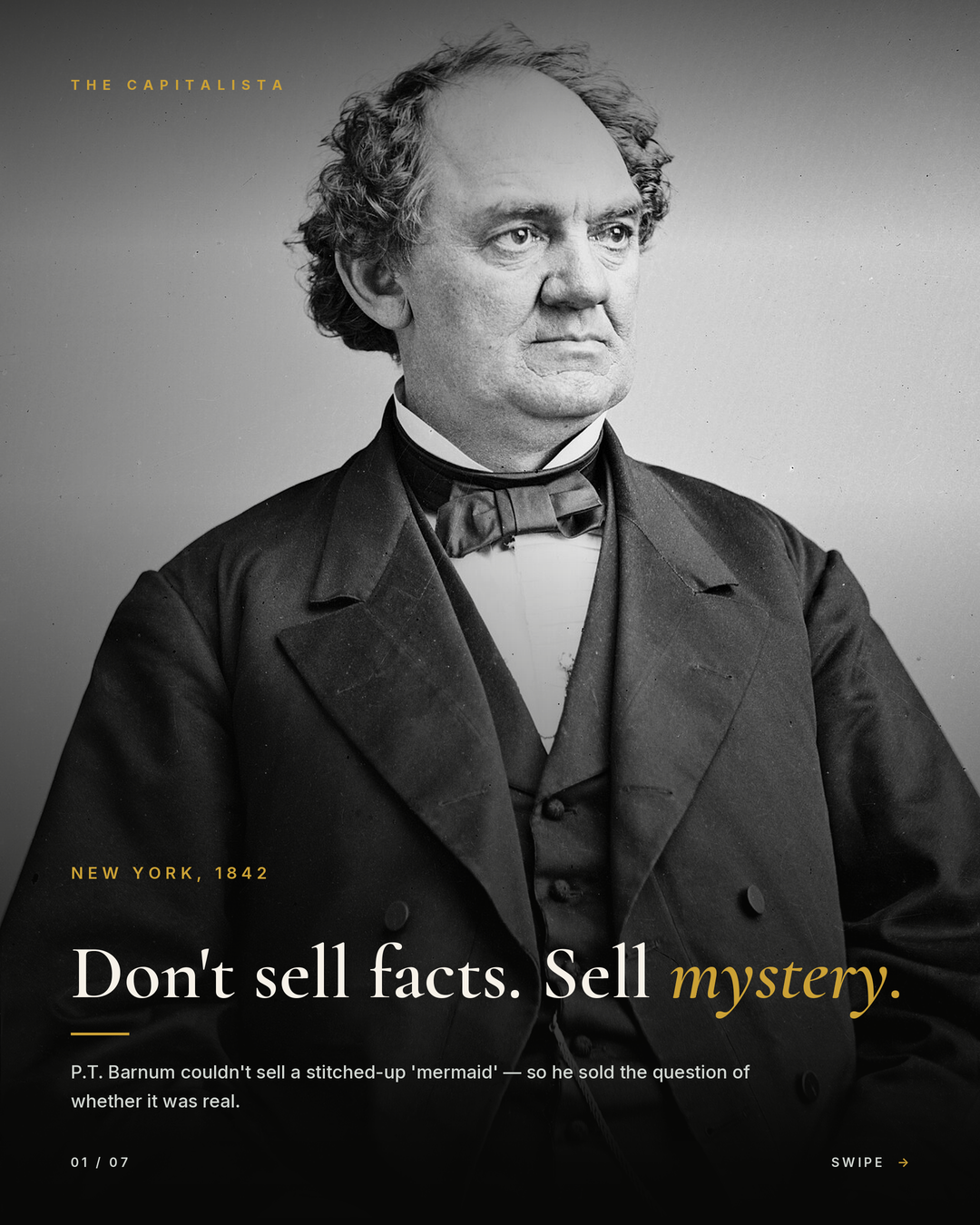
In the summer of 1842, a struggling showman named P.T. Barnum got his hands on one of the ugliest objects in the history of entertainment ...
the desiccated torso of a juvenile monkey sewn onto the tail of a fish. He called it the Feejee Mermaid. And instead of putting it in a case and telling people what it was, he did something far cleverer. He sold them a question.
The result was one of the most profitable marketing campaigns of the 19th century, and a masterclass in a principle that still moves money today: if you give the market all the answers, you destroy their reason to engage. Barnum didn't sell facts. He sold a mystery.
This post breaks down what the Feejee Mermaid was, how Barnum engineered the frenzy around it, and how to apply the curiosity-gap principle to your own headlines and campaigns, without becoming a fraud.
What Was the Feejee Mermaid?
The Feejee Mermaid (sometimes spelled Fiji or Fejee) was a fake. Physically, it was the head and torso of a young monkey stitched to the back half of a fish and mummified, then presented as the preserved body of a real half-mammal, half-fish creature.
Barnum acquired the object and, rather than simply displaying it, built an elaborate publicity machine around it. A man calling himself "Dr. J. Griffin," supposedly a member of the "British Lyceum of Natural History," arrived in New York with the specimen. Griffin was a fraud twice over: there was no British Lyceum of Natural History, and "Griffin" was really Levi Lyman, Barnum's accomplice.
When the mermaid was finally exhibited at Barnum's American Museum, ticket receipts promptly tripled. People did not pay to see a beautiful mermaid. They paid to settle an argument.
The Real Trick: He Sold the Question, Not the Object
Here is the part most people miss. The mermaid itself was hideous and unconvincing. If Barnum had simply advertised "come see a mermaid," the public would have looked, shrugged, and moved on. The object could not carry the campaign. The question could.
So Barnum manufactured a debate before anyone ever saw the thing. Throughout the summer, New York newspaper editors received a steady drip of letters from "Southern correspondents," mailed from Montgomery, Charleston, and Washington, all describing a mysterious Dr. Griffin and his astonishing mermaid, and urging the New York press to see it before he sailed for England. Barnum wrote and planted those letters himself.
By the time the mermaid went on display, the city was already arguing about whether mermaids could possibly be real. Barnum flooded New York with material posing the question at the heart of it all: is it real? He didn't tell people the answer. He made them buy a ticket to find out.
The Curiosity Gap: Why "Is It Real?" Beat Every Feature List
There is a name for what Barnum exploited: the curiosity gap. It's the psychological tension a person feels between what they know and what they want to know. A provoked mind treats that gap as an itch, and it will spend time, attention, and money to scratch it.
An answer closes the gap and ends the engagement. A question holds it open. That is why "is it real?" outperformed any honest description of a monkey sewn to a fish. A description gives the brain closure and a reason to stop. A question denies closure and creates a reason to keep going.
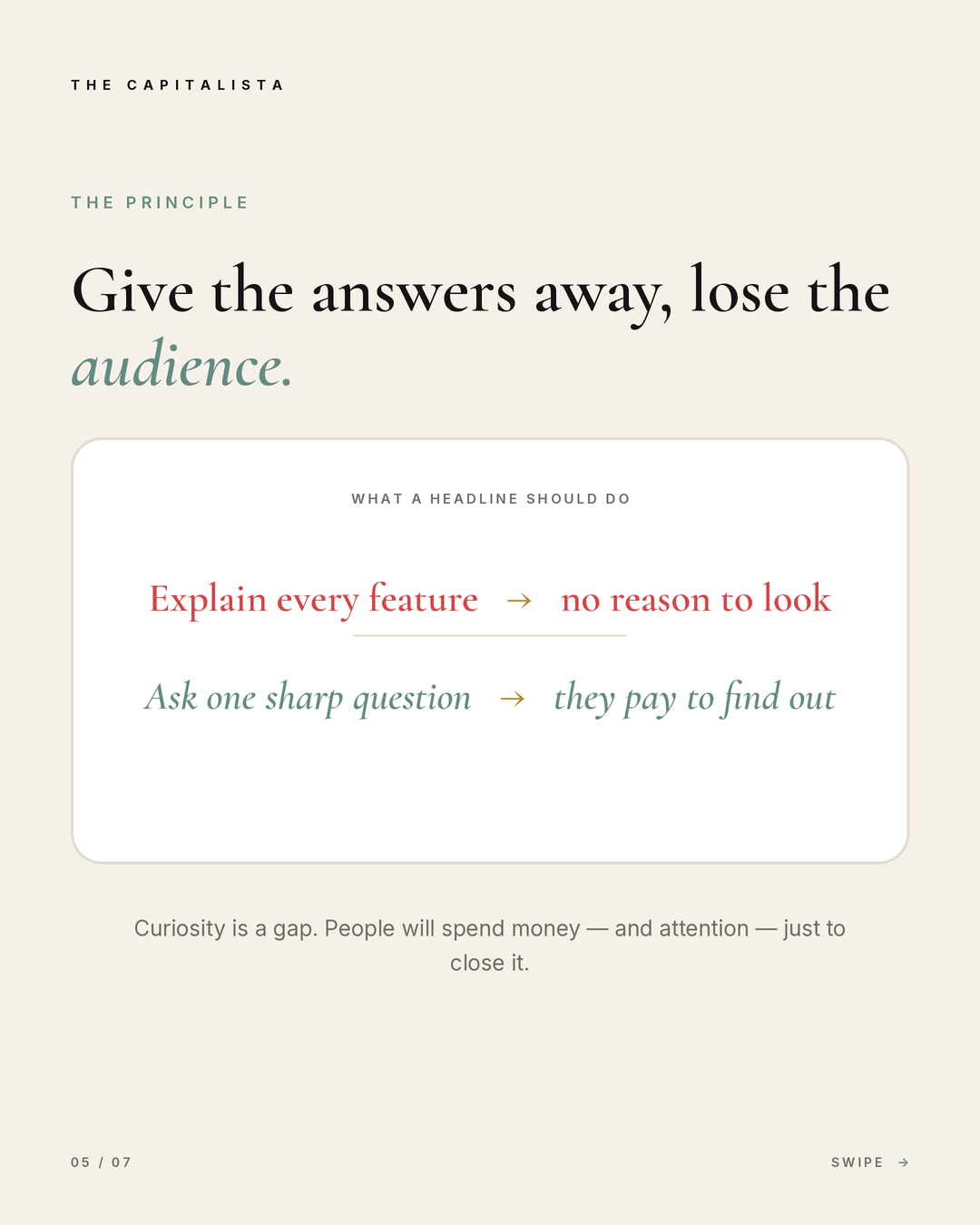
Most marketing does the opposite of Barnum. It leads with the answer. It explains every feature, benefit, and specification up front, in the name of being clear and helpful, and in doing so it quietly removes the one thing that makes a person lean in: the unanswered question.
The Marketing Lesson: Stop Explaining, Start Provoking
If your headlines read like a specification sheet, you are handing the market closure for free. "Full-service accounting for small businesses" is accurate, complete, and completely inert. There is nothing left to wonder about, so there is no reason to click.
The Barnum move is to trade the descriptive headline for a provocative question that opens a gap your prospect suddenly needs closed. Not clickbait that betrays the reader, but a genuine question that touches a real tension they already feel.
Compare:
- Descriptive: "We help founders manage cash flow."
- Provocative: "Why do so many profitable businesses still run out of cash?"
The first tells you what the company does. The second makes you want to know the answer, especially if you are a founder who has felt that exact fear. The gap does the selling.
How to Write a Headline That Opens a Curiosity Gap
You don't need a fake mermaid. You need one sharp, honest question. Here's how to build it.
1. Find the tension your prospect already feels
Curiosity has to attach to something. Identify the fear, frustration, or contradiction your buyer lives with, then point a question straight at it.
2. Remove the answer from the headline
Take your current descriptive headline and delete the part that explains the outcome. Replace it with the question that outcome answers. Make them click, read, or ask to get the rest.
3. Promise a payoff, not a trick
The gap must be worth closing. A good curiosity headline implies there's a real, valuable answer on the other side, and then it delivers one. That is the difference between intrigue and clickbait.
4. Keep it specific
Vague mystery is just noise. "Are you making this one pricing mistake?" beats "You won't believe this." Specificity makes the gap feel personal and real.
5. Test the question against a shrug
Read your headline and ask: could someone glance at this and feel nothing? If yes, it isn't provocative enough. A working curiosity gap produces a small, involuntary "wait, what?"
The Ethics Line: Provoke Honestly
There's an obvious problem with taking marketing advice from a man who sold a monkey-fish as a mermaid: Barnum's mermaid was a lie. The curiosity was real; the payoff was a fraud.
That's the line you don't cross. The curiosity-gap principle is powerful precisely because it can be abused, and abusing it burns trust fast. The modern market has infinite alternatives and a long memory. Use a question to earn attention, then honor it with a real answer and a product that delivers. Barnum got away with a hoax in a world without the internet. You won't. Open the gap honestly, and close it with something true.
What The Capitalista Does
Provoking attention is only half the equation. The other half is turning that attention into money, and that's where most operators leak value. A campaign can generate a stampede of interest and still fail to convert it into margin, because the offer is mispriced, the funnel is unprofitable, or nobody is tracking which curiosity actually pays.
The Capitalista is a fractional CFO service that closes that loop. We tie the attention you create to the numbers that matter. Concretely, we:
- Price your offers to convert demand into profit, so a spike in interest becomes a spike in margin, not just traffic.
- Track which campaigns actually pay, separating the curiosity that sells from the noise that only entertains.
- Model your customer economics, so you know what you can afford to spend to open the next gap.
- Turn marketing wins into financial results, so "it went viral" becomes "it was profitable."
Barnum tripled his receipts because he understood that attention is the beginning of the sale, not the end of it. We make sure the attention you earn shows up in the bank.
Frequently Asked Questions
What was the Feejee Mermaid?
The Feejee Mermaid was a 19th-century sideshow object made from the head and torso of a juvenile monkey sewn to the tail of a fish, presented by P.T. Barnum in 1842 as a genuine mermaid.
Was the Feejee Mermaid real?
No. It was a hoax, a manufactured object rather than a real creature. Barnum promoted it as authentic to draw crowds, and the "expert" who introduced it, "Dr. Griffin," was actually Barnum's accomplice Levi Lyman.
How did Barnum promote the Feejee Mermaid?
He planted anonymous letters in New York newspapers all summer to build a public debate about mermaids, then displayed the object while flooding the city with the question of whether it was real. Museum ticket receipts tripled.
What is a curiosity gap in marketing?
A curiosity gap is the tension between what someone knows and what they want to know. Marketing that opens a curiosity gap uses an unanswered question to pull people in, rather than explaining everything up front.
How do I use the curiosity gap without being clickbait?
Attach the question to a real tension your audience feels, keep it specific, and always deliver a genuine, valuable answer once they engage. Clickbait breaks that promise; effective curiosity marketing keeps it.
The Bottom Line
The Feejee Mermaid was a monkey stitched to a fish. It should have been worthless. Instead it tripled a museum's ticket sales, because Barnum understood that people don't pay for answers, they pay to close the gap between curiosity and closure.
Look at your own marketing today. Find the headline that explains everything, and replace it with the one question your prospect can't leave unanswered. Just make sure that when they come to find out, what's waiting for them is real.