
Most advice about confidence tells you to picture success. Visualize the win, see yourself closing the deal, imagine the launch going perfectly.
It's intuitive advice, and it's also backed by a strange amount of contradicting evidence: in study after study, rehearsing a positive outcome doesn't reliably reduce anxiety about failure. Sometimes it makes the fear of losing that outcome worse.
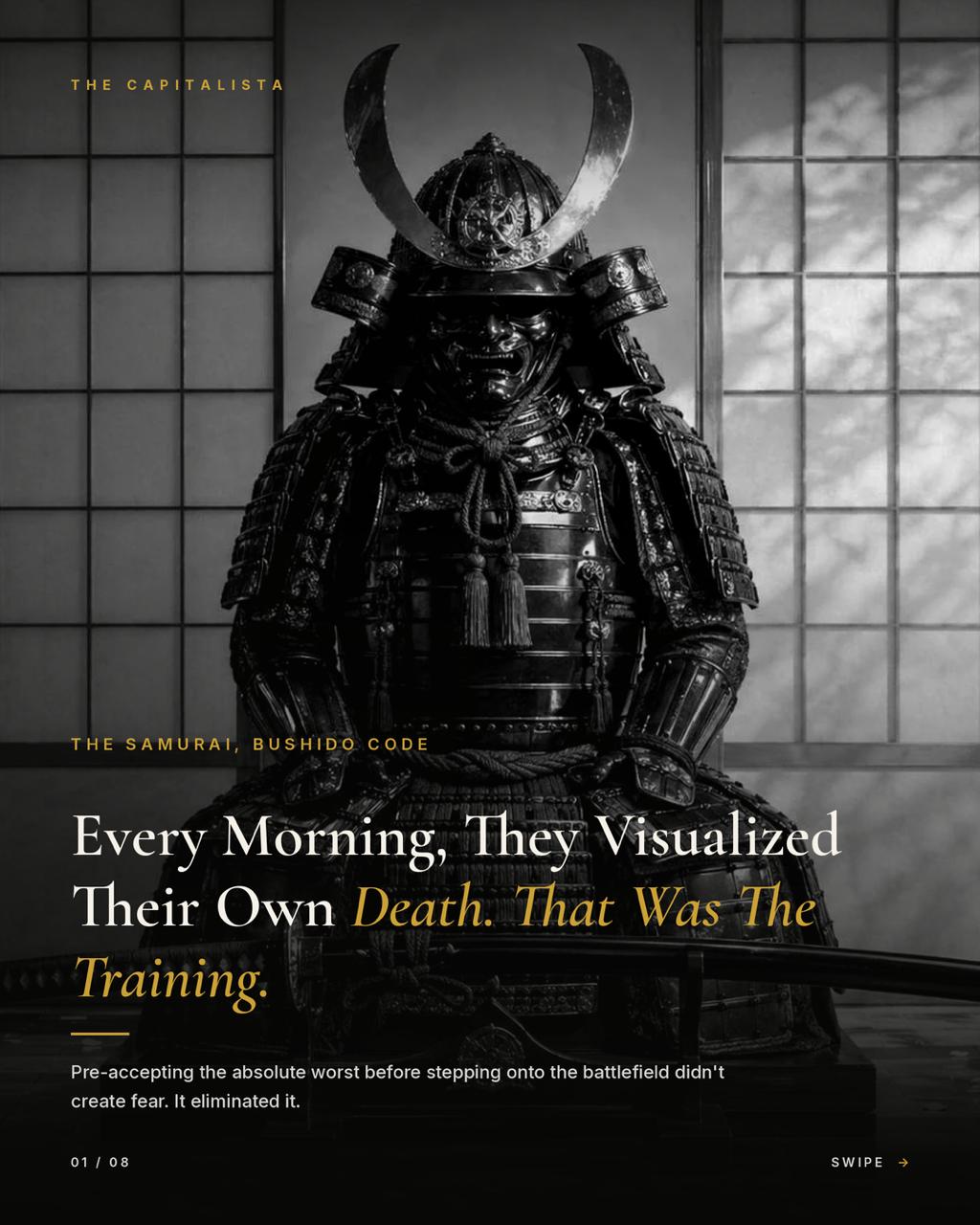
Three very different traditions, separated by centuries and continents, arrived at the opposite approach independently. Samurai warriors in feudal Japan built a daily ritual around confronting their own death before duty began. Roman Stoic philosophers practiced something they called premeditatio malorum, the premeditation of evils. And in 2007, a cognitive psychologist gave the same basic idea a name modern businesses actually use: the premortem. All three converge on the same counterintuitive insight, that mentally surviving the worst outcome in advance, not rehearsing the best one, is what actually produces steady execution under real risk.
The Hagakure and the Way of the Samurai
The Hagakure, a collection of commentary compiled in the early eighteenth century by the samurai Yamamoto Tsunetomo, opens with one of the most direct lines in martial philosophy: "The Way of the Samurai is found in death." Tsunetomo wasn't describing a death wish. He was describing a discipline, meditating daily on one's own death so thoroughly that the fear of it lost its grip on decision-making in the moment that mattered.
The logic was practical, not mystical. A warrior who has never confronted the possibility of dying in battle carries that fear into every decision, and fear under pressure produces hesitation, second-guessing, and self-preservation instincts that get in the way of clear action. A warrior who has already accepted death as a settled outcome removes that variable from the equation entirely. What's left, according to the Hagakure's own framing, is a mind free to act without the drag of an unprocessed fear sitting underneath every choice.
Premeditatio Malorum: The Stoic Version
Centuries earlier and thousands of miles away, Roman Stoic philosophers were teaching a strikingly similar exercise. Seneca, in his letters to Lucilius, repeatedly advised imagining the loss of everything one valued, wealth, position, even life itself, not as pessimism but as preparation. The Stoics called this premeditatio malorum, and its purpose was identical to the samurai's daily ritual: strip an outcome of its power to shock you by rehearsing it in the mind before it has any chance to happen in reality.
Both traditions understood something modern psychology would later formalize: anticipated threats that have already been consciously processed produce less disruptive fear than threats a person has never let themselves consider. The rehearsal isn't about expecting the worst to happen. It's about removing the specific kind of paralysis that comes from a catastrophe you haven't allowed yourself to think through.
The Premortem: A Modern Management Technique
In a 2007 Harvard Business Review article, cognitive psychologist Gary Klein introduced a business tool he called the premortem, built on a similar principle and grounded in decision-making research. Klein's method is simple: before launching a project, gather the team and ask everyone to imagine that the project has already failed completely. Then have each person write down, in as much specific detail as possible, exactly what went wrong.
Klein's research found that this exercise, sometimes called "prospective hindsight," surfaces risks that standard risk assessments miss, largely because imagining a failure as having already happened removes the social and psychological pressure of arguing that a plan might not work. It's far easier to say "the plan already failed because X" than to say "I think this plan might fail because X" in a room full of people invested in its success. The premortem doesn't just reduce fear. It produces a more honest, more specific list of what could actually go wrong, before any of it has the chance to.
1. Name your worst-case scenario specifically, not vaguely
A generic fear like "this could go badly" doesn't do the work a premortem is designed to do. Specificity is what disarms it. Instead of "the launch could fail," write the precise version: the client cancels the week before go-live, the primary vendor misses a delivery deadline, the biggest account churns and takes twenty percent of revenue with it. Vague fears stay large in the mind because they're formless. Specific ones become finite, addressable problems.
2. Write down exactly how you would survive it
This is the step both the samurai tradition and Klein's premortem share, and it's the step most people skip. It's not enough to imagine the failure. Write out, concretely, what you would actually do the day after it happened: which costs you'd cut, which clients you'd call, which reserves you'd draw on. A worst case with a written plan attached stops functioning as an open threat and starts functioning as a known, bounded cost.
3. Run the exercise before the decision, not after
The entire value of a premortem comes from doing it in advance, while there's still time to change course based on what it reveals. Running the same exercise after a launch has already gone wrong is just a postmortem, useful for learning, but useless for prevention. Build the premortem into your actual decision process: before signing a contract, before a major hire, before a product launch, not as a retrospective habit.
4. Repeat it for your currently successful systems, not just new risks
Both the Hagakure's daily ritual and the Stoic practice were routines, not one-time exercises performed only when danger felt obvious. The businesses most exposed to a bad surprise are often the ones running on a system that's worked so reliably that nobody has stress-tested it recently. Apply the premortem periodically to your best-performing revenue stream or process, not only to new and obviously risky ventures.
What The Capitalista Does
Running a premortem on your own finances requires a kind of honesty that's hard to hold simultaneously with the day-to-day optimism it takes to run a business. That's exactly the outside perspective a fractional CFO is built to provide.
- We model your specific worst case, not a vague one. A named client loss, a defined revenue drop, an exact vendor failure, run through your real numbers instead of a hypothetical.
- We write the survival plan before you need it. Cash reserves, cost cuts, and contingency financing mapped out in advance, not improvised during a crisis.
- We stress-test the systems that are currently working. Your safest-looking revenue stream is often the one that's gone longest without a real premortem.
- We keep the exercise routine, not reactive. A quarterly review cadence, not a one-time panic exercise triggered by a bad quarter.
- We turn the fear into a number. Once a worst case has a dollar figure and a plan attached to it, it stops being able to freeze a decision.
Frequently Asked Questions
Is the premortem a real, established business technique, or just a metaphor drawn from the samurai comparison?
It's real and well established. Cognitive psychologist Gary Klein introduced the premortem in a 2007 Harvard Business Review article, and it's since been adopted widely in project management and risk planning. The comparison to the Hagakure and Stoic premeditatio malorum in this article is drawn to show that three independent traditions converged on the same underlying mechanism, not to suggest the premortem is derived from samurai practice.
Doesn't constantly imagining failure just create more anxiety?
The research and historical practice both suggest the opposite, provided the exercise includes a survival plan and not just the imagined failure on its own. Imagining a vague, unprocessed catastrophe tends to increase anxiety. Imagining a specific failure and then writing out exactly how you'd respond to it tends to reduce it, because the outcome moves from an open threat to a bounded, planned-for scenario.
How is a premortem different from a standard risk assessment or SWOT analysis?
Traditional risk assessments ask a team to identify risks while the project is still framed as likely to succeed, which creates social pressure to downplay concerns. A premortem reframes the exercise entirely: the project has already failed, so identifying what went wrong isn't pessimism, it's simply describing a settled fact. Klein's research found this reframing surfaces more, and more specific, risks than standard assessments do.
How often should a business actually run this exercise?
There's no universal cadence, but treating it as a standing part of major decisions, new launches, large contracts, hiring at scale, is more valuable than running it only during a crisis. Periodically applying it to already-successful systems, not just new risks, is what both the historical practice and the modern technique emphasize.
Can an individual do this alone, or does it require a team?
Klein's original premortem was designed as a group exercise specifically because it removes social pressure among team members who might otherwise avoid voicing doubt. Used individually, for personal decisions or a smaller business, the same core exercise still works: write the specific failure, then write the specific survival plan, on your own or with a trusted advisor.
The Bottom Line
Three unrelated traditions, a warrior code, a school of Roman philosophy, and a modern psychological research finding, all reached the same conclusion from different directions: confidence built on imagined success is fragile, and confidence built on a rehearsed, planned-for worst case is not. The fear doesn't disappear because you avoided thinking about it. It disappears because you already have an answer for it.
What's the worst-case scenario for your biggest current risk, and do you actually have a written answer for how you'd survive it, or just a hope that it won't happen?