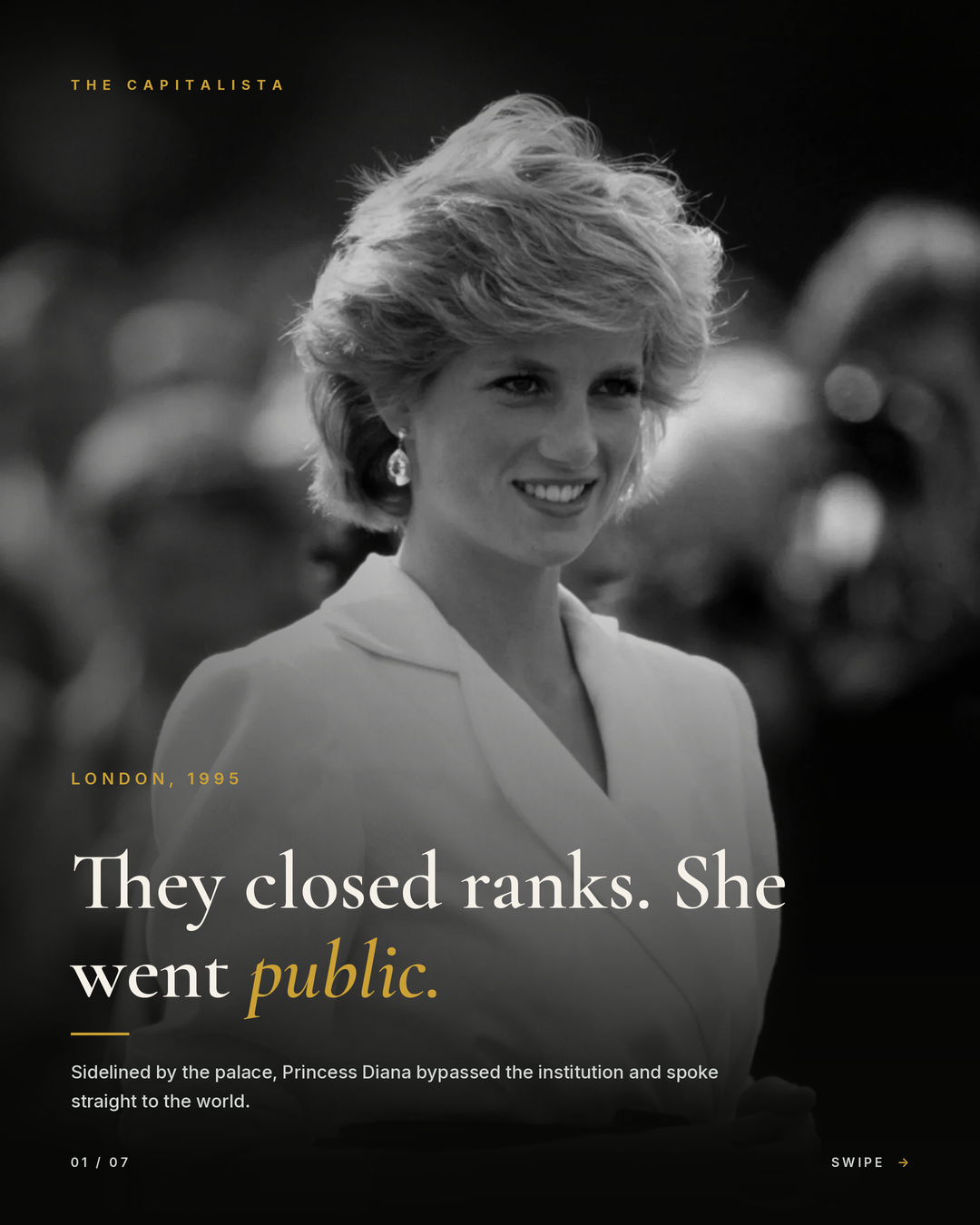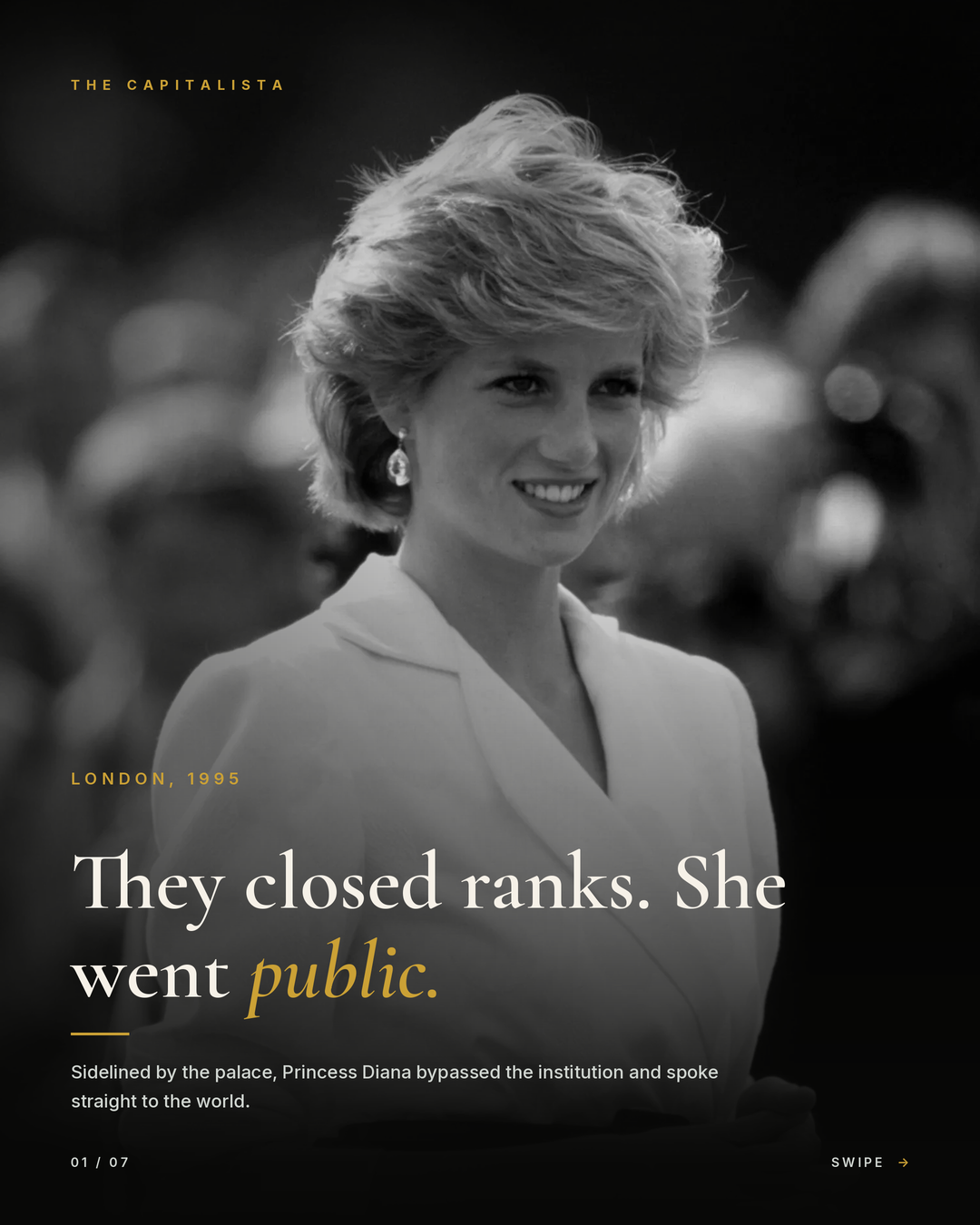
In November 1995, the most famous woman in the world sat in front of a single camera and spoke past the most powerful institution in Britain.
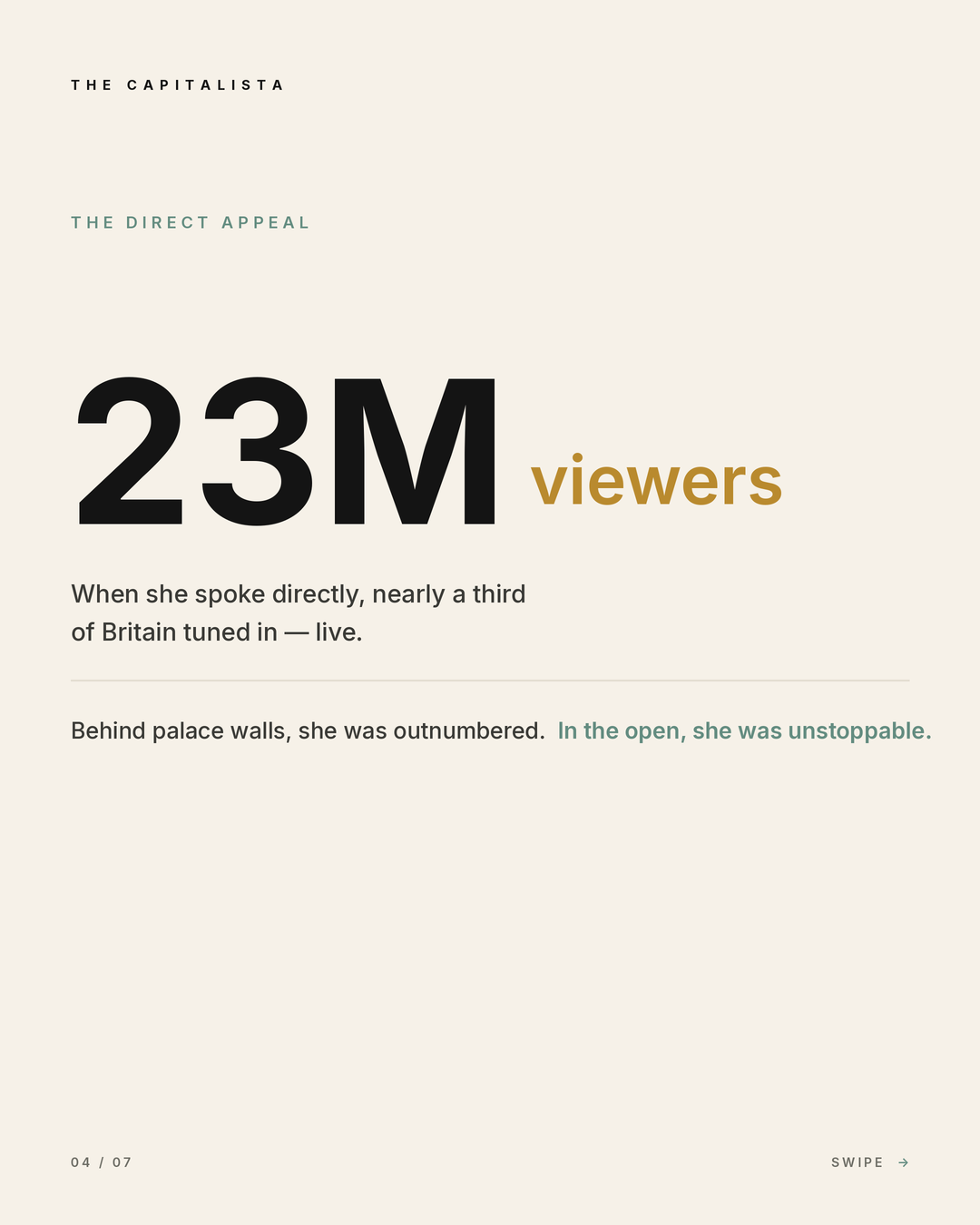
She didn't lobby courtiers. She didn't wait for permission. She talked directly to the public — and roughly 23 million people in the UK watched live.
The Princess Diana Panorama interview is remembered as a turning point in the relationship between the monarchy and the media. It's also, underneath the royal drama, a case study in a strategy any founder or operator can use: when a bigger, more powerful institution has you cornered, your best move is often to stop fighting inside their walls and go directly to the people who actually decide your fate.
This post covers what the interview was, what Diana said, the serious controversy you shouldn't ignore, and the transparency lesson — including the sharp caveat that makes it work.
What Was the Princess Diana Panorama Interview?
On 20 November 1995, the BBC current-affairs program Panorama aired an interview between journalist Martin Bashir and Diana, Princess of Wales. In it, Diana spoke with unusual candor about her marriage to Prince Charles, her mental health, and her strained position inside the royal establishment.
The reach was staggering. Around 23 million people watched in the United Kingdom alone, with a worldwide audience estimated at some 200 million across 100 countries. For a woman who felt increasingly sidelined and controlled by the palace machinery, it was an extraordinary act of leverage: she bypassed the institution entirely and appealed straight to the global public.
What Diana Said — and Why It Landed
Two lines from the interview became instantly iconic.
On her marriage and Charles's relationship with Camilla Parker Bowles, she said: "Well, there were three of us in this marriage, so it was a bit crowded."
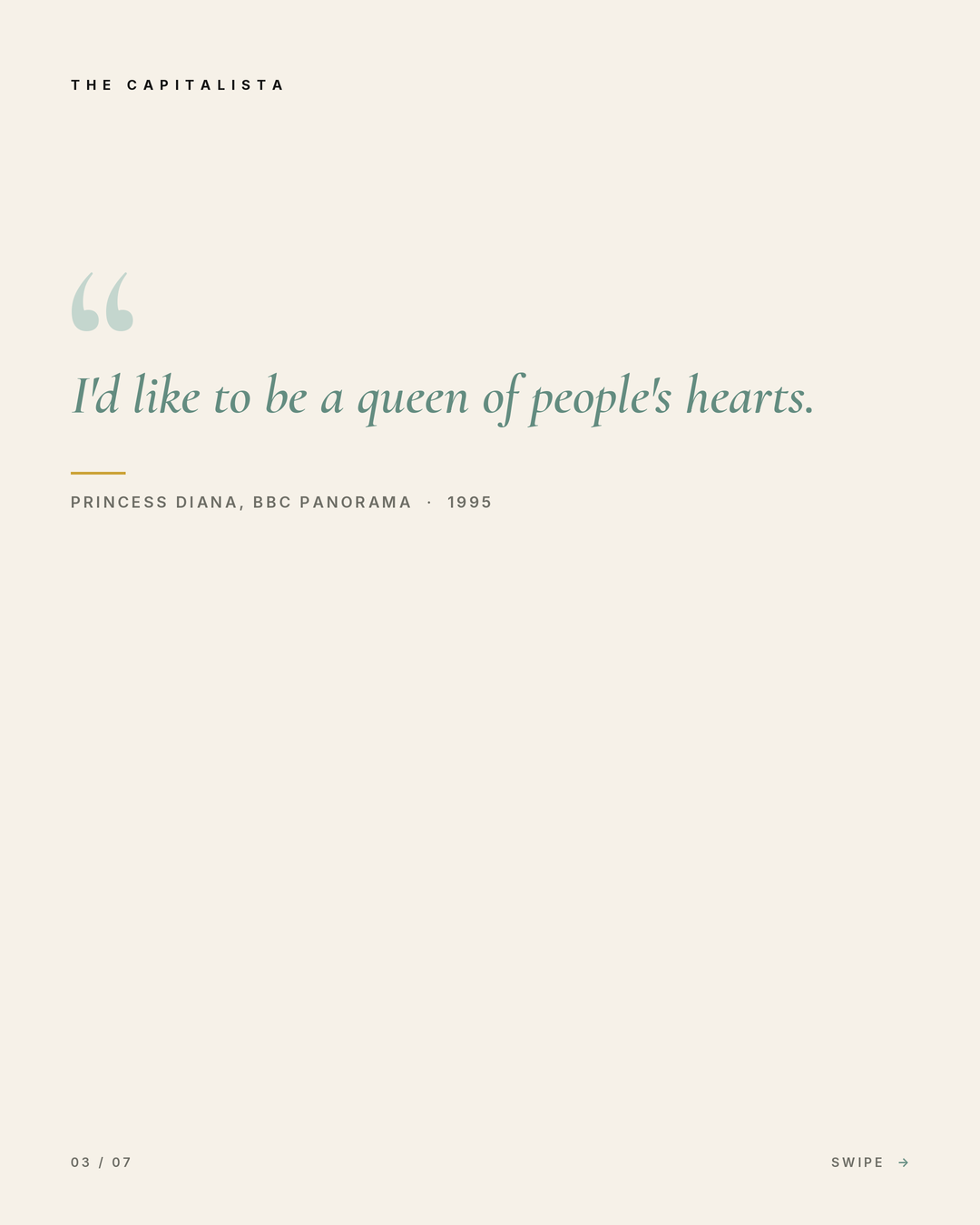
And on her own future, she offered a phrase that reframed her entire public identity: "I'd like to be a queen of people's hearts, in people's hearts, but I don't see myself being queen of this country."
Those weren't the words of someone defending a position with legal precision. They were human, candid, and emotionally direct — and that's exactly why they worked. Against the palace's careful, buttoned-up formality, Diana's openness made the institution look cold and out of touch, and made her look like the one telling the truth.
The Controversy You Can't Ignore
Any honest account of this interview has to include what came later, because it changes how you should use the lesson.
Decades on, it emerged that Bashir had secured the interview through deception. He commissioned forged bank statements and showed them to Diana's brother, Charles Spencer, to gain his trust and access to Diana. In 2020 the BBC apologized, and in 2021 an independent inquiry led by Lord Dyson concluded that Bashir had used "deceitful" methods and that the BBC had fallen short of "high standards of integrity and transparency" in how it handled the matter. The BBC said the process for securing the interview "fell far short of what audiences have a right to expect."
There's a lesson buried in that scandal, and it's the most important one in this whole story: the power of the interview came from apparent transparency — but the deception behind it eventually collapsed the trust it created. Going public works. Faking it does not. When you use this strategy, the openness has to be real, because the truth about how you operate always surfaces in the end.
The Strategy Underneath: Going Over the Institution's Head
Strip away the palace and the tabloids, and the strategic pattern is simple and repeatable.
Diana was in a losing position inside a closed system. The institution controlled the rules, the messaging, and the machinery. Playing strictly within that system — quietly, through official channels — meant she'd lose, because the house always wins on its own turf.
So she changed the game. Instead of fighting the institution where it was strong, she took the dispute to a venue where she was strong: direct, human communication with a mass audience. The palace's size and formality, so powerful behind closed doors, suddenly worked against it in the open. Rigid corporate posture reads as cold. Candor reads as brave.
Why "Going Direct" Beats Suffering in Silence
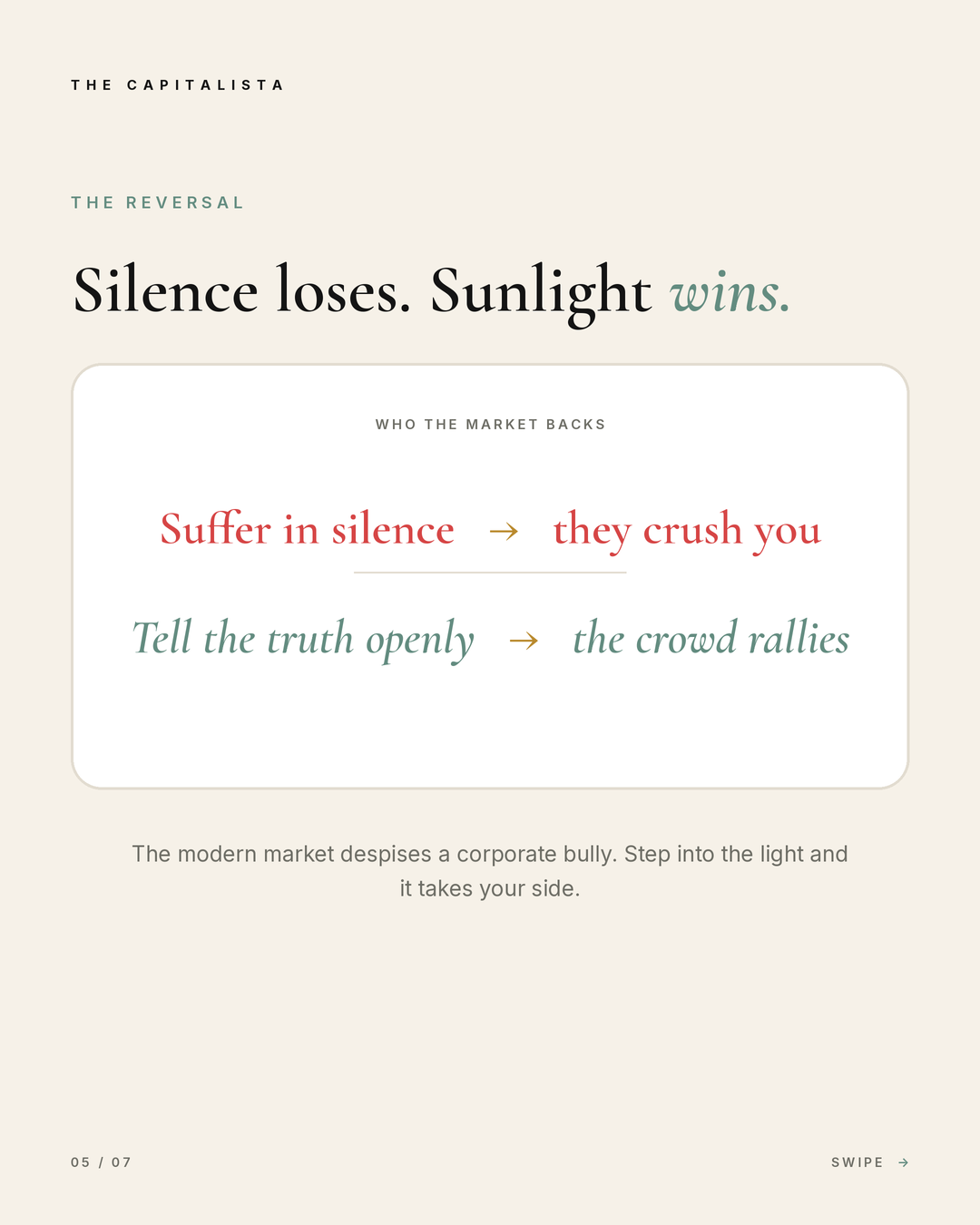
When an institutional heavyweight, a predatory competitor, or a toxic client tries to squeeze you — with legal jargon, contract threats, or sheer corporate weight — the instinct is to keep it quiet and handle it "professionally." That instinct usually guarantees you lose.
Here's why. In private, on their terms, the bigger player's advantages compound: more lawyers, more leverage, more patience. Silence is the condition under which their size matters most. Bring the situation into the open, and a different force takes over — public sympathy. The modern market has little patience for cold corporate bullies, and it will rally behind the smaller operator brave enough to tell the unvarnished truth.
You don't dismantle a giant by matching its strength. You dismantle its rigid posture by appealing to the human element it can't perform.
The Business Lesson: Don't Fight in Their Sandbox
If you're an operator being pressured by someone much larger, the takeaway is direct:
- Don't suffer in silence. Quiet endurance is the outcome your opponent is counting on.
- Step outside their closed ecosystem. Stop fighting only through the channels they control.
- Speak transparently about your values and your situation. Share the real struggle openly with your audience and network.
- Appeal to the human element. Facts plus honesty plus a human voice beats a corporate wall.
When you bring a lopsided fight into the light, you change who's watching — and a watching public is the one force a bully can't out-lawyer.
How to Use Radical Transparency (Without Blowing Yourself Up)
Going public is powerful and risky. Diana's story shows both the upside and, through the later scandal, the danger of getting it wrong. Use it deliberately.
1. Lead with facts, not just feelings
Emotion earns attention; facts earn belief. Document the unfair pressure clearly — the timeline, the terms, the specifics — so your transparency is credible, not just cathartic.
2. Make sure your version is genuinely true
The Panorama scandal is the cautionary tale. Transparency that turns out to be manufactured destroys more trust than staying silent ever would. Only bring into the light what you can stand behind completely.
3. Speak to your people, not at your opponent
Address your audience, your customers, your network — the humans who decide your fate. You're not trying to win a legal argument; you're inviting the market to take a side.
4. Stay measured, not vindictive
Candor lands. Bitterness repels. The goal is to look like the reasonable person telling the truth, not the aggrieved party settling a score.
5. Start small
You don't need a 23-million-viewer moment. Pick one ongoing friction point or unfair market pressure and use your platform to speak on it honestly. Then see how your market responds.
The Financial Backbone: What The Capitalista Does
Here's the part that decides whether you can actually take a stand: your finances. You can only refuse a bullying client, walk away from a lopsided contract, or go public against a bigger player if your business is strong enough to survive the fight. Courage without a balance sheet is just risk.
That's where The Capitalista comes in. We're a fractional CFO service that builds the financial strength behind your stance. Concretely, we:
- Own your margins and pricing, so you're profitable enough to say no to bad terms.
- Run your cash flow and forecasting, so you have the runway to hold your ground rather than fold under pressure.
- Stress-test the downside, so you know exactly what you can afford to walk away from.
- Translate the numbers into leverage, so you always negotiate from strength — and never sign from a position of fear.
Diana had the public on her side. You need the public and a business that can weather the storm. The Capitalista makes sure the second part is never your weak point.
Frequently Asked Questions
What was the Princess Diana Panorama interview?
It was a BBC Panorama interview between journalist Martin Bashir and Diana, Princess of Wales, broadcast on 20 November 1995, in which she spoke candidly about her marriage, her mental health, and her role in the royal family. Around 23 million people watched in the UK.
What did Diana say in the Panorama interview?
Her two most famous lines were "there were three of us in this marriage, so it was a bit crowded," referring to Camilla Parker Bowles, and "I'd like to be a queen of people's hearts."
Why is the Panorama interview controversial?
An independent inquiry by Lord Dyson found in 2021 that Martin Bashir had used "deceitful" methods — including forged bank statements — to secure the interview. The BBC apologized and acknowledged serious failings.
Who was Martin Bashir?
Martin Bashir was the BBC journalist who conducted the 1995 interview. He was later found to have obtained access through deception, which led to a BBC apology and an independent inquiry.
What does "the People's Princess" mean?
It's the enduring epithet associated with Diana, popularized by Prime Minister Tony Blair after her death in 1997, capturing the unusually direct bond she had with the public — the same bond her 1995 appeal to viewers helped cement.
The Bottom Line
Cornered by an institution she couldn't beat on its own terms, Princess Diana changed the venue and spoke straight to the public — and for a moment, the smaller, more human figure outmaneuvered the palace entirely.
The strategy is available to any operator being outmuscled: don't suffer in silence, step out of the system they control, and tell the truth openly to the people who decide your fate. Just make sure it's actually the truth — because the one thing more powerful than transparency is what happens when fake transparency gets exposed.