
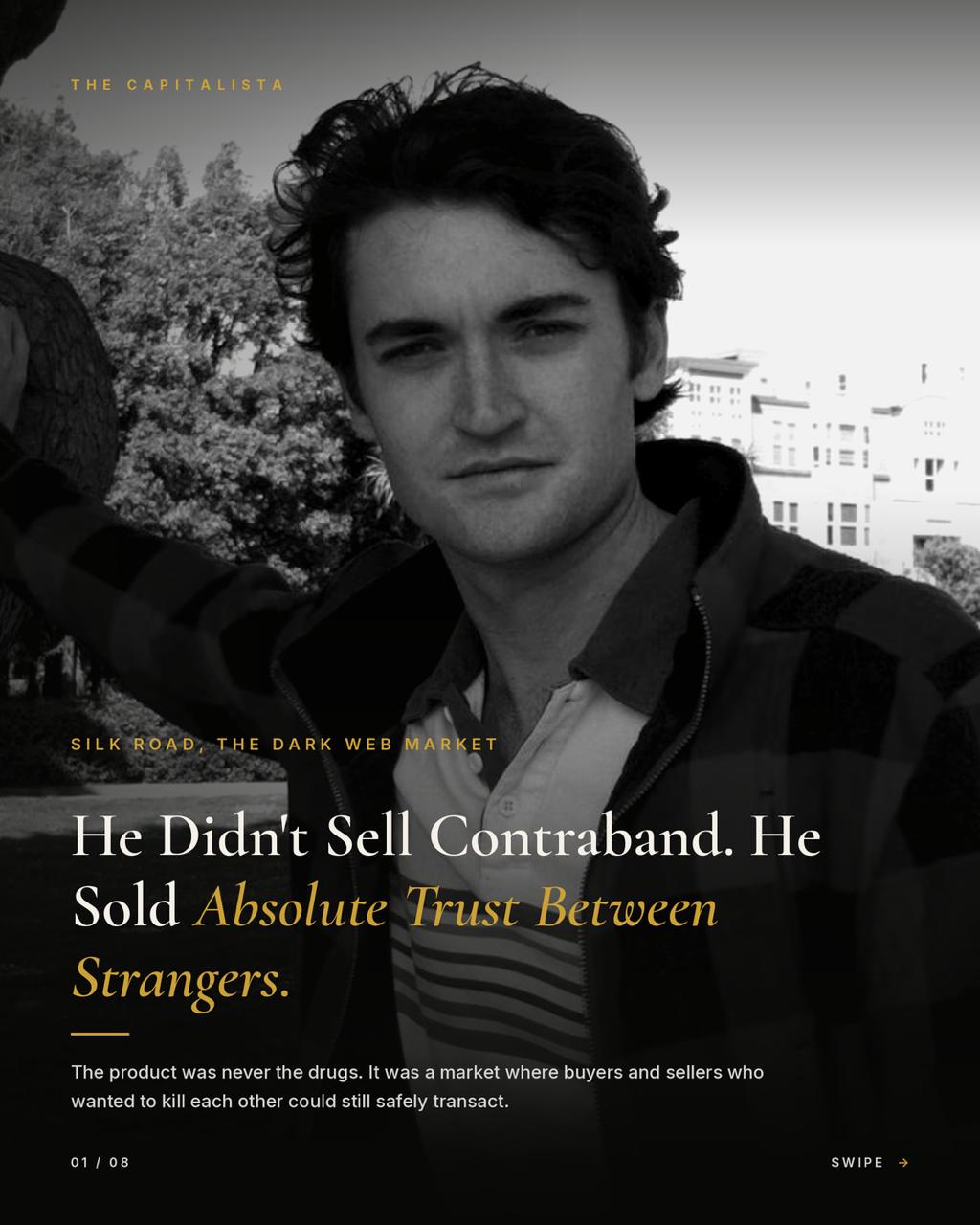
Silk Road was the first major dark web marketplace, launched in February 2011 and shut down by the FBI in October 2013 after agents tracked its founder, Ross Ulbricht, to a public library in San Francisco.
Ulbricht, operating under the pseudonym "Dread Pirate Roberts," was convicted in 2015 on charges including narcotics trafficking, money laundering, and computer hacking, and sentenced to life in prison. In January 2025, President Trump granted him a full pardon after he had served more than 11 years.
None of that is in dispute, and none of it is what this article is about. What's genuinely interesting from a business standpoint isn't the illegal goods that moved through the platform. It's the infrastructure Ulbricht built to make an inherently high-fraud, high-paranoia market function at all, and the pricing behavior of the people who used it. That infrastructure, an escrow system and a public reputation mechanism, solved a problem every business with anxious buyers still has to solve today.
The Market Silk Road Actually Solved
Black market trade in illegal goods predates Silk Road by centuries. What didn't exist before 2011, at least not at scale, was a reliable way for two anonymous strangers, neither of whom could involve police or courts if the other cheated them, to complete a transaction with confidence. That's a genuinely hard problem. In a market with no legal recourse, every transaction carries the live risk of paying and receiving nothing, or shipping and never getting paid.
Silk Road's real product wasn't any single item listed on it. It was a working answer to that trust problem, built from two mechanisms that are still instantly recognizable to anyone who's used a modern e-commerce platform.
The Two Mechanisms: Escrow and Reputation
The first was an escrow system. When a buyer placed an order, their payment was held by the platform rather than released directly to the seller, and only paid out once the buyer confirmed the item had actually arrived. This single structural choice eliminated the most basic fear in an anonymous transaction: paying first and getting nothing in return.
The second was a public vendor rating system, functionally similar to the feedback mechanisms eBay and Amazon use for entirely legal commerce. Buyers rated sellers after every transaction, and those ratings were visible to the next buyer deciding whether to trust that vendor. Sellers with a track record of reliable delivery rose to the top of the market. Sellers who scammed buyers accumulated bad reviews and lost access to future business, a form of enforcement no legal system was available to provide.
Together, these two mechanisms didn't just make Silk Road usable. They made it the dominant platform in a category where dozens of competitors eventually existed, precisely because trust, once established at scale, is extraordinarily hard for a competitor to replicate quickly.
What the Commission Structure Reveals
Here's the detail most retellings of the Silk Road story skip past, and the one most directly useful to an actual business. Silk Road charged sellers a commission on every sale, and that commission wasn't a flat, maximized rate. In its first year, the platform charged a flat 6.23 percent across all transactions. Ulbricht later restructured it into a sliding scale: a roughly 10 percent commission on smaller orders, dropping to around 1.5 percent on transactions over $1,000.
That's not the pricing behavior of an operator squeezing every available dollar out of a captive market. It's the pricing behavior of someone optimizing for transaction volume and vendor loyalty over per-transaction margin, betting correctly that a platform with lower friction and lower fees would attract more sellers, which would attract more buyers, which would make the trust layer itself more valuable over time. The commission wasn't the product. It was priced as the cost of maintaining the infrastructure that made trust possible, and it dropped exactly where volume made the platform valuable enough that ubiquity mattered more than the marginal fee.
Why This Applies Far Beyond a Marketplace for Contraband
Every business, regardless of legality, sells into some version of buyer hesitation. It's rarely as extreme as "the other party might disappear with my money and I have no legal recourse," but the underlying psychology is the same mechanism, just at a lower intensity: a buyer weighing whether to trust an unfamiliar seller with money before receiving anything in return.
Most businesses respond to that hesitation by trying to out-argue it, more marketing copy, a longer features list, more aggressive discounting to make the risk feel worth taking. Silk Road's approach suggests a different lever entirely: don't argue the buyer out of their fear, structurally remove the thing they're afraid of. A guarantee, an escrow-like payment structure, or a visible track record does something that persuasive copy can't. It changes the actual risk calculation, not just the buyer's perception of it.
1. Name the specific fear, not a generic one
"Buyers might be hesitant" isn't actionable. "Buyers worry they'll pay a deposit and the project will stall before delivery" is. Get specific about the exact moment your buyer's confidence wavers, usually right before they commit financially, and design around that precise moment rather than a vague sense of "building trust."
2. Build a mechanism, not a promise
A promise is words. A mechanism is a structural change to how money or risk moves. Silk Road didn't promise buyers they wouldn't get scammed. It held the money in escrow so a scam was structurally harder to execute. Translate that into your own business: a milestone-based payment schedule, a clear and enforced refund window, a performance guarantee tied to a specific, measurable outcome. If it can be broken by simply ignoring it, it's a promise, not a mechanism.
3. Price the guarantee into your structure, not as a discount
Silk Road's sliding commission wasn't a discount handed out to nervous buyers. It was a rate structure built into the platform from the start, designed around what would sustain trust and volume long-term. When you build a safety mechanism into your own offer, price it as a standing part of your business model, not an apologetic concession you make only when a client pushes back.
4. Let reputation compound instead of resetting
Vendor ratings on Silk Road meant a seller's history followed them into every future transaction. The equivalent for most businesses is testimonials, case studies, and a visible track record that a new prospect can actually verify, not just take on faith. If your best client relationships aren't documented anywhere a new prospect can see them, you're rebuilding trust from zero with every single deal.
What The Capitalista Does
The mechanisms that build buyer trust, guarantees, milestone structures, clear financial terms, all have real cost and cash flow implications, and getting that structure wrong can quietly bleed margin instead of protecting it. That's where a fractional CFO earns its keep.
- We model what your safety net actually costs. A refund policy or milestone structure only works long-term if the cash flow behind it is sustainable, and we run those numbers before you commit to them.
- We help you price trust into your offer, not apologize for it. A guarantee built into your standard terms reads very differently than one you only offer when a deal is at risk of falling through.
- We track whether the trust mechanism is actually working. Conversion rates, deal velocity, and client retention all move when buyer fear drops, and we help you measure that instead of guessing.
- We build the financial documentation that makes your track record visible. Verifiable numbers, not just testimonials, are often the strongest trust signal a prospective client can be shown.
- We keep the guarantee sustainable as you scale. What works as a trust-builder at ten clients can become a liability at two hundred if the underlying financial structure isn't revisited.
Frequently Asked Questions
Is this article endorsing Silk Road or the goods sold on it?
No. Silk Road facilitated illegal transactions, and its founder was convicted on serious federal charges before later receiving a presidential pardon. This article examines a specific, well-documented business mechanism, the escrow and reputation system, and the commission structure behind it, purely as a case study in how trust infrastructure affects pricing power. It is not an endorsement of the platform's underlying activity.
What actually happened to Ross Ulbricht?
Ulbricht was arrested by the FBI in October 2013, convicted in February 2015 on charges including narcotics trafficking, money laundering, and computer hacking, and sentenced to life in prison without parole. He served more than 11 years before receiving a full pardon from President Trump in January 2025.
Is the commission structure detail in this article verified, or is it an approximation?
It's drawn from documented reporting on Silk Road's operations: a flat 6.23 percent commission in its first year, later restructured into a sliding scale of roughly 10 percent on smaller transactions down to about 1.5 percent on transactions over $1,000. Exact figures vary slightly across sources, but the direction, commission rates dropping as transaction size and platform trust grew, is consistently documented.
Can a small business realistically build an "escrow-like" mechanism without the infrastructure of a full platform?
Yes, at a much simpler scale. A milestone-based payment schedule, where a client only releases the next payment after a defined deliverable is confirmed, functions on the same principle as escrow: risk is distributed across the transaction instead of concentrated entirely upfront. It requires a clear written agreement, not a technical escrow platform.
Doesn't offering guarantees or flexible payment terms just cut into profit margin?
Not necessarily, and often the opposite. The core argument here is that removing buyer fear can increase what a business can charge and how many buyers convert, offsetting the cost of the guarantee itself. The commission data suggests Silk Road's operators understood this: a lower per-transaction take rate at scale outperformed a higher rate that suppressed volume and vendor loyalty.
The Bottom Line
The most valuable thing Silk Road ever built wasn't a product catalog. It was a structural answer to buyer fear, priced deliberately to reward trust and volume over maximizing every transaction. Nearly every business, legal or otherwise, is competing on some version of that same unresolved fear in its buyers.
What's the one structural change, not a better pitch, not a bigger discount, that would make your next hesitant buyer actually feel safe saying yes?