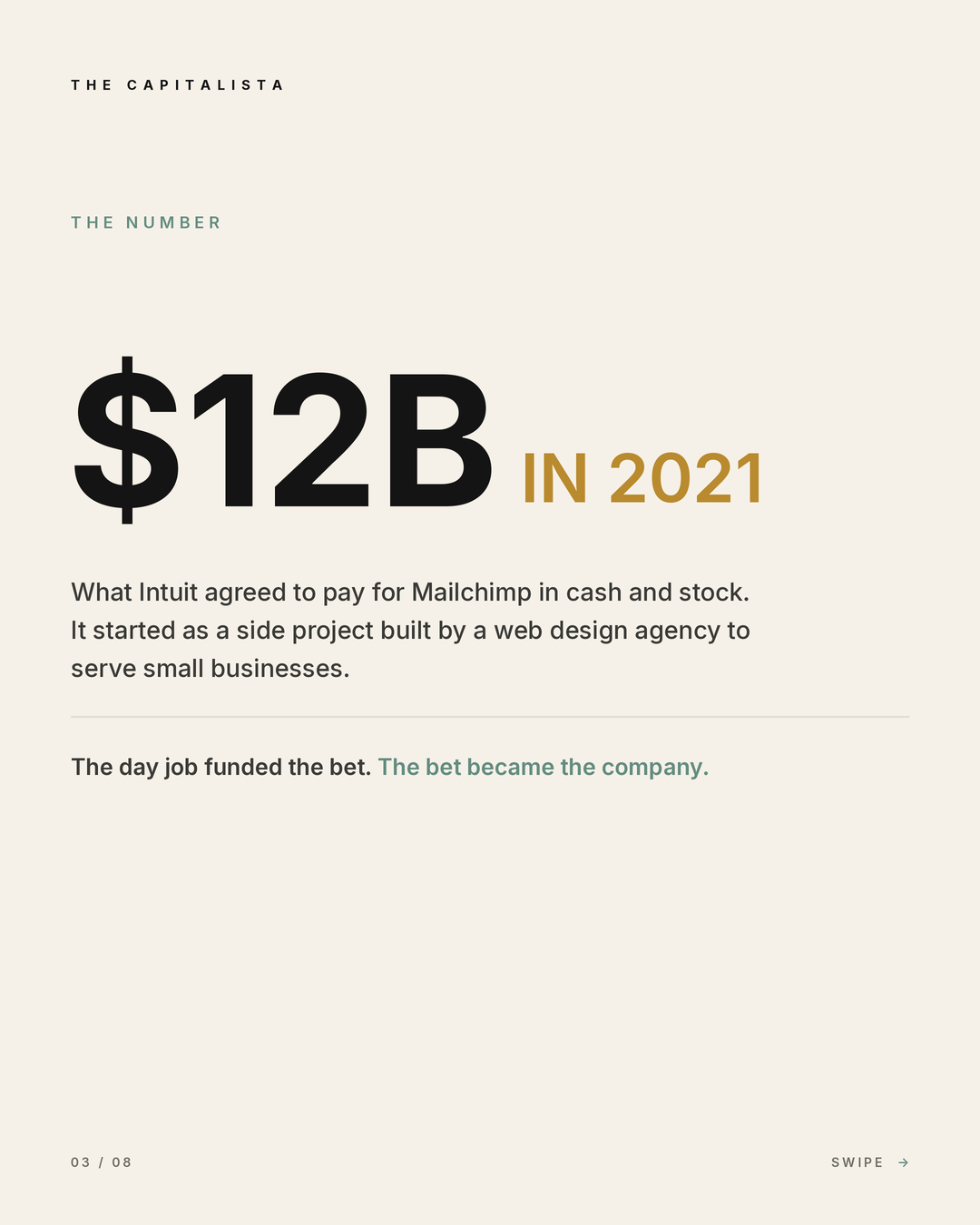
Mailchimp began as a web agency’s side project. Learn how to calculate the cash your current business can safely invest in a new venture, with a practical forecast and fractional CFO support.
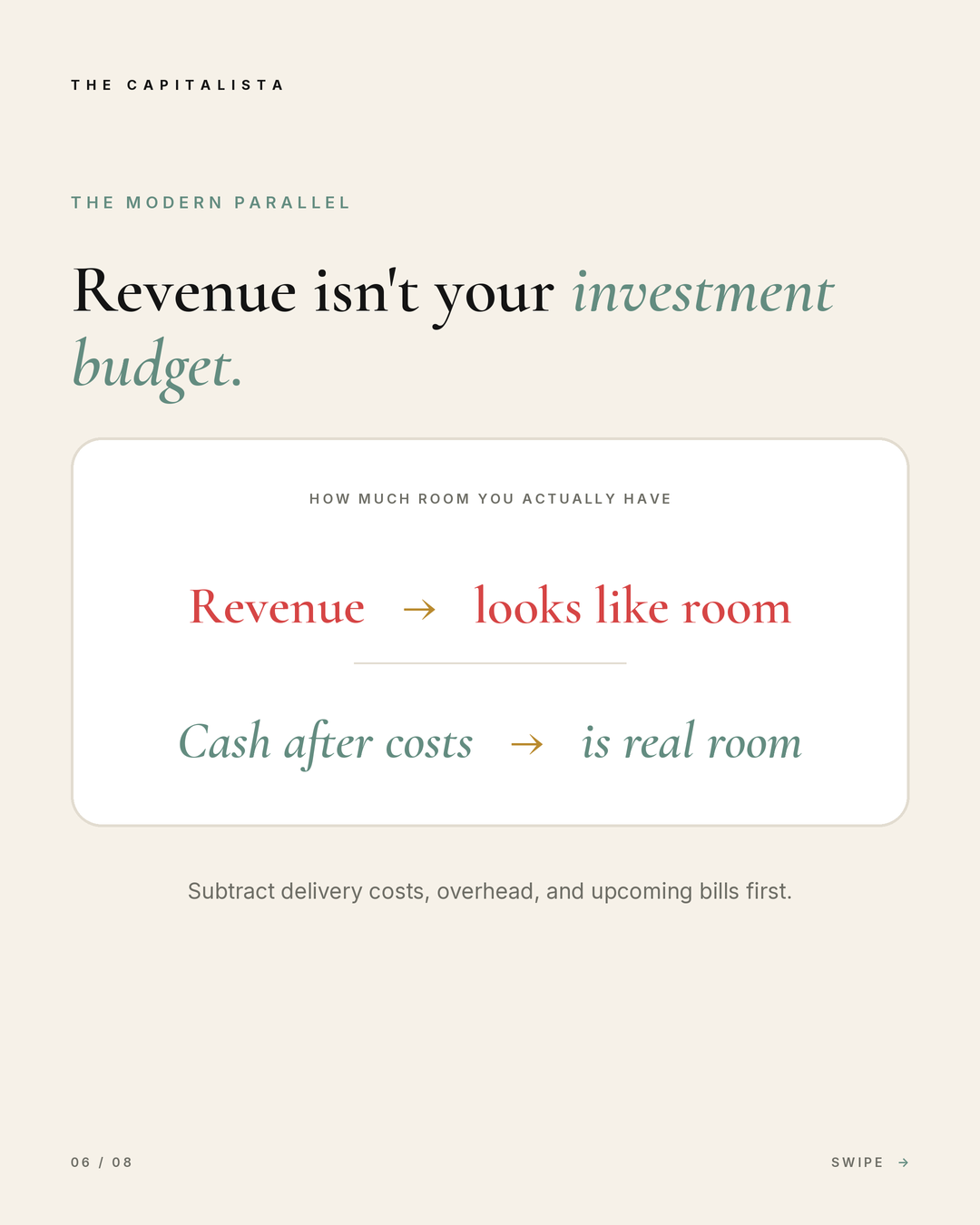
Your existing business can finance a new venture only when it produces cash you can actually spare. Revenue is the starting point. The useful number is what remains after delivery costs, operating bills, debt payments, tax provisions, and a reserve for the commitments already on your calendar.
Mailchimp’s origin makes that distinction worth examining. Its founders, Ben Chestnut and Dan Kurzius, ran a web design agency called Rocket Science Group while developing an email service on the side. Mailchimp’s own company history describes the product as an affordable option for smaller businesses. The agency and the new product served different needs, giving the team a way to explore another business alongside client work.
That history does not prove every agency should build software. It raises a better question: how much can your current business invest in the next idea without weakening the work that funds it?
Why revenue is a poor investment budget
A strong sales month can create a misleading sense of room to spend. Some invoices may still be unpaid. Some cash may be a deposit for work you have not delivered. Contractors, payroll, and tax payments may fall due before the next customer payment arrives.
Profit and available cash can also move differently. A profitable project can consume cash when suppliers need payment before the customer pays. Our article on cash flow timing explores that gap between the size of the revenue and the timing of the bills.
Before assigning a budget to a new product, identify which money is already committed. Treat customer advances as funding for their delivery until your forecast shows what you can safely release.
Calculate the cash your business can invest
Use a weekly forecast covering the next 13 weeks. Start with available bank cash, then add customer receipts in the weeks you reasonably expect to collect them. Subtract payments when they will leave the bank.
Include payroll, contractors, rent, software, debt service, planned equipment purchases, and tax provisions. Add the new venture’s spending on a separate line. This lets you see whether the investment creates a temporary cash shortfall even when the total looks affordable.
A worked example
Consider an illustrative agency that expects to collect $80,000 next month. Delivery costs require $32,000, overhead requires $25,000, debt service requires $3,000, and planned tax payments require $5,000. That leaves $15,000 before any new reserve requirement or product investment.
If the business needs to add $10,000 to its operating reserve, only $5,000 remains available for consideration. A $12,000 development commitment would exceed that amount by $7,000. The agency might stage the work, wait for more collections, or reduce the first test.
The calendar still matters. If the $80,000 arrives after payroll and supplier bills, the agency needs enough opening cash to cover the gap. Repeat the calculation week by week. A positive monthly total can hide a negative Tuesday.
Want help turning your numbers into a usable investment limit? Book a call with The Capitalista to discuss a cash forecast and the decision you need it to support.
Give the new idea its own budget and evidence
Track the venture separately from the core business, even if both operate inside one company. Record development costs, software, marketing tests, and time spent by employees or founders. Internal hours have an opportunity cost when they displace billable work or delay delivery.
Set a small first commitment with a clear learning goal. For example, fund a prototype that tests whether five target customers will pay for a defined result. Decide in advance what evidence releases the next tranche of spending. Positive feedback alone is weaker evidence than paid demand.
Our guide to using a premortem before execution offers another useful check. Ask what could cause the project to fail, then price the most credible risks into your plan.
Use three decision rules
- Set a cash floor. Choose the minimum balance needed for your business’s payment cycle and uncertainty. There is no universal reserve number that fits every company.
- Set a spending ceiling. Make the total authorized investment visible, including internal time and recurring costs.
- Set a review date. Compare spending, customer evidence, and remaining cash before approving another stage.
These rules make a pause possible before the core business becomes responsible for an open-ended commitment. They also make a good result easier to recognize.
Test a slower collection scenario
Run a second version of the forecast with your largest expected receipt arriving two weeks late. Then test lower sales or higher delivery costs. Check the lowest weekly cash balance in each version.
If a modest delay forces you to postpone payroll or rely on unplanned borrowing, the proposed investment is too large for the current cash position. Change the amount, timing, or funding source before you sign the commitment.
Customer concentration matters here. A venture funded by one large client’s timely payment carries a different risk from one funded by many predictable collections. For a related perspective, read how to turn high-risk revenue into more durable wealth.
How a fractional CFO helps you fund growth
The Capitalista helps founders connect growth plans to the cash and margin behind them. A fractional CFO can help you assess the core business’s cash generation, model the new venture’s costs, and compare the effect of different investment schedules.
The decision should be clear enough to state in one sentence: we can invest this amount by this date, provided collections and our minimum cash balance stay within these limits.
Talk to The Capitalista about your growth budget. Bring the idea, your expected spending, and your current financial reports so the conversation starts with the decision you need to make.
Frequently asked questions
Can I use my existing business to fund a startup?
You can assess that option by forecasting the cash available after existing commitments and an appropriate reserve. The structure of any transfer between separate entities also needs accounting and legal review. Start by establishing affordability before choosing how to move the money.
How much revenue should I reinvest?
A fixed percentage of revenue can overlook thin margins and slow collections. Use the forecast’s lowest cash balance, your obligations, and the cost of the next validated milestone to set the amount.
What is the difference between profit and cash available to invest?
Profit measures income and expenses under your accounting method. Cash available to invest depends on actual receipts and payments, existing commitments, and the reserve your business needs.
When should I stop funding a side project?
Review it when it reaches the spending ceiling, misses its evidence milestone, or threatens the core business’s cash floor. Decide whether a smaller test is justified before approving more money.
Your next step
Take one idea you want to fund. Write down the cost of its next test, the evidence that would justify continuing, and the lowest cash balance your business can accept. Then put the spending into your weekly forecast. If you want a CFO’s view of that decision, contact The Capitalista.
Make your next growth decision with clarity.
Review your cash forecast and investment budget with The Capitalista.